Bench press bar path — why an efficient press is not a vertical one
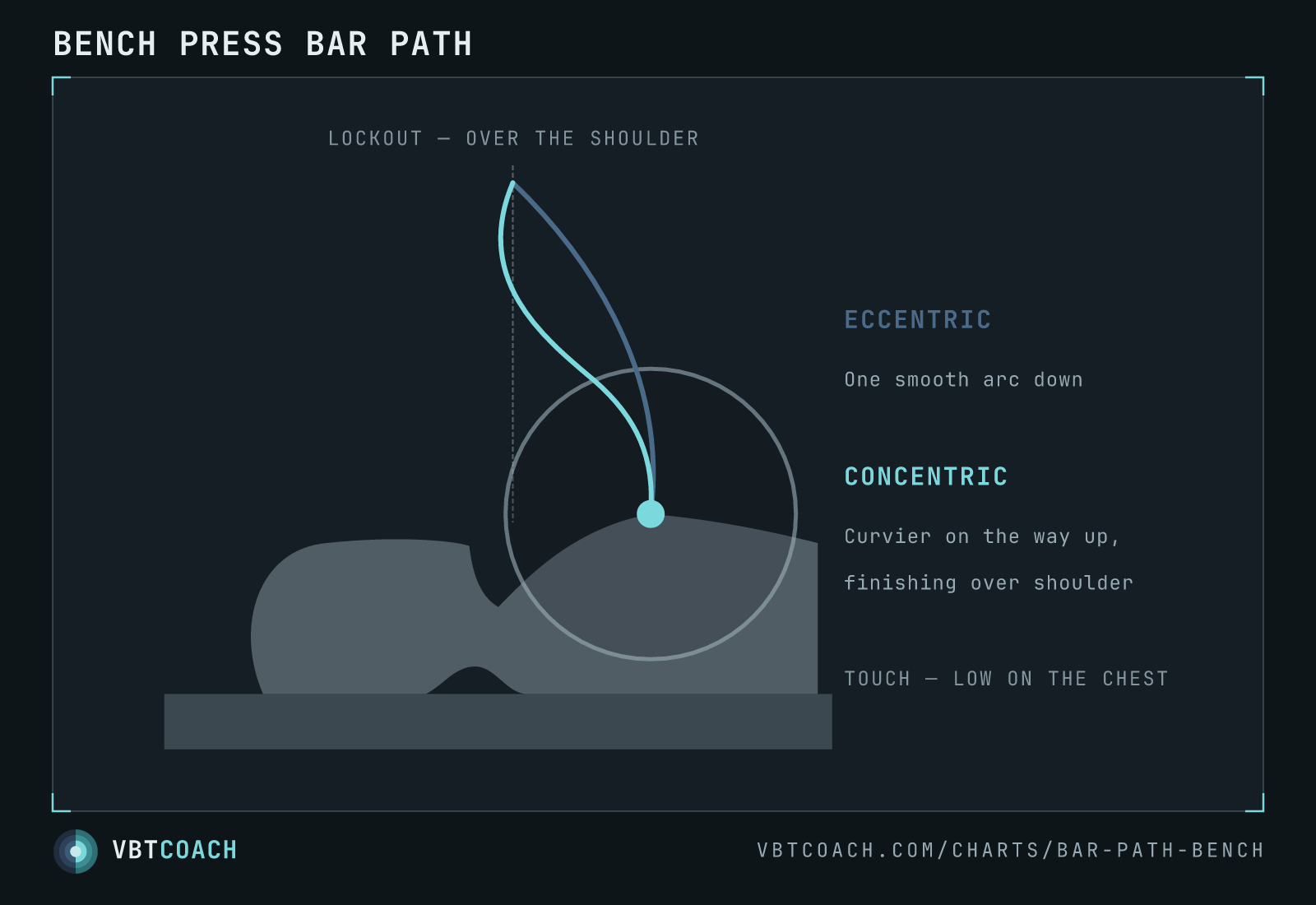
The bench bar touches mid-chest and finishes stacked over the shoulder, so an efficient path is a shallow arc rather than a straight line. Eccentric and concentric drawn separately on one good rep.
The first thing to unlearn about bench press bar path is that it should be vertical. It shouldn’t. The bar touches your mid-chest and finishes stacked over your shoulder joint, and those are two different points in space — so the path between them is an arc, and it is supposed to be.
How to read this chart
One rep, drawn from the side, with the lifter at the touch point.
The two phases are separated by colour. The descent runs close to the direct line between lockout and the chest. The drive bows further toward the feet coming off the chest before curving back over the shoulder — on a normal bench the way up is the curvier half.
The dashed vertical marks the shoulder joint. That, not a straight line, is what lockout is judged against.
Your arc is yours
The shape and size of the arc is individual and heavily influenced by technique. An aggressive wide-grip, high-chest competition-style bench has a shorter range of motion and very little arc. A narrow grip with less thoracic extension produces a much bigger one. Both are correct for the lifter doing them.
So the question is never whether your arc matches the one on this chart. It’s whether it’s consistent for you:
- Does the shape drift over the course of a set?
- Does it change under heavier weights?
The typical breakdown on a heavy single is the arc flattening out through the sticking point, as you lose tension and control driving the bar off your chest. That flattening is the thing to watch for — not the arc itself.
Download high res chart images
High-resolution PNG, 1600×1000, watermarked. Free to share, embed in slides, or print. Credit appreciated.