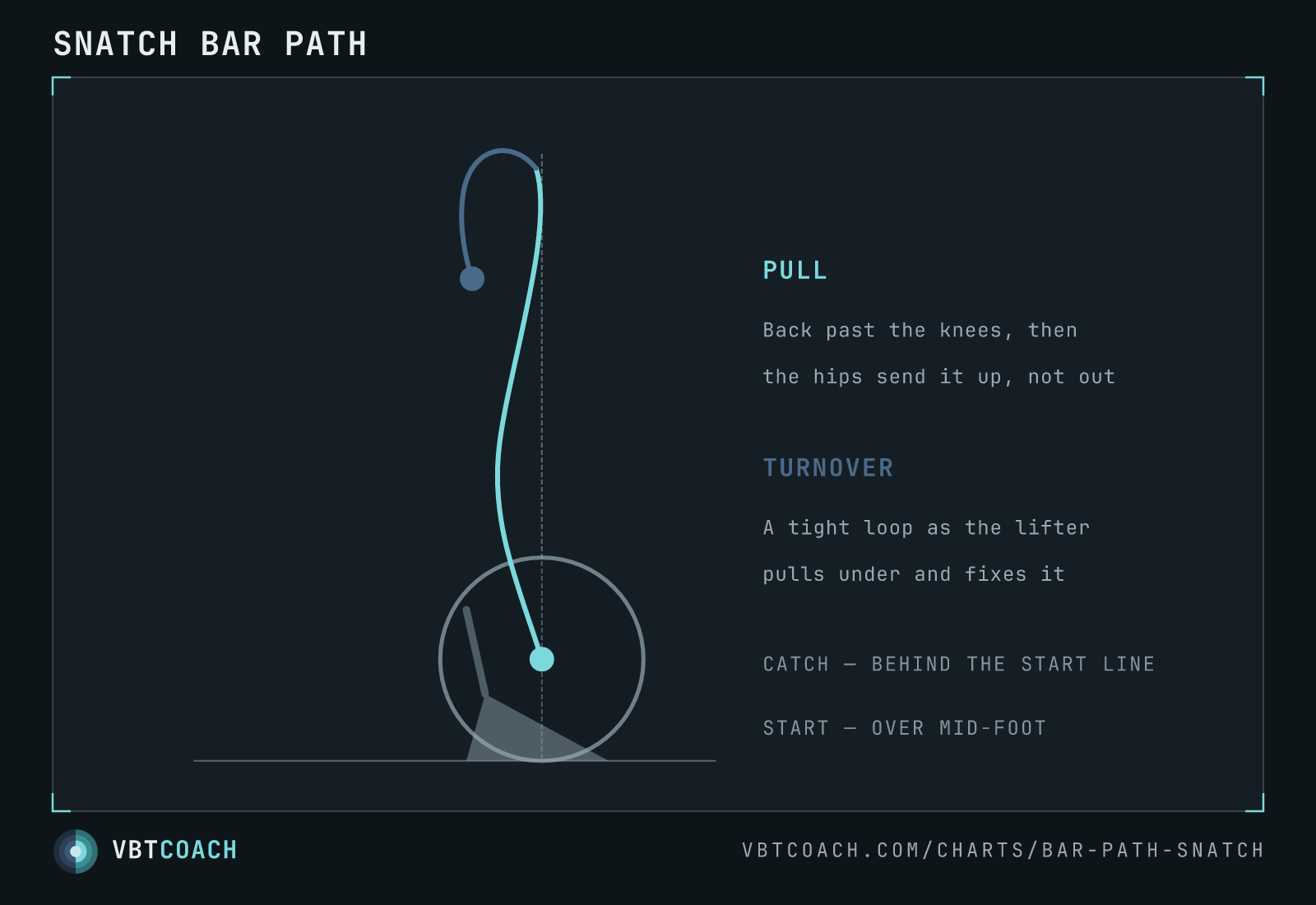
Snatch bar path — the S-shaped pull and the turnover loop
What a good snatch trace looks like — the bar drifting back past the knees, the hips sending it up rather than out, and a tight turnover loop finishing behind the line it started on.
If bar path is useful on the powerlifts, it’s close to essential on the snatch. A few centimetres of horizontal displacement at the wrong moment is the difference between a make and a miss, and the fault is usually invisible at full speed. This is the one context where I’d treat bar path as a primary tool rather than a periodic check.
How to read this chart
Every lifter’s snatch has its own signature, but they all follow the same broad pattern: a gentle S on the way up, finishing in a tight loop as the bar is received overhead.
The dashed vertical runs through the start position, over mid-foot. Horizontal displacement is read against that line and nothing else — it’s the only measurement on the chart that matters.
Off the floor, the bar drifts subtly back toward you as it passes the knees, staying close and loading the hips. A bar that drifts away early leads to a catch you have to chase forwards on the platform.
Through the second pull, contact with the hips should send the bar up rather than out. The most common fault in developing lifters is a pronounced forward hip bump — the bar swings away from the body and vertical drive becomes a forward looping arc that has to be chased.
At the turnover, the bar loops overhead as you pull yourself under it. The size and tightness of that loop is the most diagnostic part of the trace. Tight means you’re staying close and pulling yourself around the bar. Wide means the bar is drifting out in front — usually because of a first or second pull problem above — and the catch becomes a scramble rather than a strong position.
A good snatch finishes with the bar slightly behind the line it started on. That’s the target, not a straight line up.
Why velocity is the wrong lead metric here
The usual metric hierarchy inverts on the competition lifts. Bar speed on a snatch is confounded by technique in a way it never is on a squat: a bar that swings out in front travels a longer path and can read faster while the lift itself gets worse. A rising velocity number can be reporting a deteriorating pull.
Lead with bar path and range-of-motion consistency on the competition lifts. Read velocity as supporting context rather than the score.
Reviewing it
Record everything, review deliberately, and make two passes.
- Immediately after a set that felt especially good or especially bad. A few seconds of playback with the trace over the video reinforces what actually happened while the feel is still fresh.
- After the session, comparing your best make against your worst miss at the same weight, side by side. The difference between the two paths is usually obvious within seconds, and gives you a specific positional target for next time instead of a general instruction to stay closer.
Download high res chart images
High-resolution PNG, 1600×1000, watermarked. Free to share, embed in slides, or print. Credit appreciated.