Squat bar path — what a held vertical looks like against a forward bow
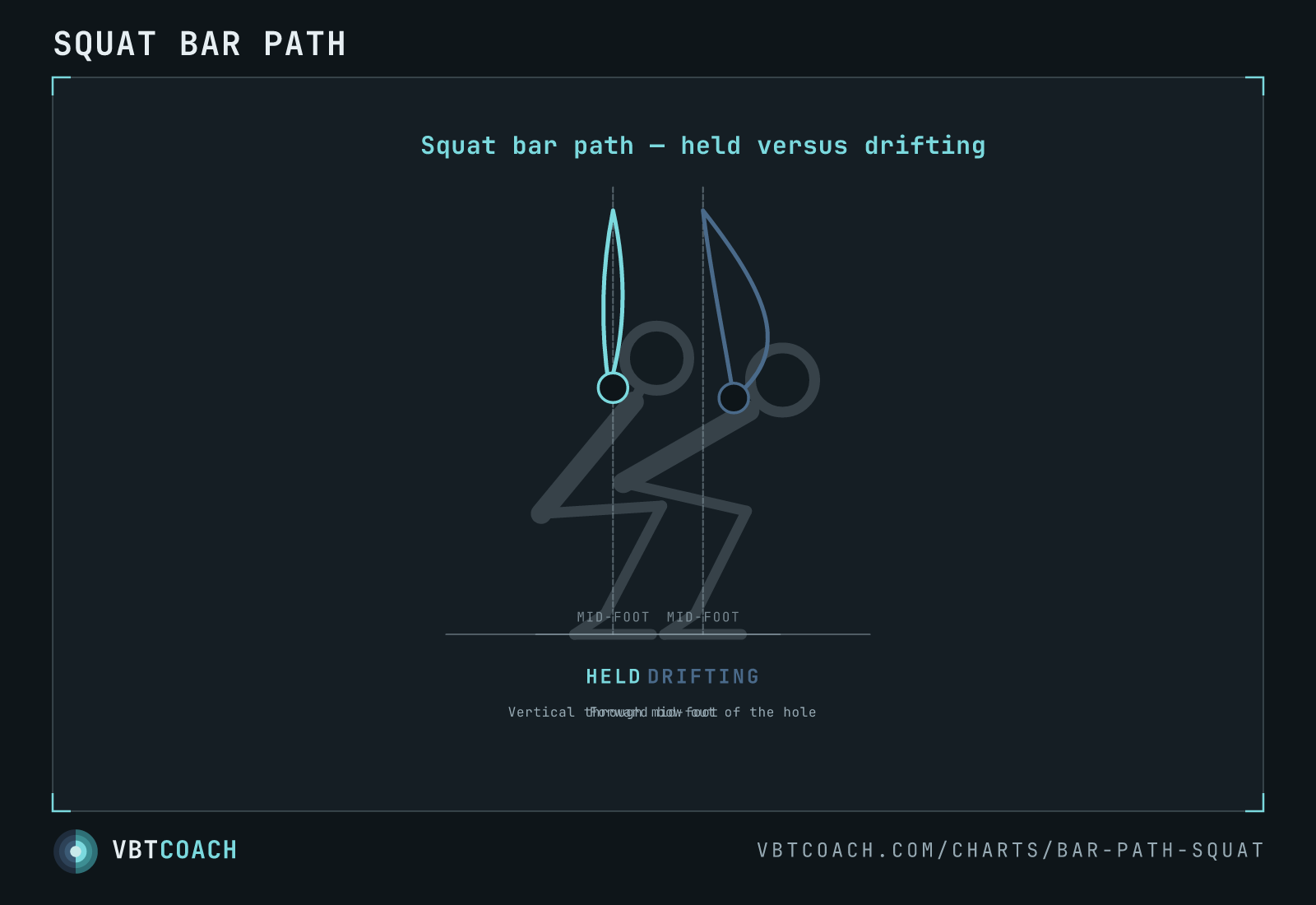
The squat bar should track a vertical through mid-foot. Side by side with the classic fault — hips shooting back out of the bottom, carrying the bar forward before the lifter drags it back to lockout.
Bar path is the one metric you read as a shape rather than a number. The squat is the easiest lift to start on, because the target is unambiguous: the bar tracks a vertical line through mid-foot, on the way down and on the way back up.
How to read this chart
Two panels, same lifter, same load. The dashed vertical is mid-foot — the line the bar is judged against, not the line it has to sit on perfectly.
Each trace draws both phases of the rep. A held path is not a single stroke; the eccentric and concentric sit a few centimetres apart and rejoin at the top. That narrow lens is what good looks like. The fault panel separates: the descent stays close to vertical, then the concentric bows forward out of the bottom and has to curve back to recover at lockout.
The bodies differ between panels on purpose. The bar drifts forward because the hips shot back and up ahead of the chest, leaving the torso pitched toward horizontal. The trace is evidence of a position.
What causes the forward bow
- An upper back that isn’t braced tightly enough, so the bar settles forward as the chest drops.
- Glutes weak relative to quads, so the hips rise first and the lift turns into a good morning.
- A weight shift onto the toes, moving the whole system forward of mid-foot.
- Load beyond current positional strength — the simplest explanation, and the most common one.
Treat these as a starting point for investigation rather than a diagnosis. The trace tells you where the bar went; the video underneath tells you which cause was actually yours.
The more useful read
A single rep’s shape matters less than how the shape holds. Run the trace across a heavy set and watch what happens. A path that keeps its shape rep after rep is positional strength holding under fatigue. A path that drifts forward or changes shape as the set goes on is telling you technique is degrading and you’re approaching failure — often before the velocity numbers make it obvious.
Download high res chart images
High-resolution PNG, 1600×1000, watermarked. Free to share, embed in slides, or print. Credit appreciated.