Kannus 1992 — Single-leg training transfers to the untrained leg
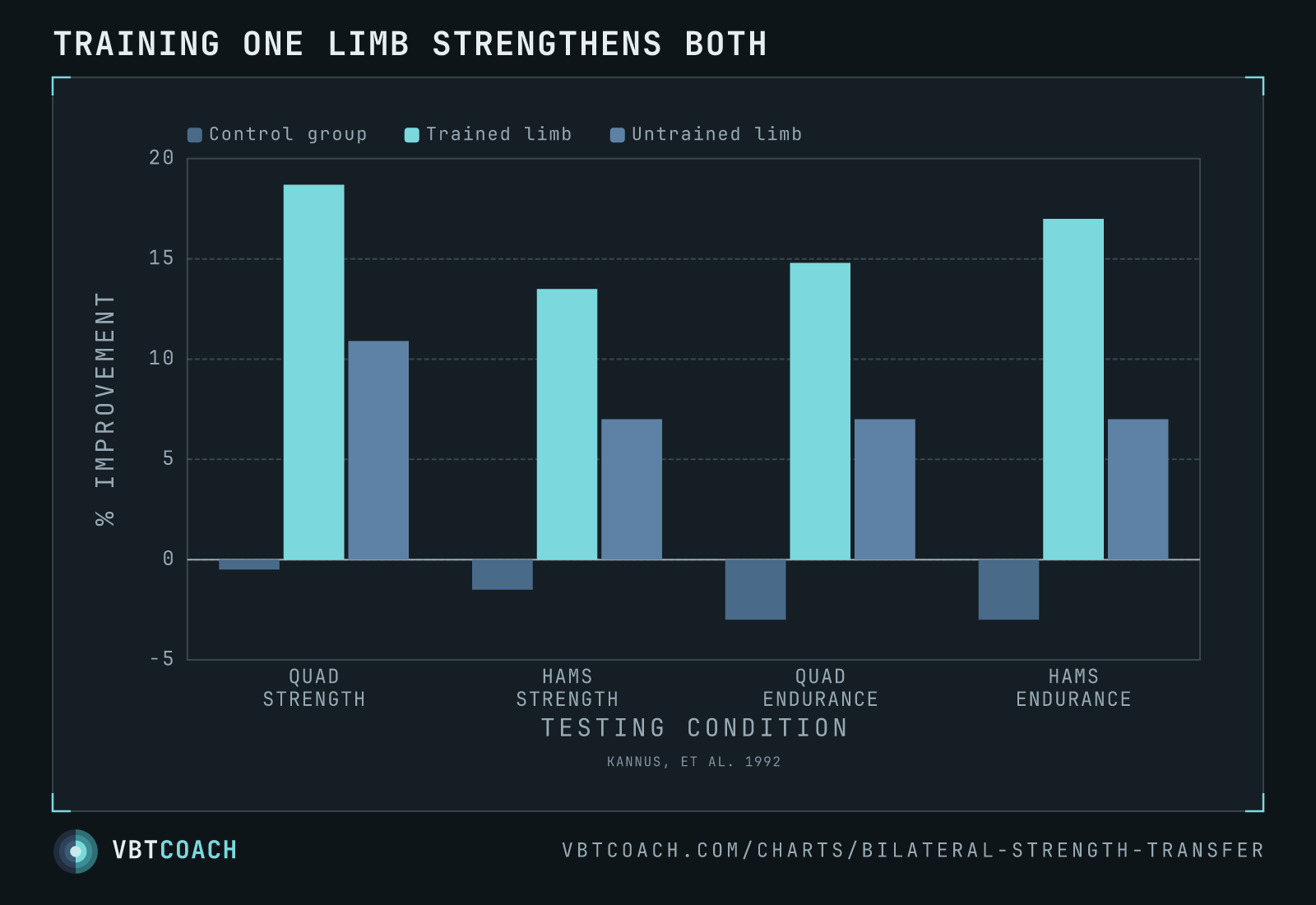
Kannus 1992 — single-leg training produced ~50 % of the trained leg's strength gains in the untrained leg too. The classic cross-education effect, in one chart.
Train one leg, and the other leg gets stronger too. The “cross-education” effect has been replicated in dozens of studies; Kannus’s 1992 paper is the cleanest illustration. Subjects trained one leg only for several weeks. The opposite (untrained) leg gained roughly half as much strength as the trained one — without ever being directly trained, and well above what a no-training control group achieved.
How to read this chart
Three series, four outcomes. The deep navy bars are the control group (no training). The teal bars are the trained limb of the experimental group. The navy bars are the untrained limb of the experimental group — same person, opposite leg, no direct training. Look at the height of the navy bars: they sit consistently around 7–11 % higher than baseline, while the control’s bars hover around or below zero.
The pattern holds across both strength (quad and hamstring) and endurance (quad and hamstring). The untrained limb tracks the trained limb at roughly 50–60 % of its magnitude.
When to use this evidence
- Returning from injury. When one limb can’t be loaded — a post-op knee, a broken arm — train the other one. You preserve strength on the immobilised side via cross-education far better than detraining alone.
- Fixing limb asymmetries. The weaker side benefits doubly: directly from training, and indirectly from training the stronger side.
- Bilateral deficit reasoning. The fact that unilateral training transfers contralaterally is part of why the bilateral squat and the unilateral split-squat aren’t strength-equivalent exercises — the neural cross-talk works in both directions.
Why it works (mostly neural)
Cross-education is primarily a neural adaptation, not a muscular one. The trained limb gets bigger; the untrained limb gets stronger without growing. The mechanism is thought to be improved central drive and inter-hemispheric coordination — the brain learns to recruit motor units more effectively, and that learning generalises to the contralateral side.
That has implications: the gains transfer well to strength and endurance (neural skill), but not to hypertrophy (which requires actual loading and protein synthesis on the untrained side).
Pitfalls
- Don’t skip direct loading. Cross-education is a useful supplement during injury, not a replacement for direct training. If both limbs can train, both should.
- The transfer percentage varies. ~50–60 % is a typical range; individual studies range from ~10 % to ~80 %. Bigger trained-side gains tend to drag bigger untrained-side gains, but the ratio isn’t fixed.
- Specific to the trained movement. Training a leg-extension transfers leg-extension strength contralaterally. It doesn’t transfer to a different lift on the untrained side.
Where to go next
The cross-education effect sits inside the broader story of neural adaptation in resistance training, which we cover in The science of velocity-based training. For the “why heavy lifting is mostly a brain skill” angle, Henneman’s Size Principle and VBT digs into the motor-unit recruitment side of the same adaptations.
Download high res chart images
High-resolution PNG, 1600×1000, watermarked. Free to share, embed in slides, or print. Credit appreciated.