Training at the peak-power load beats heavy strength work for dynamic performance
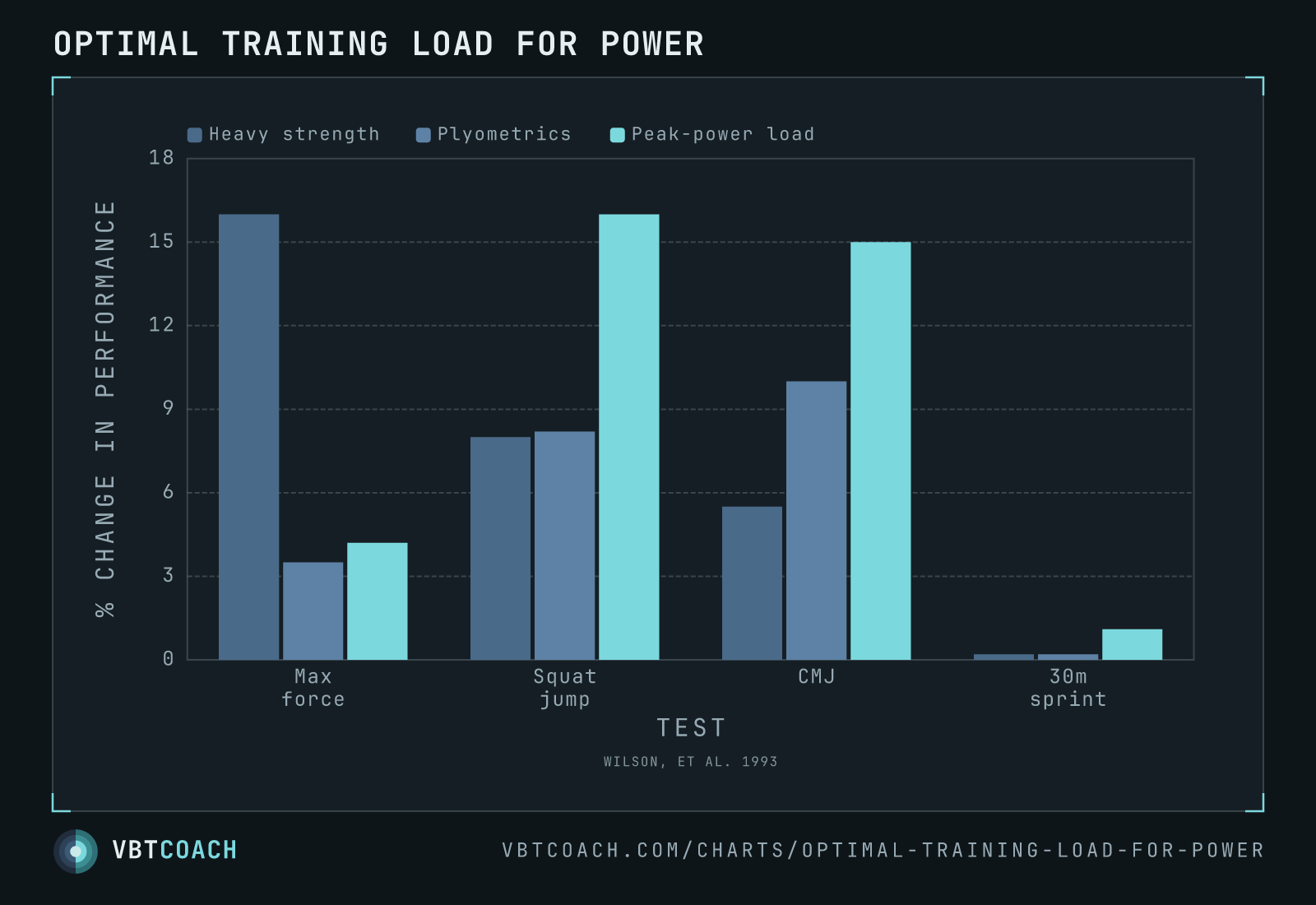
Wilson 1993 — three matched groups trained heavy squats, plyometrics, or jump squats at the peak-power load. Heavy squatting won the strength test and lost every dynamic test.
The specificity argument, settled in one experiment. Three matched groups trained for 10 weeks — heavy squats, plyometrics, or loaded jump squats at the load that maximises power output — then all three were tested on maximum force and three dynamic performance measures.
How to read this chart
Each cluster is one test; each bar is one training group’s improvement on it.
Max force goes to the heavy strength group by a distance — 16 % against roughly 4 % for the other two. Exactly what you’d expect, and worth stating plainly so the rest of the chart doesn’t read as an argument against strength training.
Every dynamic test goes the other way. The peak-power group won the squat jump, the countermovement jump and the 30 m sprint. On the squat jump they doubled the strength group’s improvement.
So the group that got strongest was not the group that got the most athletic, and the group that improved dynamic performance most was not the strongest. You train what you train.
The trap to avoid
This is not “don’t squat heavy”. A 30 m sprint improvement of ~1 % is small in absolute terms, and this study ran 10 weeks on one population — it can’t tell you what a training year looks like, or what happens to an athlete with no strength base.
The honest reading is narrower and more useful: if your goal is dynamic output, some of your training has to happen at the load where power is actually maximised. That load is athlete-specific and lift-specific, which is the whole reason for profiling it rather than guessing at a percentage.
Strength remains the foundation. It just isn’t the whole building, and past a point it stops being the thing that’s limiting you.
Download high res chart images
High-resolution PNG, 1600×1000, watermarked. Free to share, embed in slides, or print. Credit appreciated.