Rhea 2016 — squat depth and transfer to vertical jump and 40-yard sprint
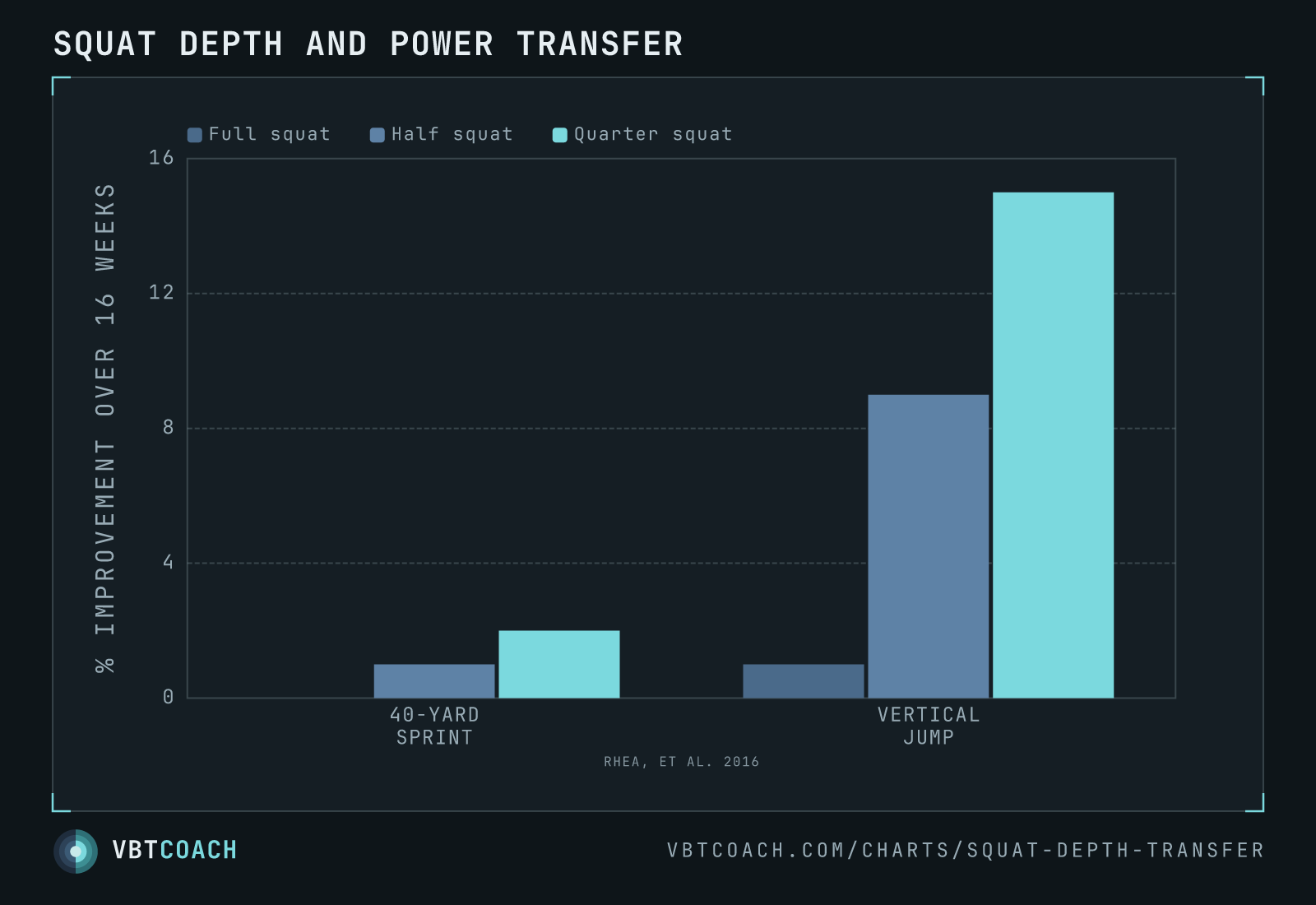
Rhea 2016 — 28 highly trained athletes, 16 weeks, identical programs bar squat depth. Quarter squats put 15 % on the vertical jump and 2 % on the 40; full squats put on 1 % and nothing.
Twenty-eight highly trained athletes — 24 footballers, plus a basketballer, a sprinter and a wrestler — split into three groups for 16 weeks. One variable separated them: how deep they squatted. Quarter, half, or full. Load prescription, sets, reps and frequency were matched.
Strength was tested at all three depths. Every group got strongest at the depth it trained, which is the study’s actual title and not remotely surprising. This chart is the interesting half: what that depth-specific strength did to jump and sprint, neither of which anyone trained directly.
How to read this chart
Percentage improvement from baseline to week 16. Three bars per test, ordered by depth — full squat, half squat, quarter squat — with the shallowest last and darkest.
The ordering is the finding. On both tests, shallower beat deeper, and it wasn’t close:
- Vertical jump. Quarter squats put on 15 %. Full squats put on 1 %.
- 40-yard sprint. Quarter squats took 2 % off. Full squats took off nothing — the full-squat bar is absent because the reported change was zero, not because the data is missing.
The half-squat group landed between the two on both tests, which is what makes this readable as a dose-response rather than a fluke of one group.
Why this happens
Strength gains are joint-angle specific. Train a narrow range near lockout and you get very strong in that narrow range near lockout — which is roughly the range a jump and a sprint stride actually use. Train through a full range and the gain spreads across the whole range, including depths that never appear in either movement.
For an already-strong athlete, that specificity is the whole game. They aren’t short of general strength. They’re short of force in the joint positions their sport uses.
What this does not say
It does not say full squats are useless. Three things worth holding onto before this becomes a programming decision:
- These athletes were already strong. A 16-week block in a novice would likely show the opposite ordering, because general strength is still the limiter.
- Sixteen weeks is a block, not a career. Quarter squats load the spine heavily for the range they cover. Nothing here speaks to what happens across years of it.
- Jump and sprint are not the only outcomes. Full-range strength buys tissue tolerance and positional strength that a countermovement jump test never asks about.
The honest read is narrower than the headline: for a well-trained athlete inside a block aimed at jump and sprint, partial-range squats transfer better. That is an in-season or pre-competition tool, not a replacement for the full squat.
Where this meets VBT
Squat depth changes the whole load–velocity relationship — a quarter squat’s velocities at a given percentage sit nowhere near a full squat’s, so a profile built on one is useless for prescribing the other. If you rotate depth across a training year, you rotate profiles with it. See load–velocity profiling for the mechanics, and power for where these transfer outcomes sit in the wider picture.
Source: Rhea, M., Kenn, J., Peterson, M., et al. (2016). Joint-Angle Specific Strength Adaptations Influence Improvements in Power in Highly Trained Athletes. Human Movement, 17(1), 43–49.
Download high res chart images
High-resolution PNG, 1600×1000, watermarked. Free to share, embed in slides, or print. Credit appreciated.