Gonzalez-Badillo 2016 — Jump performance crashes for 48h after high-effort squats
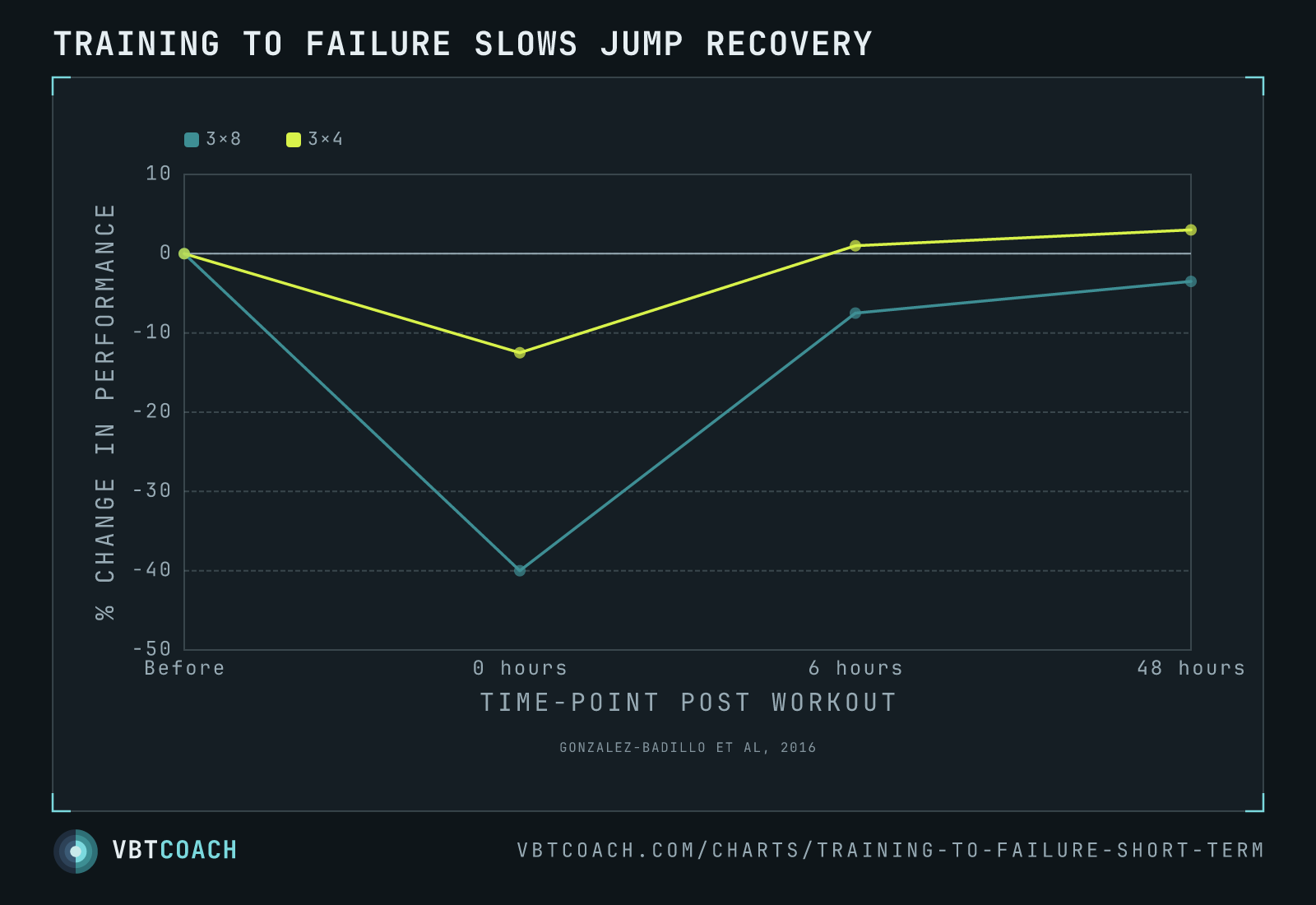
Gonzalez-Badillo 2016 — jump performance crashed 44 % immediately after a higher-effort squat workout (3×8) and stayed depressed for 48 hours; the lower-effort 3×4 group bounced back inside 6 hours.
Gonzalez-Badillo and colleagues measured jump performance immediately after, 6 hours after, and 48 hours after two squat protocols: a higher-effort 3 × 8 (closer to failure) and a lower-effort 3 × 4 (further from failure). The 3 × 8 group lost 44 % of their jump at the 0-hour mark and was still 2 % down at 48 hours. The 3 × 4 group dropped 13 % immediately and was above baseline by 48 hours.
How to read this chart
Four time points across the bottom: before the workout, immediately after (0 hours), 6 hours later, and 48 hours later. The navy line is the 3 × 8 group, the teal line is the 3 × 4 group. The y-axis is percentage change in jump performance from baseline. Both groups start at zero; both crash at the 0-hour mark; the 3 × 4 line recovers above baseline by 6 hours and overshoots at 48 hours; the 3 × 8 line is still in deficit two days later.
The 0-hour valley dominates the chart — the immediate post-workout crash is enormous (-40 % vs -12 %). But the more practically important finding is the 48-hour reading: a lifter doing 3 × 8 training is still functionally compromised heading into their next session.
When to use this evidence
- Programming session-to-session recovery. A 3-day-per-week strength block that pushes close to failure on day one stacks fatigue into days two and three. The 3 × 4 trajectory shows what “manageable fatigue” looks like.
- Coaching deload timing. When jump performance, bar speed, or any other readiness marker stays depressed 48 hours after a session, the previous session was too much. This chart puts numbers on that intuition.
- Comparing protocols. Same exercise, same load, half the reps from failure → dramatically different recovery profile. Effort, not load, drives the within-session fatigue cost.
Why jump performance crashes after near-failure
Heavy resistance training is a stress on the central nervous system, not just on muscle tissue. Reps performed in close proximity to failure burn through neural drive at a rate the recovery system can’t immediately replenish. Jump performance — which depends on rate-of-force-development, a fundamentally neural quality — drops first and recovers last. A lifter whose 1RM is restored after 24 hours may still be jumping below baseline for another full day.
Pitfalls
- Single-session study. This was an acute measurement, not a longitudinal one. The chart shows what one session does to recovery; it doesn’t directly show what 8 weeks of either protocol would produce. (For that, see the long-term version.)
- Jump performance is just one marker. 1RM strength typically recovers faster than jump or sprint performance. If your goal is purely strength, the depressed 48-hour jump might be acceptable.
- Effort ≠ failure. “Closer to failure” and “true failure” produce different recovery profiles. The 3 × 8 protocol here was hard but not absolute failure.
Where to go next
For the multi-week trajectory, training to failure long-term shows what happens when this within-session crash compounds across 8 weeks. The prose case lives in the risk and reward of training to failure. For the v-loss-based reframe, velocity-loss guidelines covers the auto-regulation alternative.
Download high res chart images
High-resolution PNG, 1600×1000, watermarked. Free to share, embed in slides, or print. Credit appreciated.