Bands or chains? Variable resistance beats a straight barbell — but only if you match the tool to the goal
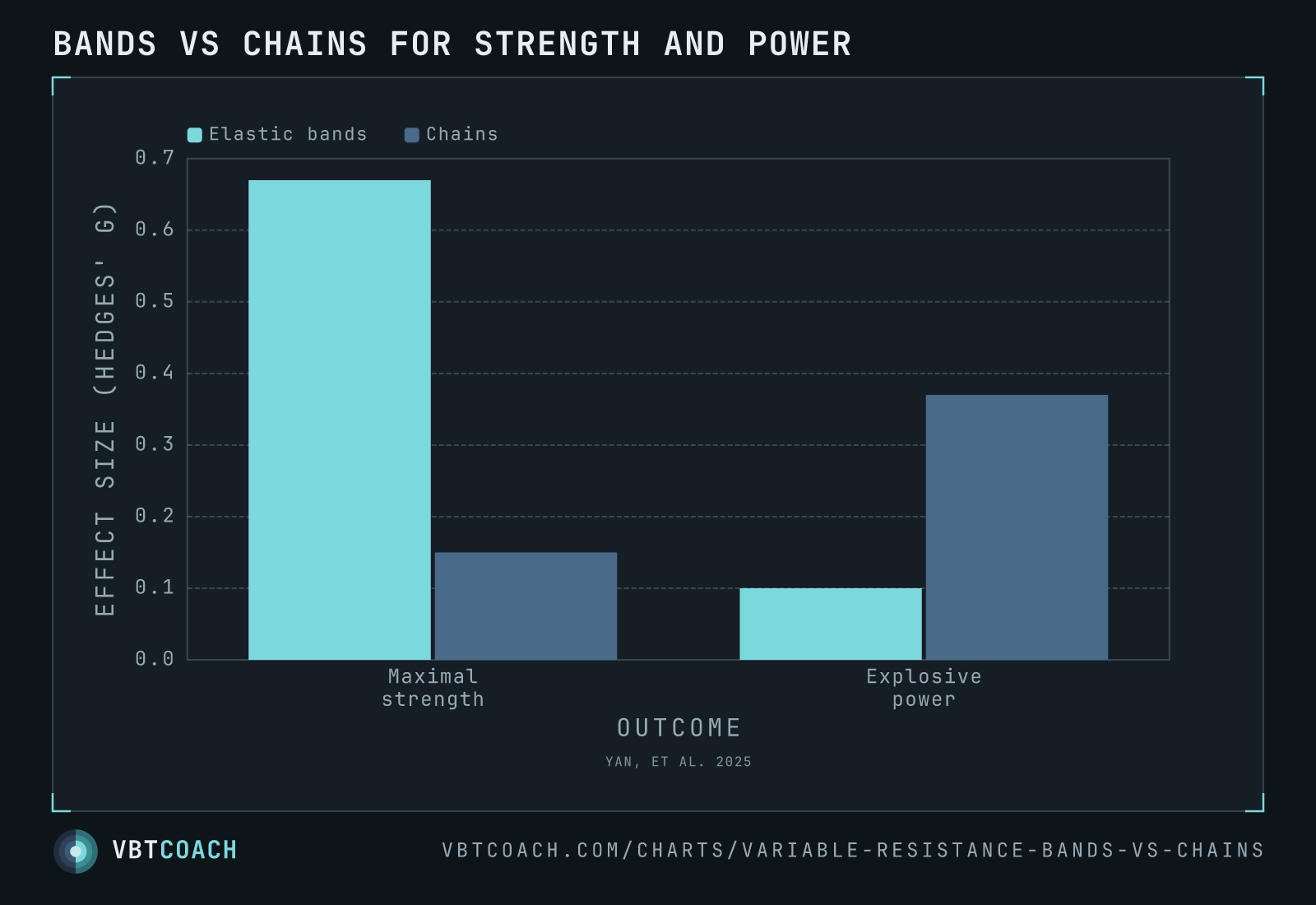
Yan 2025 — a squat-only meta-analysis of 20 studies. Elastic bands drove maximal strength (g = 0.67) while chains did nothing; chains drove explosive power (g = 0.37) while bands did nothing.
Hang bands or chains on the bar and the load rises as you leave the hole, matching resistance to your strength curve instead of leaving the top of the lift under-loaded. The question is whether it actually produces more than a straight barbell.
Yan and colleagues (2025) pooled 20 studies — the first meta-analysis to restrict itself to the squat rather than averaging across exercises, which matters because the strength curve of a squat is not the strength curve of a bench press.
The headline understates it, and the split explains why
Pooled across all equipment, variable resistance wins on both outcomes but modestly: g = 0.31 for maximal strength (95 % CI 0.12–0.51, p = 0.003) and g = 0.17 for explosive power (0.02–0.32, p = 0.02). Real effects, small ones.
Split by equipment, the same data set says something far more useful:
| Outcome | Elastic bands | Chains |
|---|---|---|
| Maximal strength | g = 0.67 (0.31–1.03, p < 0.001) | g = 0.15 (−0.11–0.40, p = 0.27) |
| Explosive power | g = 0.10 (−0.08–0.28, p = 0.26) | g = 0.37 (0.06–0.67, p = 0.019) |
The tools swap places. Bands produced a moderate strength effect and did nothing measurable for power; chains produced a meaningful power effect and did nothing measurable for strength.
The likely reason is the shape of the resistance. A band’s tension climbs steeply and peaks at lockout, which loads the top of the lift where a barbell goes slack — a strength stimulus. Chains add mass more gradually and let you keep accelerating through the rep, which is a power stimulus.
Read the whiskers
Two of the four bars cross zero. Chains-for-strength and bands-for-power are not statistically significant — this chart says “pick the right tool”, not “both tools work and one works better”.
What else the review found
- Short blocks beat long ones for strength. Under 8 weeks: g = 0.44. Eight weeks or more: g = 0.09, not significant. Treat it as a phase, not a permanent fixture.
- Lower frequency did better. Two sessions a week or fewer: g = 0.45. More than two: g = 0.17, not significant.
- Trained lifters benefited; untrained didn’t. g = 0.35 in trained subjects, nothing in untrained — which fits, since a novice gets plenty from the barbell alone.
- It transfers to jumping, not sprinting. Vertical jump g = 0.20, horizontal jump g = 0.38, sprint g = −0.09 (p = 0.57). Squat-pattern power doesn’t carry into a cyclical high-speed skill.
Pitfalls
- Effect sizes this size are not transformations. A g of 0.3–0.7 is a worthwhile edge for a trained lifter, not a new training paradigm.
- Setup dominates. Band tension and chain mass vary enormously between studies; “bands” is not one dose.
- Female data is thin. Only four comparisons included women, and that subgroup was not significant — likely a power problem rather than evidence of no effect.
Download high res chart images
High-resolution PNG, 1600×1000, watermarked. Free to share, embed in slides, or print. Credit appreciated.