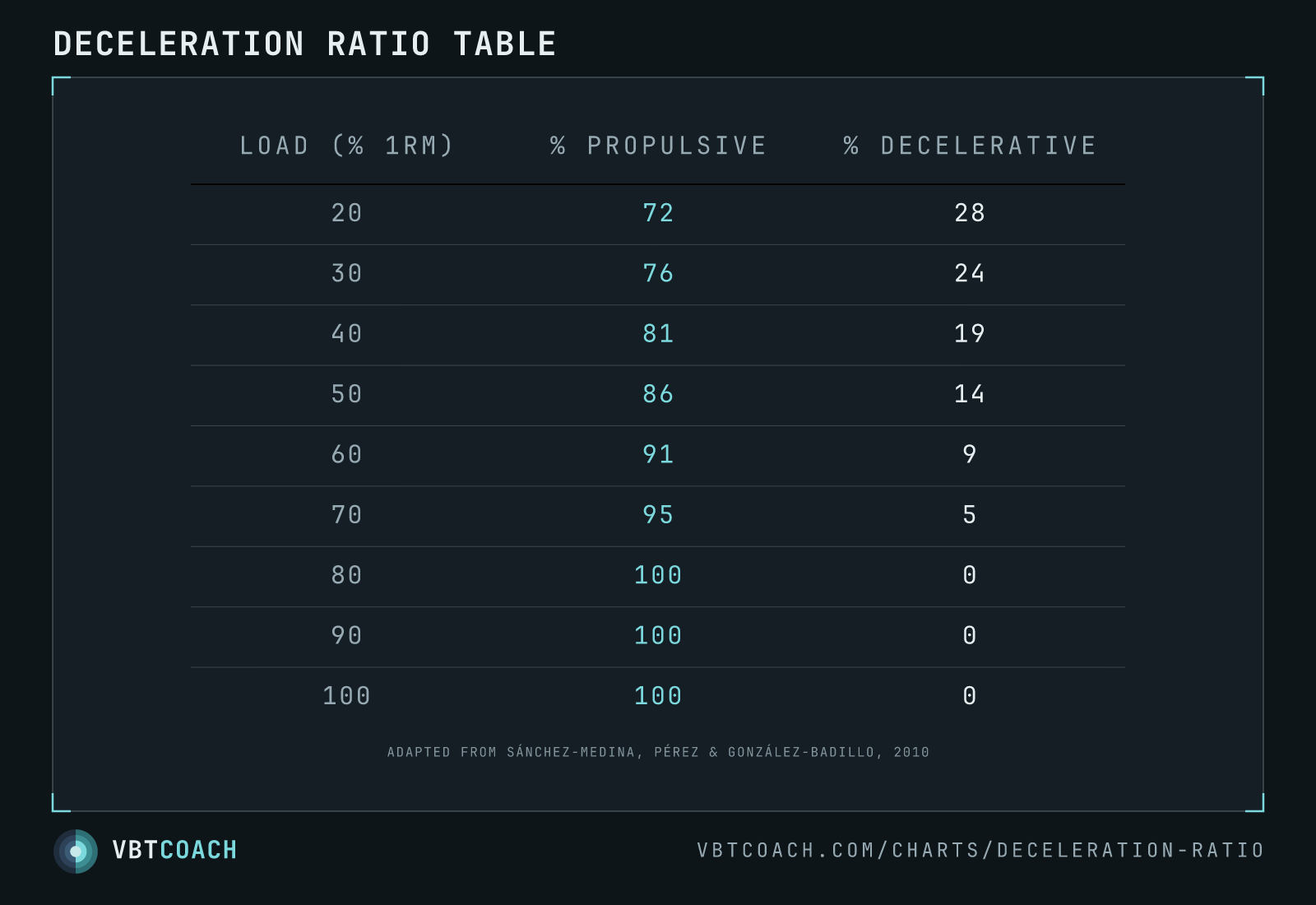
Deceleration ratio across intensities — how much of a rep you spend braking
The share of the concentric spent actively decelerating the bar, by load. It falls from 28 % at 20 % 1RM to zero at ~80 % 1RM — the point where propulsive and mean velocity become identical.
When you move a light load with intent, you can’t just keep accelerating — you’d throw the bar. So you brake it at the top. This table quantifies how much of the concentric that braking eats up, and how it shrinks as the load gets heavier.
How to read this table
Each row is a load, expressed as a percentage of 1RM. % propulsive is the share of the concentric where you’re driving the bar; % decelerative is the share where you’re actively slowing it down. They add to 100.
At 20 % 1RM, 28 % of the rep is spent decelerating — you hit peak velocity early and spend the back third braking. As load climbs, the deceleration phase shrinks: 14 % at 50 %, 5 % at 70 %, and by ~80 % 1RM it hits zero — the bar is heavy enough that it slows on its own, no active braking required.
Why it matters
That zero point is exactly why VBT has more than one velocity metric:
- Below ~80 % 1RM there’s a real deceleration phase, so mean velocity (which averages it in) reads lower than propulsive velocity (which cuts it off). The two disagree, and the gap is biggest on the lightest loads.
- At or above ~80 % 1RM the deceleration phase is gone, so mean and propulsive velocity are identical — the metric choice stops mattering.
This is the evidence behind the common advice to use propulsive velocity on light strength work and why it’s moot on heavy sets.
Where to go next
See where mean and propulsive are each measured on a single rep in the anatomy of a rep, and the full argument in Is everything we know about VBT wrong?.
Download high res chart images
High-resolution PNG, 1600×1000, watermarked. Free to share, embed in slides, or print. Credit appreciated.