Henneman size principle — the order motor units are recruited
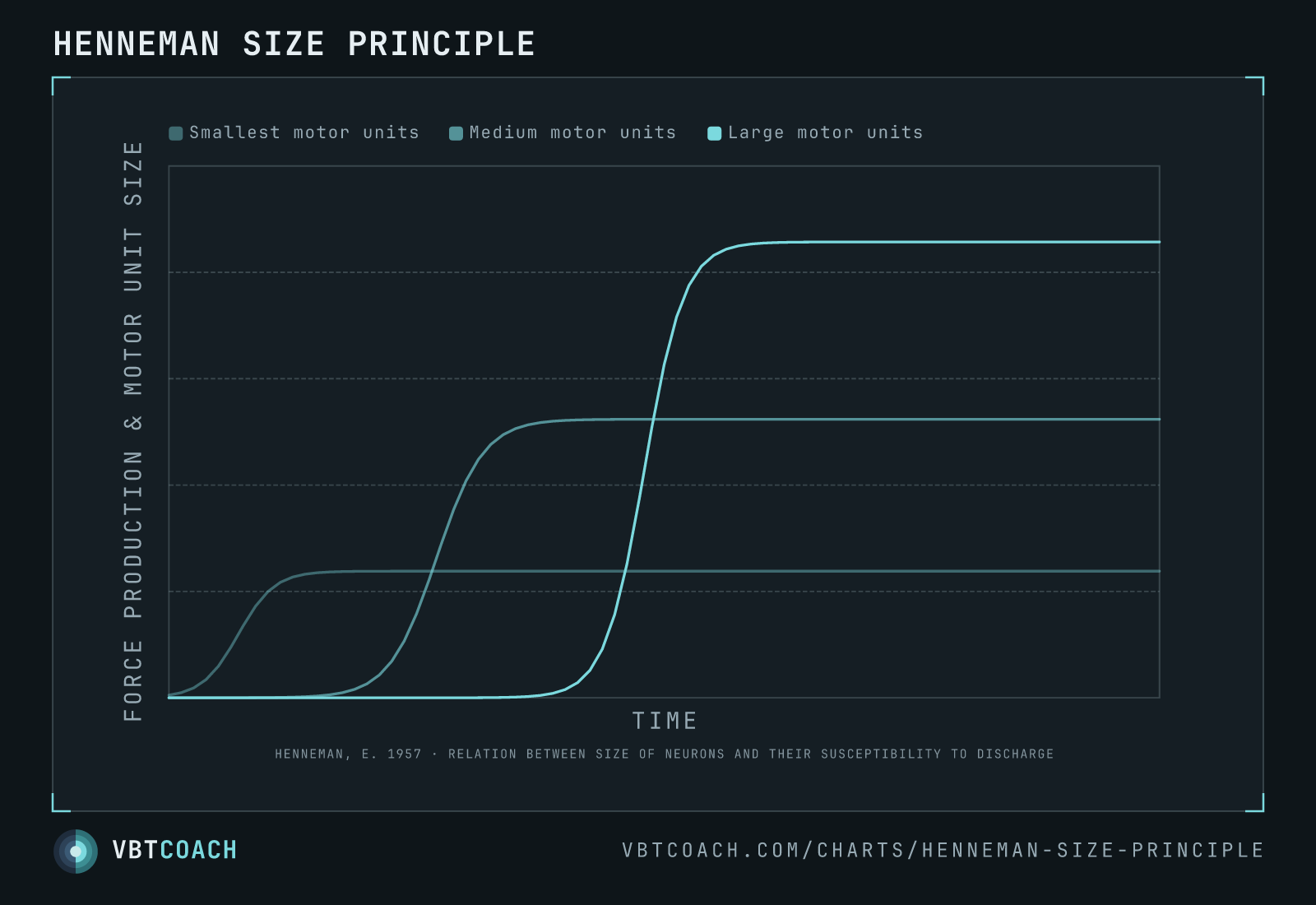
Motor units are recruited smallest-first, largest-last. Three logistic curves show how force production and motor-unit size climb as demand rises — and why only maximal intent recruits the high-threshold units.
The size principle, first described by Elwood Henneman in 1957, is the rule that governs the order your nervous system switches motor units on: smallest first, largest last. Low-threshold, slow-twitch units come online at the lightest demands; as the force requirement climbs, progressively larger, higher-threshold, faster-twitch units are recruited on top of them. This chart plots that order as three logistic rise-to-plateau curves — each unit type switching on at a different point and settling at a higher plateau of force and size.
How to read this chart
The x-axis is time or ascending effort; the y-axis is a combined “force production & motor-unit size” — there are no units, because the shape is the whole point. The lowest, dimmest curve is the low-threshold (type I) pool: recruited first, smallest, lowest force output. The middle curve is the mid-threshold (type IIa) pool, recruited later and plateauing higher. The brightest, latest-rising curve is the high-threshold (type IIx) pool: recruited last, largest, and responsible for the most force.
The key reading is the stagger. Each curve stays flat until its recruitment threshold, then rises sharply and plateaus. You never get the top curve without first climbing through the two below it.
Why it matters for training
- You can’t cherry-pick the big units. High-threshold units only fire once the demand is high enough — either heavy load or, critically, high intent.
- Intent substitutes for load. Moving a submaximal load with maximal velocity raises the force demand steeply enough to recruit up the chain, which is the whole mechanistic case for velocity-based training and compensatory acceleration.
- Grinding light loads slowly leaves the top of the curve untouched. If the bar never accelerates hard, the high-threshold units never switch on, and the adaptation you’re chasing never gets trained.
Where to go next
See the full write-up in The Henneman size principle and velocity-based training. Pair this with the Force–velocity curve to connect recruitment order to where power output actually peaks.
Download high res chart images
High-resolution PNG, 1600×1000, watermarked. Free to share, embed in slides, or print. Credit appreciated.