Hernández-Belmonte 2023 — Machines match barbells on most athletic outcomes
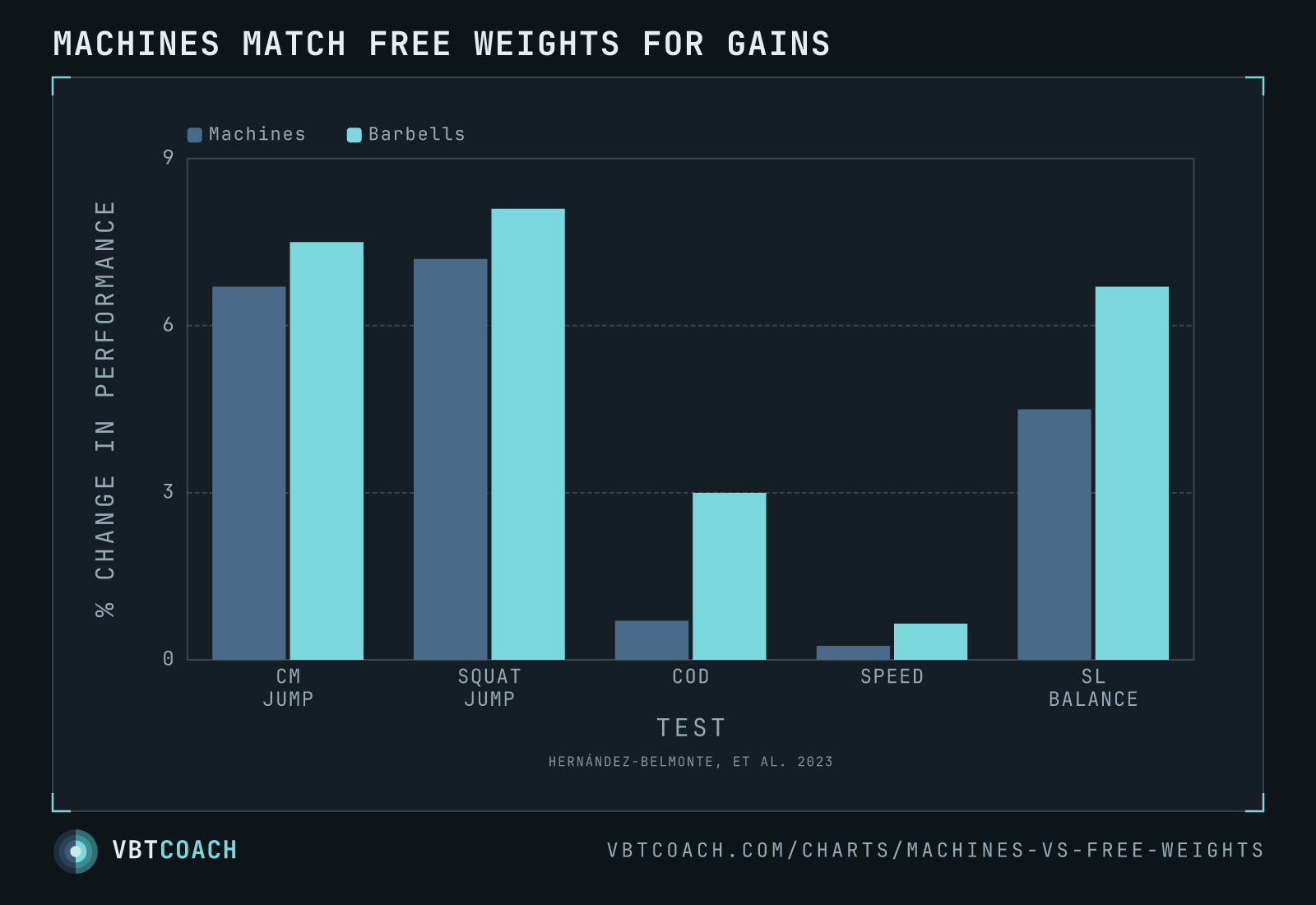
Hernández-Belmonte 2023 found no statistical difference between machine-only and barbell-only training on most athletic measures — barbells edged ahead on change-of-direction and balance.
The “machines vs free weights” question gets relitigated every few years. Hernández-Belmonte’s 2023 trial took two groups of athletes, prescribed identical training in everything except the equipment, and ran them for 8 weeks. Both groups used velocity-based load selection. Outcome: most performance measures showed no statistical difference. The two that did — change-of-direction speed and single-leg balance — favoured barbells.
How to read this chart
Five tests: countermovement jump, squat jump, change-of-direction (COD), straight-line speed, single-leg balance. Navy bars are the machine-only group, teal are the barbell-only group. The two leftmost categories (vertical jumps) sit close. The middle two (COD, speed) and the right one (SL balance) all show barbells ahead — modestly on speed, substantially on COD and balance.
When to use this evidence
- Defending a machine-heavy program. For pure jump performance and straight-line acceleration, machines hold their own. The “you have to use barbells” argument doesn’t hold up.
- Justifying barbell work for sport athletes. The COD and SL balance gaps are the real findings — stabilisation and direction-changing both improve more under free-weight load. That’s the case for keeping squat and deadlift in a sport program even if you have access to machines.
- Gym constraints. If your facility is machine-only (commercial gym, hotel, rehab clinic), the chart says you can still build jump power and straight-line speed. The trade-off shows up only in agility and balance.
What the chart doesn’t capture
- Hypertrophy outcomes weren’t the focus of this study. Other research suggests machines may produce comparable or larger muscle growth — different metric, different conclusion.
- Skill transfer. A barbell back squat trains the act of holding a bar on your back; a machine doesn’t. For sport-specific transfer (Olympic lifters, powerlifters), there’s no machine substitute.
- Injury and rehab context. Machines reduce stabilisation demand on purpose — that’s a feature when an athlete is returning from injury or learning a movement pattern.
Pitfalls
- The “barbells > machines” conclusion is local. This chart says barbells edge out machines on a subset of athletic outcomes; it doesn’t say machines are worthless. Combining both is almost always the right answer.
- 8 weeks is short. Longer-duration studies often blunt differences as both groups approach physiological ceilings.
- Specific transfer wins specific outcomes. If your goal is a heavier squat, train the squat. If your goal is jumping higher, the free-weight squat doesn’t beat a jump-based program in the long run.
Where to go next
For a deeper take on the equipment question, Machines vs free weights for performance covers the broader trade-offs. The Load–velocity profile chart is the underlying tool both groups in this study used to set loads.
Download high res chart images
High-resolution PNG, 1600×1000, watermarked. Free to share, embed in slides, or print. Credit appreciated.