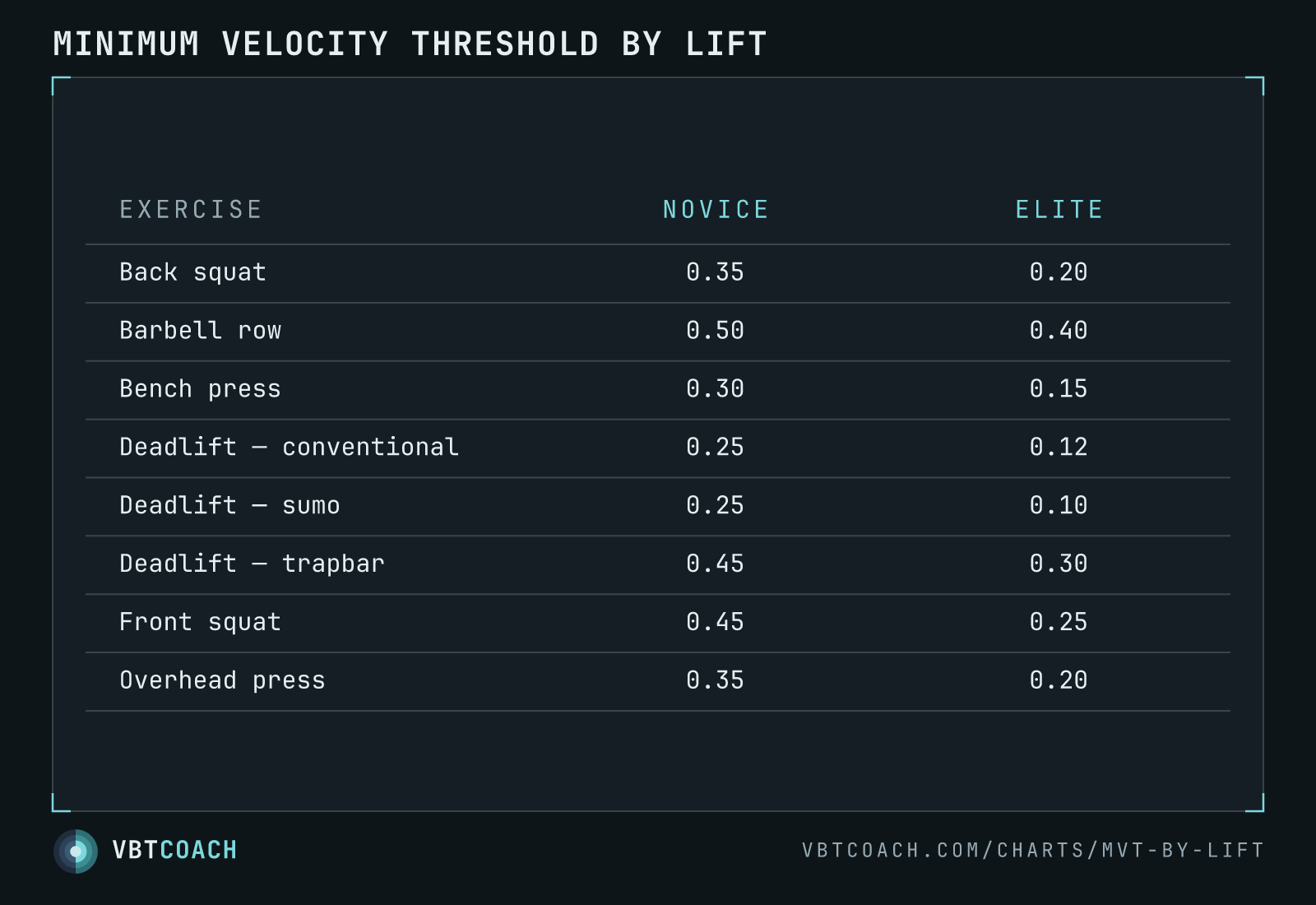
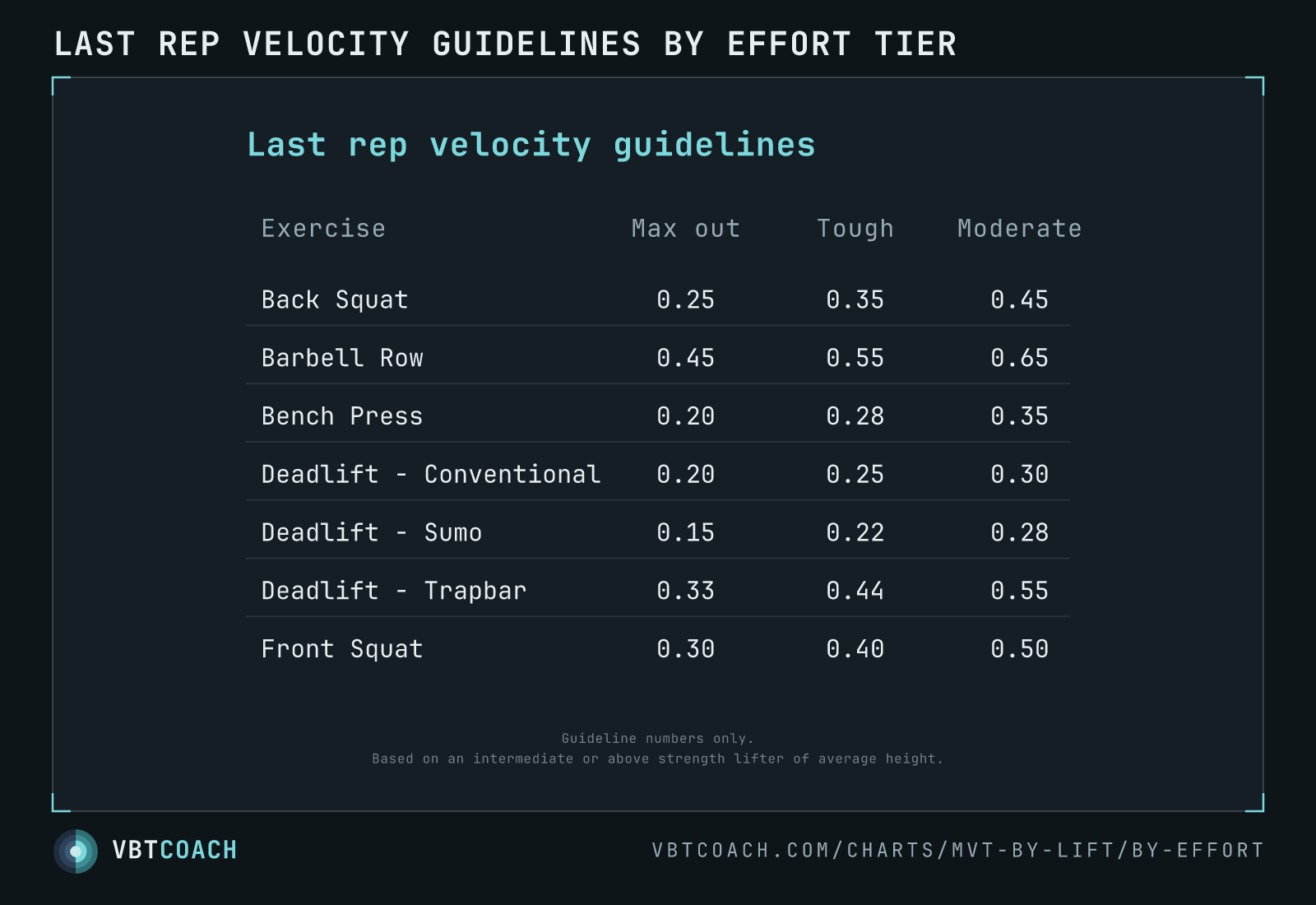
MVT by lift reference table — 1RM minimum velocity thresholds across eight strength exercises
Minimum velocity threshold values for back squat, front squat, bench, all three deadlifts, barbell row, and overhead press — by training level (novice / elite) and by effort tier (max out / tough / moderate).
Minimum velocity threshold (MVT) is the bar speed at a true 1RM. It’s the floor of what concentric velocity can become when the load is maxed; below it, the rep doesn’t complete. Once you know yours for a lift, you can read 1RM straight off a load–velocity profile without grinding through a max attempt.
How to read this table
Each row is a lift. The two right columns split out by training level: Novice (lifters with under 12 months of serious training) and Elite (lifters at or past ≥ 2× bodyweight on a lower-body 1RM, or equivalent). All values are mean concentric velocity in m/s.
Two patterns are worth noticing:
- Elite MVTs are lower than novice MVTs. Trained lifters can grind through a slower bar at their max — the gap is roughly 0.10–0.15 m/s across most lifts.
- Different lifts have different MVTs. Sumo deadlift bottoms at 0.10 m/s for elites; barbell row stays at 0.40 m/s. The number reflects ROM, leverage, and how rate-limited each lift is at the top end.
Values are mid-of-published-range estimates. Real numbers vary ± 0.05 m/s by athlete, technique, and how exactly mean concentric is computed.
When to use this table
- 1RM estimation from a profile. Plot a 3-point load–velocity line, draw a horizontal at the MVT for your lift + level, where the line crosses is your predicted 1RM.
- Auto-regulating off a single set. First-rep velocity at a known load + the MVT lookup lets you back-calculate today’s likely 1RM.
- Sanity-checking a profile fit. If your regression line crosses MVT at an absurd load, the data is wrong — fatigued points, poor measurement, ROM cheat.
Common variations
Olympic lifts have higher MVTs (≥ 0.40 m/s) because the lift stops being completable below that — they’re rate-of-force-limited rather than max-force-limited. Single-leg variants don’t fit the MVT framework cleanly. Pull-ups and dips sit around 0.20 m/s for trained athletes.
ROM matters: a competition-paused bench has a slower MVT than a touch-and-go bench by ~0.02 m/s. Squat depth shifts MVT by 0.02–0.04 m/s. Equipment matters too — a sleeved squat is slower than a wrapped one at the same %1RM.
Pitfalls
- Treating textbook MVTs as exact. They’re starting points. Confirm yours by capturing velocity on a true 1RM at least once per training year.
- Mixing velocity types. MVT in mean concentric ≠ MVT in peak velocity ≠ MVT in propulsive velocity. Pick one and stay consistent.
- Picking the wrong column. “Novice” and “Elite” are training-status, not bodyweight or age. An older lifter with 20 years of experience uses elite values; a 22-year-old with 6 months under the bar uses novice.
Where to go next
For the practical use of MVT in 1RM estimation, see the 1RM and VBT complete guide. To build your own profile and overlay your MVT, use the Load–velocity profile generator. The companion load–velocity profile chart includes a by-lift variant showing how the four common lifts produce different LV profiles even on the same athlete.
Download high res chart images
Every chart on this page as a high-resolution PNG — 2 exports, 1600×1000, watermarked. Free to share, embed in slides, or print. Credit appreciated.