Is accommodating resistance better than straight barbell training? Every outcome, side by side
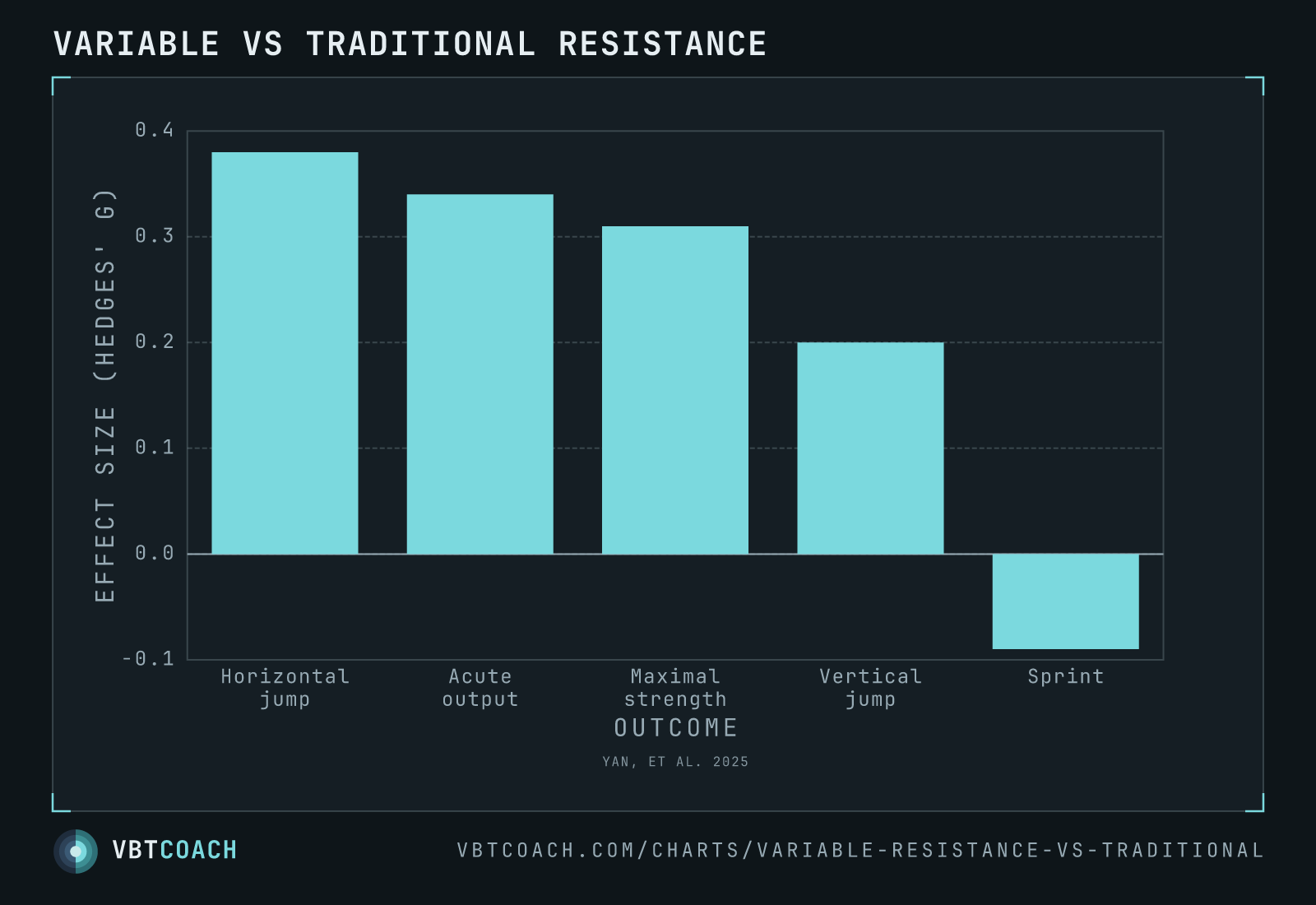
Yan 2025 — a squat-only meta-analysis of 20 studies. Variable resistance beat constant resistance on strength, acute output and jumping, and did nothing for sprinting.
Hang bands or chains on the bar and resistance rises as you leave the hole, loading the top of the lift where a straight barbell goes slack. The claim is that this builds more strength and more power than the barbell alone. Here is what happens when you test it.
Yan and colleagues (2025) pooled 20 squat studies — the first meta-analysis to restrict itself to one exercise rather than averaging across the squat, bench and everything else, which matters because the strength curve of a squat isn’t the strength curve of a press.
Every bar is variable resistance minus constant resistance. Zero means a straight barbell did just as well, and positive always favours variable resistance — including for sprint, where the authors have already accounted for the fact that a faster sprint is a smaller number. A negative sprint bar means variable resistance came out slightly behind, not that times fell.
What it says
Four of the five outcomes favour variable resistance, and one doesn’t:
| Outcome | Hedges’ g | 95 % CI | p |
|---|---|---|---|
| Horizontal jump | 0.38 | 0.06 – 0.70 | 0.025 |
| Acute output (single session) | 0.34 | 0.20 – 0.47 | < 0.001 |
| Maximal strength | 0.31 | 0.12 – 0.51 | 0.003 |
| Vertical jump | 0.20 | 0.00 – 0.40 | 0.05 |
| Sprint | −0.09 | −0.40 – 0.22 | 0.57 |
Pooled explosive power across all jump measures came out at g = 0.17 (0.02–0.32, p = 0.02).
These are small effects. A g of 0.2–0.4 is a real edge, not a different category of training — the honest summary is that accommodating resistance is modestly and consistently better in the squat pattern, not that it transforms an athlete.
Where it stops
Sprinting is the outcome that doesn’t move, and it’s the most instructive one. Sprinting is a cyclical, high-frequency skill with its own motor programme; loading the top of a squat doesn’t reach it. Everything variable resistance improves here — strength, acute output, jumping — sits close to the squat pattern itself.
Read the sprint bar as no effect, not as harm. The point estimate is negative but the confidence interval runs from −0.40 to 0.22 and p = 0.57, so it is statistically indistinguishable from zero. Nothing in this data suggests bands or chains make an athlete slower; they simply do not make them faster.
How to use it
The review’s own subgroup analysis is where the practical detail lives:
- Run it as a block, not a fixture. Under 8 weeks: g = 0.44. Eight weeks or longer: g = 0.09, not significant.
- Two sessions a week or fewer. g = 0.45 at ≤ 2/week against g = 0.17 above that — this is a high-tension stimulus, not a volume one.
- Trained lifters only. g = 0.35 in trained subjects and nothing in untrained, which is what you’d expect when a novice still has plenty to gain from the bar alone.
- Match the tool to the goal. Bands and chains are not interchangeable — see bands vs chains.
Pitfalls
- “Variable resistance” is not one dose. Band tension and chain mass differ enormously between studies; the included protocols ranged from +15 % to +44 % of 1RM added at the top.
- Female data is thin. Four comparisons included women and the subgroup wasn’t significant — a sample-size problem rather than evidence of no effect.
- Effect sizes, not kilos. These studies used different loads, lifts and populations, so the pooled result is expressed as a standardised effect rather than kg on the bar.
Download high res chart images
High-resolution PNG, 1600×1000, watermarked. Free to share, embed in slides, or print. Credit appreciated.