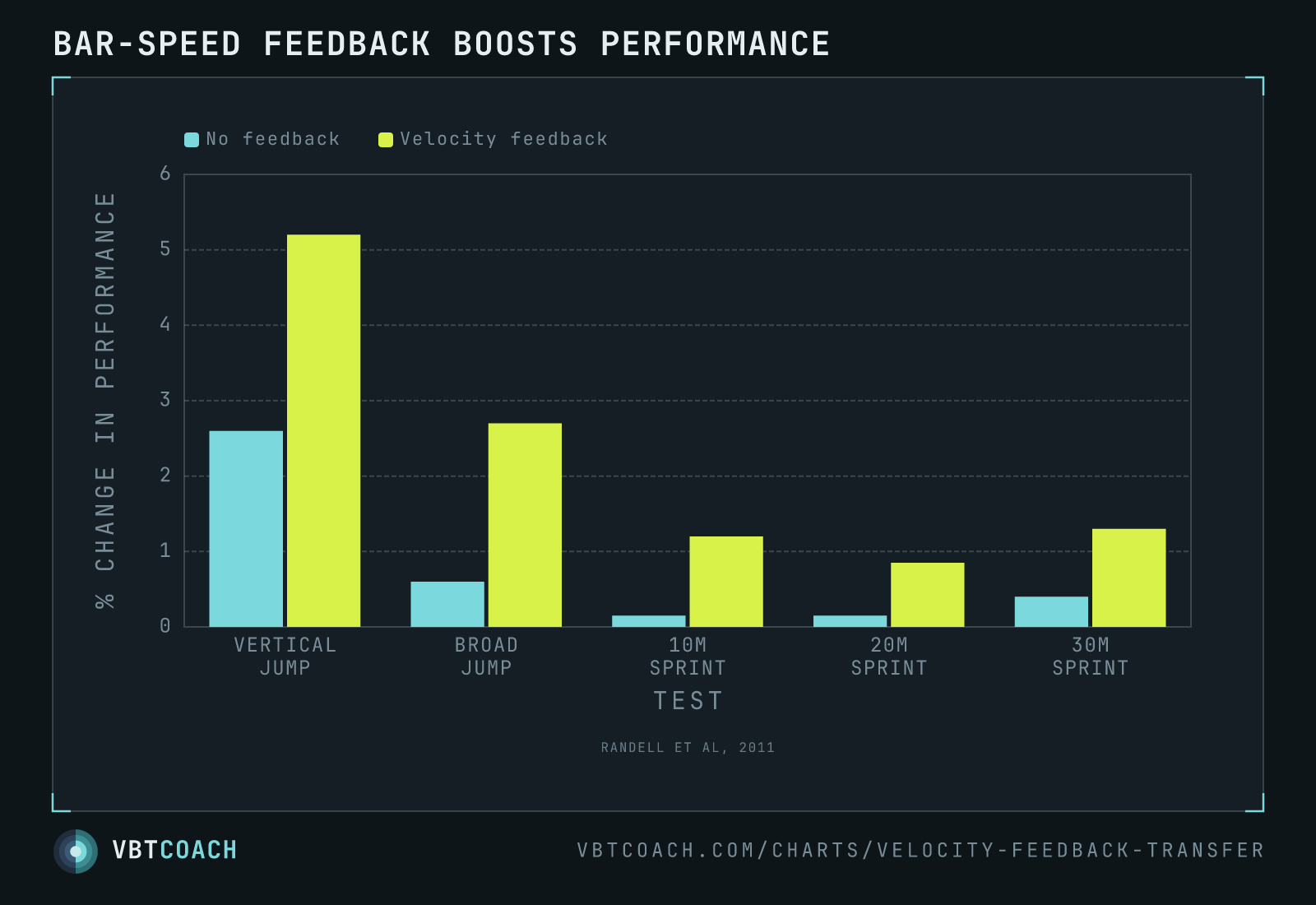
Randell 2011 — Bar-speed feedback nearly doubles jump and sprint gains
Randell 2011 — pro rugby players who saw real-time velocity feedback during jump-squat training out-gained the no-feedback group on every transfer test.
The simplest VBT win has nothing to do with load selection — it’s the feedback loop. Randell and colleagues had two groups of pro rugby players run the same fixed-load jump-squat protocol for 6 weeks. The only difference: one group saw bar speed displayed after each rep, the other didn’t. Across every transfer test (jumps and sprints), the feedback group out-gained the control by roughly 2× — with the same loads, same volume, and same coaching.
How to read this chart
Five tests across the bottom: vertical jump, broad jump, and three sprint distances. Navy bars are the no-feedback group, teal is the velocity-feedback group. The y-axis is percentage change in performance from pre to post. The feedback group is taller in every category, with the biggest absolute gap on broad jump (~+2 %) and the biggest relative gap on 10 m sprint (~8× larger improvement).
When to use this evidence
- Justifying real-time feedback in a session. A simple display next to the bar — even just “0.84 m/s” called out by the coach — produces measurable training effects.
- Designing a power block. Maximum-intent reps drive RFD adaptations. Visible velocity is the cheapest, fastest way to enforce maximum intent.
- Auto-regulating an athlete who’s coasting. A velocity drop on a familiar load is the earliest sign of going through the motions; feedback puts a number on it.
Why feedback matters
Maximum intent on every rep is what differentiates VBT-style training from percentage-based grinding. Without feedback, athletes naturally regress toward “good enough” effort — especially on light, fast lifts. Visible velocity makes the difference between rep 4 at 0.92 m/s and rep 4 at 0.78 m/s explicit, immediate, and quantifiable. The athlete tries harder. The neural adaptations follow.
Pitfalls
- It’s the feedback, not the device. Randell used a basic linear position transducer. Apps, smart phones, lasers, and hi-end timing systems all produce the same effect if they show the number after each rep.
- Effort ceiling matters. If the athlete is already maxed out on intent, feedback adds little. The wins are biggest where the lifter has the most room to improve effort — typically novice and intermediate athletes.
- Watch for over-correction. Some athletes optimise for the velocity number rather than the lift quality. Coaching cues still rule; velocity is a tool, not a target.
Where to go next
For the day-to-day “how to set up real-time feedback in your gym,” see Real-time feedback with VBT. To pick the right device for the job, Velocity-based training devices buyers’ guide breaks down the options. The broader topic page on Intent and effort covers the underlying principle.
Download high res chart images
High-resolution PNG, 1600×1000, watermarked. Free to share, embed in slides, or print. Credit appreciated.