Cormie 2010 — ballistic power training versus heavy strength training in weak lifters
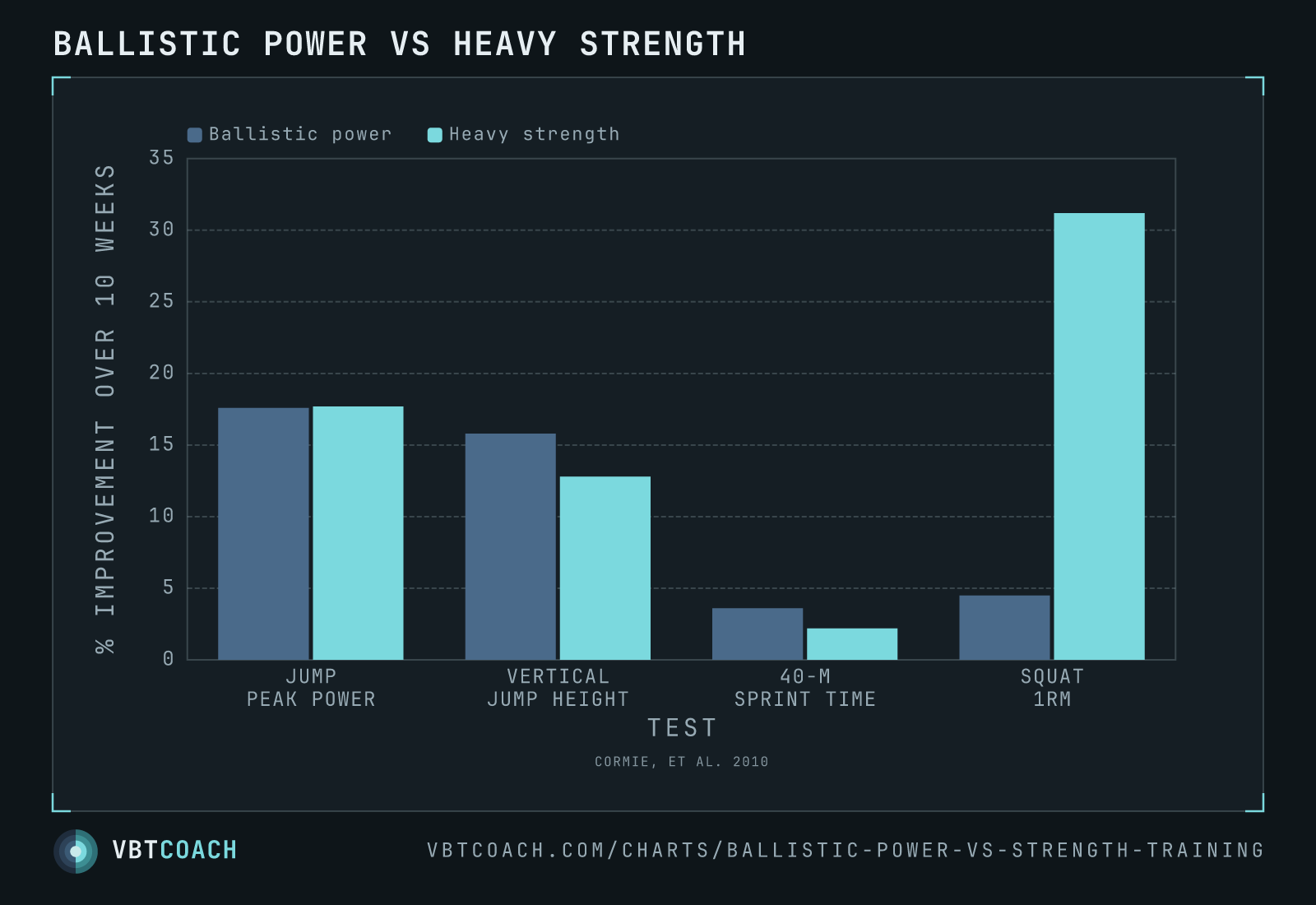
Cormie 2010 — 24 relatively weak men, 10 weeks, jump squats at 0–30 % 1RM versus back squats at 75–90 % 1RM. Jump and sprint improved the same in both groups. Squat 1RM went up 31 % versus 4.5 %.
Twenty-four relatively weak men — able to back squat with proficient technique, but only around 1.3× body mass — randomised for 10 weeks, three sessions a week. There was also a control group, which moved on nothing and isn’t plotted.
- Ballistic power (PT). Maximal-effort jump squats at 0–30 % 1RM.
- Heavy strength (ST). Back squats at 75–90 % 1RM.
Two training stimuli about as far apart as you can get inside the same exercise pattern.
How to read this chart
Percentage improvement from baseline to the 10-week posttest. Sprint is plotted as time reduction, so on every bar taller means better.
The first three bars are the athletic-performance outcomes, and they’re a wash:
- Jump peak power — 17.6 % versus 17.7 %. Identical.
- Vertical jump height and 40-m sprint — the power group edges it, by margins this study wasn’t powered to separate. No significant between-group differences on either.
Then the fourth bar: squat 1RM up 31.2 % with heavy strength, 4.5 % with ballistic power. Seven times the gain, over the same ten weeks, in the same people.
What this actually means
Read the first three bars alone and you’d conclude the training method doesn’t matter. Read the fourth and you get the paper’s conclusion, which is the opposite:
The ability of strength training to render similar short-term improvements in athletic performance as ballistic power training, coupled with the potential long-term benefits of improved maximal strength, makes strength training a more effective training modality for relatively weak individuals.
Both groups bought the same jump. Only one group also bought a bigger engine to run the next block with. If the ten-week outcomes are level, the tiebreaker is what you’re holding at week eleven.
The word doing the work is “weak”
This result does not generalise upward, and the paper doesn’t claim it does. These men squatted about 1.3× body mass. At that level almost any competent stimulus works, because general strength is the limiter and it’s nowhere near ceiling.
Run the same comparison in an already-strong athlete and the answer flips — see Cormie 2007, where in recreationally trained men adding heavy squats to jump squats beat jump squats alone on everything heavy, and Rhea 2016, where in highly trained athletes the specific joint angle mattered more than the load.
The practical rule that falls out of all three: build the base first, get specific later. Ballistic work isn’t wrong for a weak lifter, it’s just not urgent.
Where this meets VBT
Both groups here trained with maximal intent — the power group had a beep cueing them when a jump hit 95 % of their best. That’s velocity feedback with 2010 hardware, and it’s the reason the power group’s numbers are as good as they are.
The lesson generalises: heavy strength work only outperforms ballistic work if the heavy work is fast. Grinding 85 % at whatever speed comes out is not the same stimulus as driving it. See intent.
Provenance
Jump peak power, 40-m sprint and squat 1RM are the percentage changes reported in the paper’s abstract. Vertical jump height is computed from the Table 1 group means (0.39 → 0.44 m and 0.38 → 0.44 m), published to two decimals, so that pair is coarse — worth about a percentage point either way. Nothing above leans on the gap between those two bars.
Source: Cormie, P., McGuigan, M. R., Newton, R. U. (2010). Adaptations in Athletic Performance after Ballistic Power versus Strength Training. Medicine & Science in Sports & Exercise, 42(8), 1582–1598.
Download high res chart images
High-resolution PNG, 1600×1000, watermarked. Free to share, embed in slides, or print. Credit appreciated.