Tufano 2016 — Cluster sets preserve bar speed across all 36 reps
Tufano 2016 — cluster set training (3×(6×2) with intra-set rest) maintains mean concentric velocity across all 36 reps; traditional 3×12 sets decline within sets and cumulatively across sets.
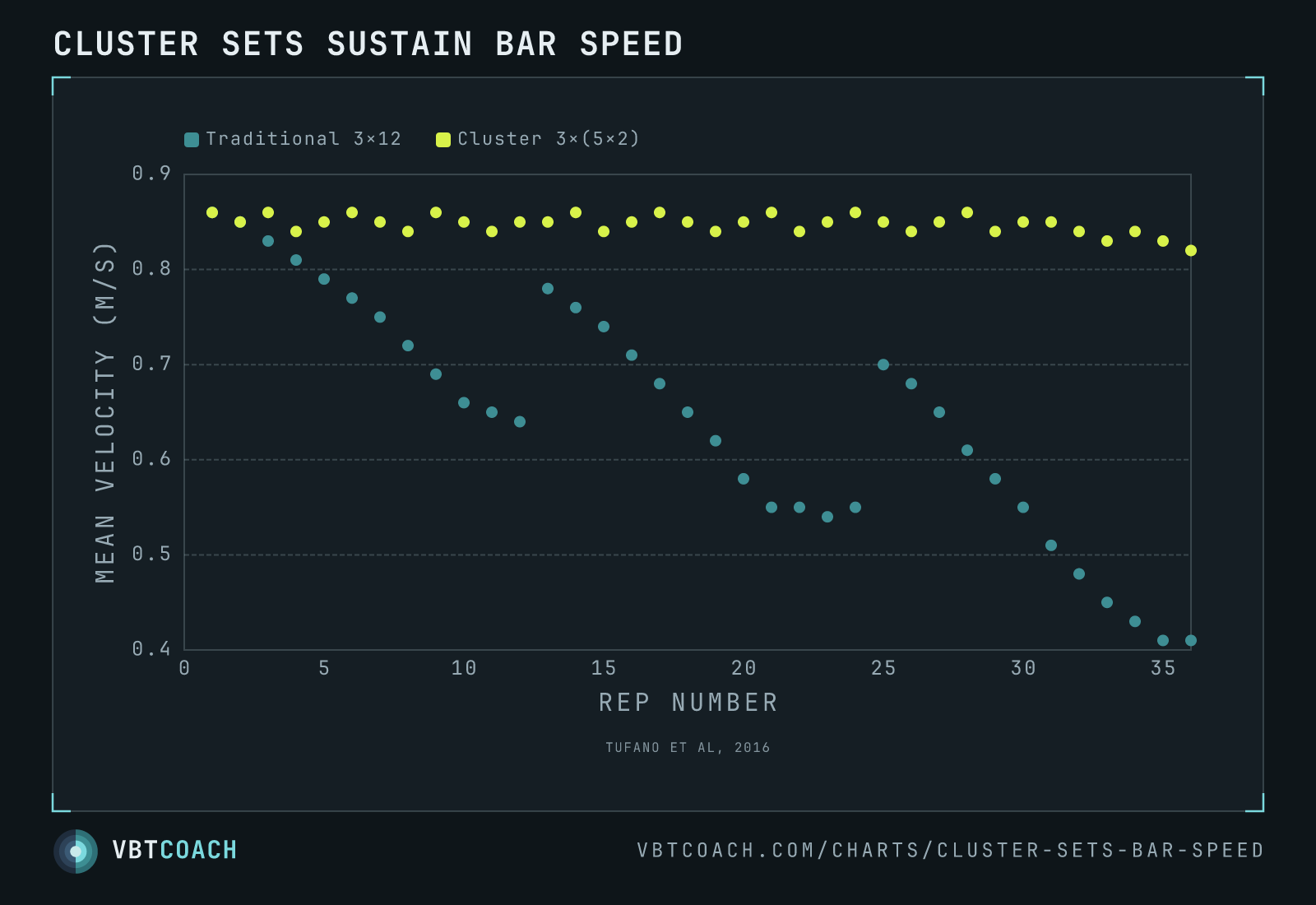
Tufano and colleagues recorded the mean concentric velocity of every single rep across two volume-matched squat protocols: a traditional 3 × 12 straight-set scheme and a cluster 3 × (5 × 2) scheme with brief intra-set rest. The cluster condition kept bar speed virtually flat across all 36 reps. The traditional condition declined steadily within each set, recovered partially between sets, then declined further. This chart is the mechanism under all the other cluster-vs-traditional findings.
How to read this chart
Each dot is one rep. The x-axis is rep number, 0 to 36. The y-axis is mean concentric velocity in m/s — higher is faster. Navy dots are the traditional 3 × 12 protocol; teal dots are the cluster 3 × (5 × 2) protocol with intra-set rest.
The cluster series sits flat between 0.82 and 0.86 m/s for every rep — the brief rest between mini-clusters is enough to preserve neuromuscular function. The traditional series shows the predictable pattern: each set starts fast, declines as fatigue accumulates, gets a partial recovery during the inter-set rest, then declines again. By rep 36, the traditional condition is ~0.40 m/s — the lifter is moving the bar at roughly half the speed of the cluster condition.
When to use this evidence
- Explaining why cluster sets out-perform traditional sets. It isn’t a magic configuration — it’s that cluster preserves bar speed, and bar speed is what differentiates power-training reps from grinding reps.
- Diagnosing an intent problem. If a lifter’s traditional sets look like the navy series here, the program is producing fatigue-tolerance training disguised as power work.
- Justifying intra-set rest to a coach. “Same total reps, dramatically different bar-speed profile” is the cleanest argument for the time cost of cluster configurations.
What the chart explains
Every other cluster-vs-traditional finding in the literature traces back to this. More gains in power output? Bar speed stayed high. More gains in 1RM strength? Bar speed stayed high — and high-velocity reps recruit more high-threshold motor units per rep.
Pitfalls
- Fixed-load illusion. This protocol used a fixed load. Real cluster programming often uses heavier loads with the cluster format, since the format affords it. The bar-speed gap shrinks when the cluster condition is loaded heavier than the traditional one.
- Doesn’t apply at low loads. At ≤ 30 % 1RM, both conditions tend to keep bar speed up — the cluster benefit is largest in the 60–80 % range.
- The flat line isn’t free. Cluster sessions take longer for the same volume; programming has to budget the time.
Where to go next
For the strength and power outcomes that fall out of this mechanism, see cluster sets strength gains and cluster sets power gains. The practical “how to program clusters” guide is in What is cluster set training.
Download high res chart images
High-resolution PNG, 1600×1000, watermarked. Free to share, embed in slides, or print. Credit appreciated.