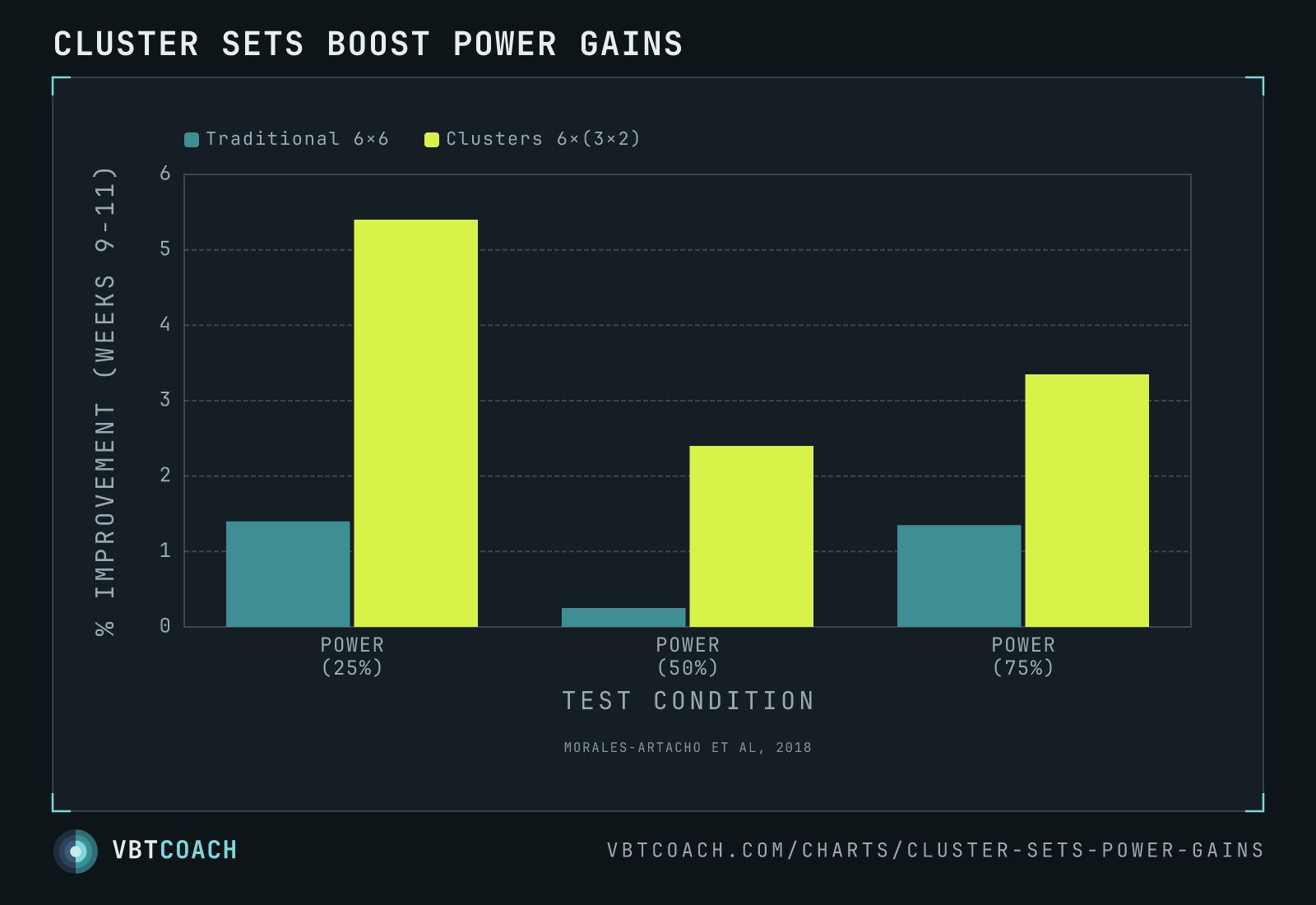
Morales-Artacho 2018 — Cluster sets out-gain traditional sets on power at every load
Morales-Artacho 2018 — cluster sets out-gained traditional 6×6 sets at every load tested (25 / 50 / 75 % 1RM), with the biggest gap at the peak-power region around 25 % 1RM.
Morales-Artacho and colleagues ran an 8-week head-to-head between two volume-matched protocols: a traditional 6 × 6 straight-set scheme and a cluster 6 × (3 × 2) scheme that broke each set into mini-clusters with brief intra-set rest. Same total reps, same load. The cluster group produced more power at every load they retested.
How to read this chart
Three test loads across the bottom — 25 %, 50 %, and 75 % 1RM — each evaluated for power output. Navy is the traditional-sets group, teal is the cluster-sets group. The y-axis shows the percentage gain in power output measured between weeks 9 and 11 (post-intervention). Every load shows clusters ahead, with the biggest absolute gap at 25 % 1RM (the peak-power region for most lifters).
When to use this evidence
- Programming a power block. When the goal is rate-of-force-development gains, swap traditional sets for cluster configurations on the main movements.
- Justifying intra-set rest to a sceptical lifter. “Same total reps, more power” is the cleanest framing — the rest doesn’t reduce the work, it moves it where it counts.
- Athlete returning from a high-volume block. Clusters preserve bar speed under volume, which means your “power day” actually trains power even when your fatigue floor is elevated.
Why cluster sets win for power
The mechanism is bar-speed preservation. Traditional sets accumulate fatigue inside the set; reps 5 and 6 of a 6-rep set move slower than reps 1 and 2. That slower movement is mechanically heavier strength training, not power training. Cluster configurations insert short rests (typically 15–30 s) that let neuromuscular function recover enough to keep every rep at near-maximal velocity. More high-velocity reps per session = more power-specific stimulus.
Pitfalls
- Time cost. Clusters take longer than straight sets at the same volume. Programming sessions need to budget for it.
- Diminishing returns at low loads. At very light loads (≤ 30 % 1RM) traditional sets already preserve velocity reasonably well. Cluster benefits shrink.
- It’s not always strength work. This study showed power gains; cluster effects on max-strength are typically smaller. For pure 1RM development, traditional configurations are competitive.
Where to go next
For the practical anatomy of cluster set programming, see What is cluster set training. The companion cluster sets bar-speed chart shows the mechanism underlying these gains — how bar speed holds up across reps in a cluster vs traditional set. For the strength-gain version of this same comparison, see cluster sets strength gains.
Download high res chart images
High-resolution PNG, 1600×1000, watermarked. Free to share, embed in slides, or print. Credit appreciated.