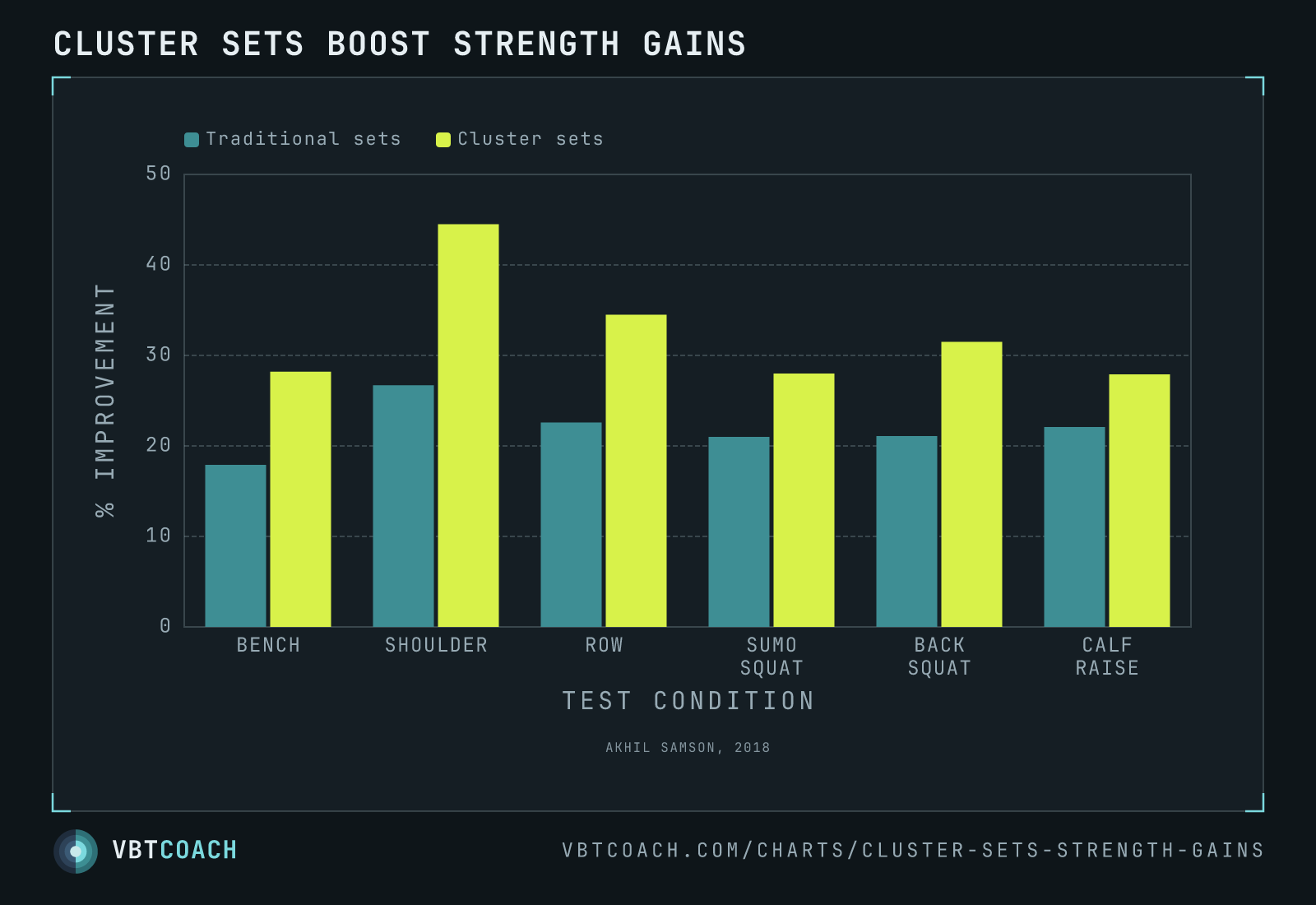
Akhil Samson 2018 — Cluster sets out-gain traditional sets on every compound lift
Akhil Samson 2018 — cluster sets out-performed traditional sets on every compound lift tested over 8 weeks — bench, shoulder, row, sumo squat, back squat, calf raise.
Akhil Samson’s 2018 trial put cluster training head-to-head with traditional set configurations on six compound lifts in recreationally active males. Across every single lift, the cluster group out-gained the traditional group by a substantial margin — biggest absolute gap on shoulder press (45 % vs 27 %), but the pattern is consistent.
How to read this chart
Six lifts across the bottom: bench, shoulder press, row, sumo squat, back squat, calf raise. Navy bars are the traditional-sets group, teal are the cluster-sets group. The y-axis is percentage gain in 1RM after 8 weeks. Every category shows the cluster group ahead by ~7–18 percentage points — a substantial margin in a strength-training trial.
When to use this evidence
- Defending cluster configurations on strength days. This isn’t a power-only finding. Cluster sets out-perform traditional sets on raw 1RM gains too, especially in a recreationally active population.
- Programming a strength block. Clusters work for upper-body, lower-body, single-joint, and multi-joint lifts. The principle generalises.
- Coaching newer lifters. The recreationally active sample matters: this isn’t a study on elite athletes who’ve already optimised everything else. The benefit shows up in normal lifters too.
Why cluster sets win for strength
Cluster’s edge on strength is the same edge it has on power: bar-speed preservation. When every rep stays near its maximum-intent velocity, the quality of the rep stays high — better motor unit recruitment, less compromised technique, less wasted neural drive. Traditional sets bury reps 5–6 of a 6-rep set under accumulated fatigue, and those reps train fatigue tolerance more than strength.
Pitfalls
- Recreational ≠ elite. Studies on highly trained powerlifters show smaller cluster effects — the ceiling is closer, the marginal gain is smaller.
- Volume confound. Total reps were matched in this trial. Some real-world programs use cluster sets to increase volume, which changes the comparison.
- Lift-specific timing. The 15–30 s rest interval typical to cluster sets is well-suited to compound lifts; it’s overkill for accessory work where fatigue accumulation is rarely the limiting factor.
Where to go next
The practical “how to program cluster sets” walkthrough lives in What is cluster set training. For the power side of the same intervention class, see cluster sets power gains. And for the underlying mechanism — bar-speed preservation under volume — the cluster sets bar-speed chart shows it in action.
Download high res chart images
High-resolution PNG, 1600×1000, watermarked. Free to share, embed in slides, or print. Credit appreciated.