Weakley 2019 — Velocity feedback wins on every athletic test in rugby
Weakley 2019 — 4 weeks of augmented velocity feedback in rugby union players. Feedback group beat the no-feedback group on every test, including a peak-power loss the no-feedback group couldn't avoid.
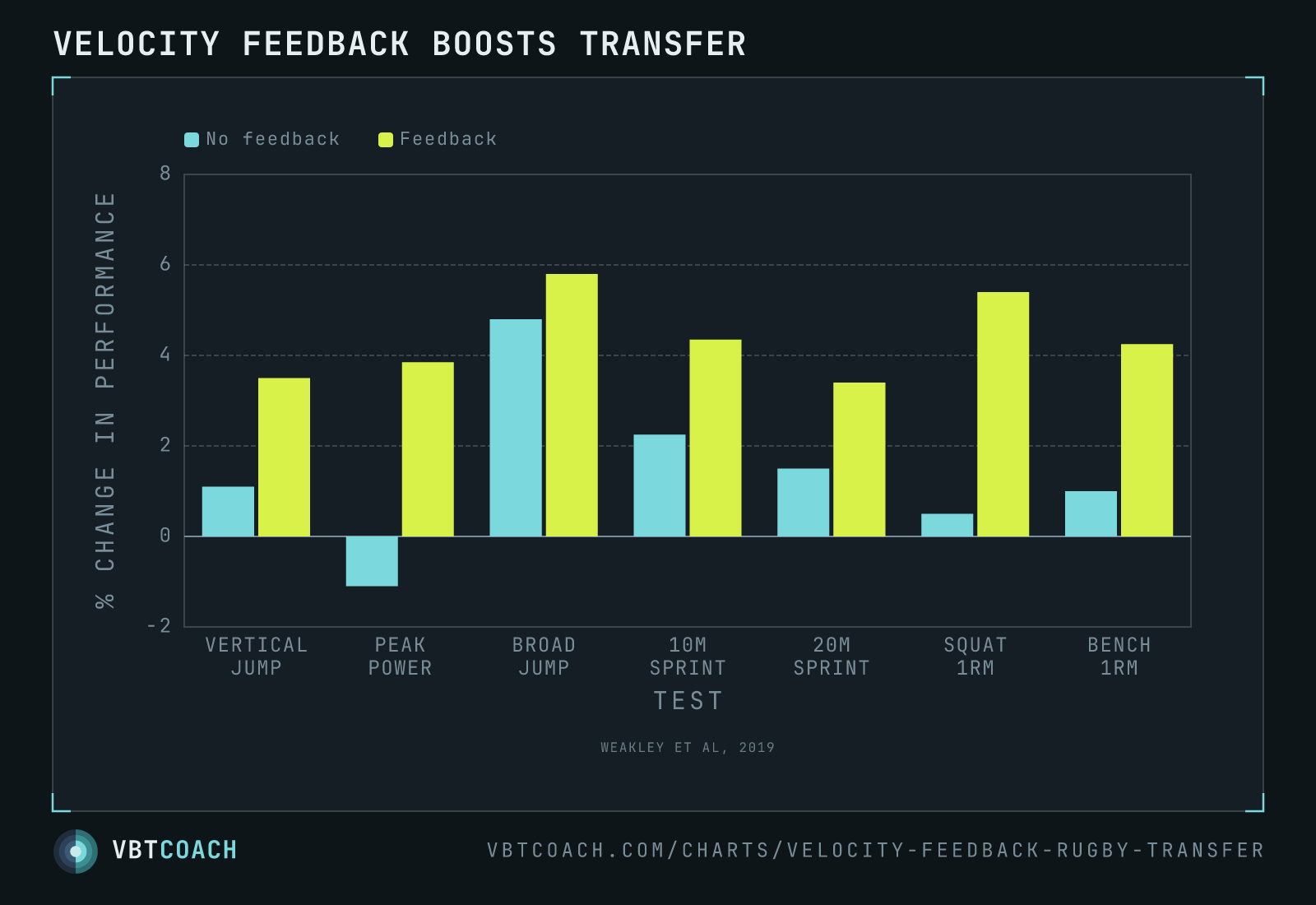
Weakley and colleagues ran a 4-week training study in elite rugby union players. Both groups did the same resistance-training program; one group received augmented velocity feedback after each rep, the other didn’t. The feedback group out-performed across all seven outcome measures — and the gap on peak power is the headline: the no-feedback group went backwards (-1.1 %), while the feedback group climbed +3.85 %.
How to read this chart
Seven outcomes across the bottom: vertical jump, peak power, broad jump, 10m sprint, 20m sprint, squat 3RM, bench 3RM. Navy bars are the no-feedback control; teal bars are the feedback group. The y-axis is percentage change in performance from baseline.
Every single category favours the feedback group. The biggest absolute gaps are on squat 3RM (5.4 % vs 0.5 %) and bench 3RM (4.25 % vs 1.0 %) — the strength outcomes, where higher per-rep intent translates directly into bigger gains. The broad-jump gap is small (5.8 % vs 4.8 %) but every outcome lands the same direction.
The peak-power loss in the no-feedback group is worth lingering on. Across a 4-week training block, well-coached athletes typically maintain or improve power. Going backwards on peak power without feedback suggests rep quality drifted across the block — the feedback group didn’t drift because the velocity number kept rep quality honest.
When to use this evidence
- Justifying velocity feedback in elite athlete environments. The Randell 2011 trial showed the effect in less-trained athletes; this trial replicates it in competitive rugby players.
- Programming for sport transfer. The breadth of outcomes — jumps, sprints, max strength — is the case for VBT-style feedback in season as well as off-season.
- Defending the device cost. Pro-team budgets often debate the per-athlete cost of velocity hardware. The peak-power finding alone — a 5 % swing across 4 weeks — easily justifies the spend.
Why feedback transfers so broadly
The mechanism isn’t sport-specific. Velocity feedback enforces maximum-intent reps. Maximum-intent reps train rate-of-force-development, which is the underlying neural quality that powers jumping, sprinting, and explosive lifting all at once. So when the chart shows gains across jumps, sprints, and 3RM strength, that’s not a coincidence — it’s the expected payoff of preserving intent across the entire training block.
Pitfalls
- 4-week trials are short. Effects this large in 4 weeks would partially regress over 12 weeks as both groups approached physiological ceilings. The direction is robust; the magnitudes shrink with longer interventions.
- Rugby cohort specifics. Pro rugby players are a high-effort population already; even larger effects might appear in less-experienced athletes (where there’s more “intent slack” to recover via feedback).
- One squad. This is a single-team intervention, not a multi-team controlled trial. The pattern aligns with the broader feedback literature — Randell, Keller, Weakley all point the same direction — but each individual study is one data point.
Where to go next
The companion velocity feedback transfer chart (Randell 2011) shows the same effect in a less-elite cohort. For the acute (within-session) version of the feedback effect, see the performance feedback chart (Keller 2014). The practical setup guide is Real-time feedback with VBT.
Download high res chart images
High-resolution PNG, 1600×1000, watermarked. Free to share, embed in slides, or print. Credit appreciated.