Keller 2015 — Augmented feedback beats verbal cueing on output and within-set fatigue
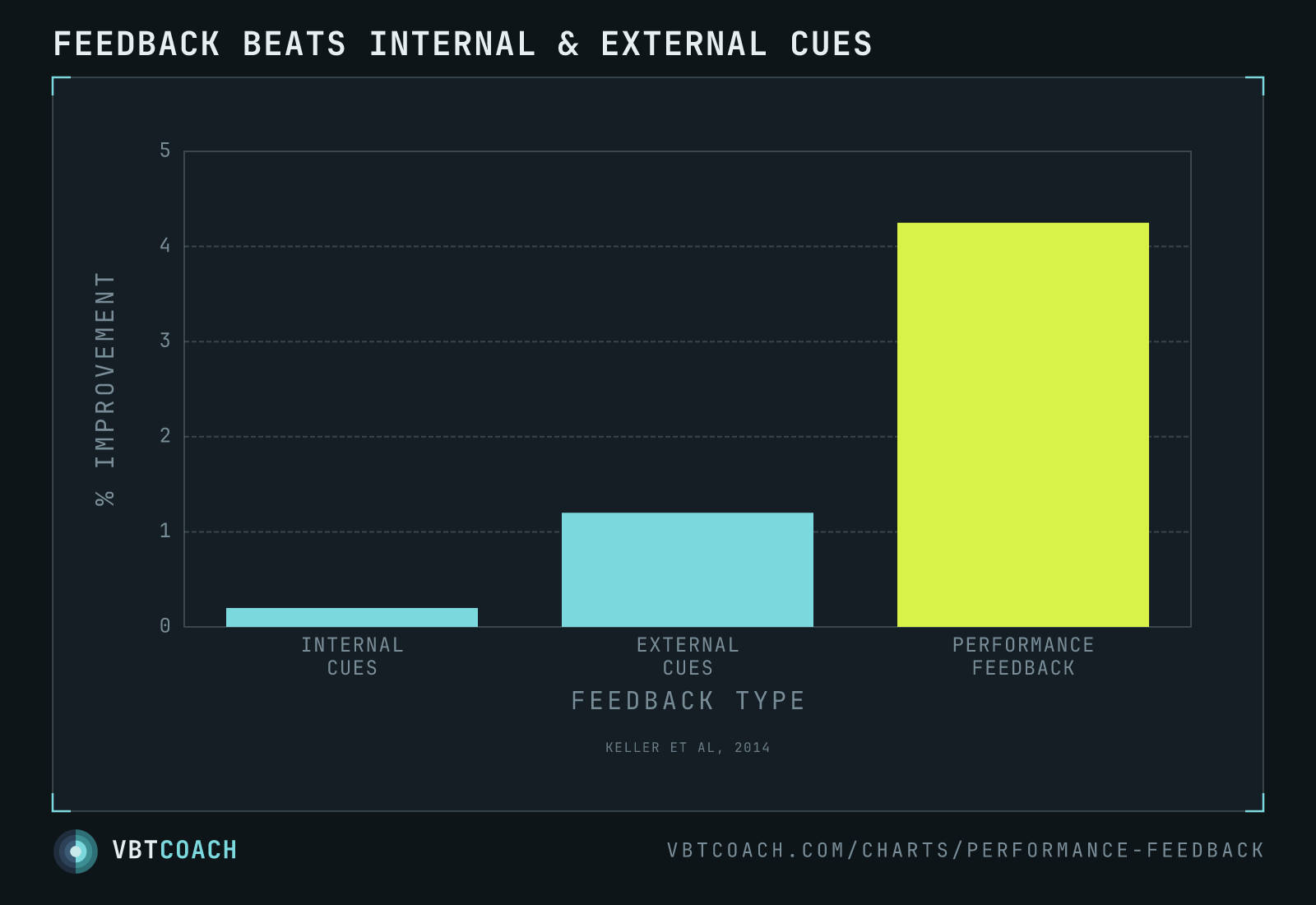
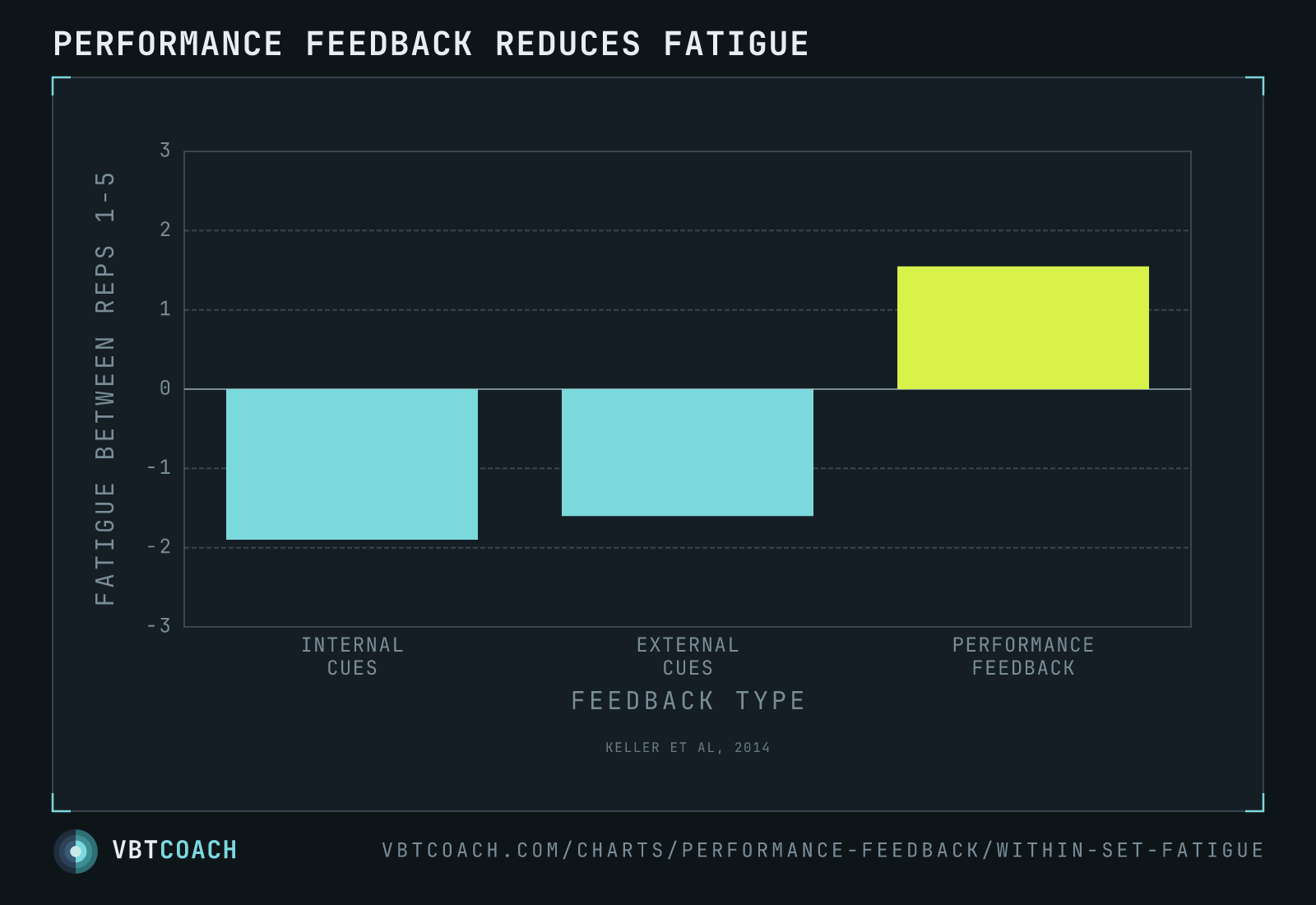
Keller 2015 measured two outcomes from the same three-condition study — acute jump output and within-set fatigue. Augmented feedback won both — ~4× more acute improvement than the best verbal cue, plus an inverted within-set fatigue curve.
Keller and colleagues ran a single-session study comparing three feedback conditions during jump training: internal-cue focus (“contract your quads”), external-cue focus (“drive the floor away”), and augmented performance feedback (the athlete sees their jump output number after each attempt). They measured two outcomes from the same protocol — acute output and within-set fatigue — and feedback won on both.
How to read this chart
Three feedback conditions across the bottom. Y-axis is percentage improvement in jump output across the session. The performance-feedback bar (4.25 %) towers over external cues (1.2 %) and internal cues (0.2 %). External cues edge out internal cues — replicating a long-standing motor-learning finding — but both are dwarfed by augmented feedback.
Why feedback wins on acute output
Verbal cues route through interpretation — the athlete has to translate the cue into intent into motor action. Augmented feedback collapses that loop. The number on the screen is direct, instant, and unambiguous: do better than that. The athlete tries harder on the next rep without needing to decode anything.
The “external > internal” finding (1.2 % vs 0.2 %) replicates Wulf’s broader motor-learning literature: when attention is directed outside the body (the bar, the floor, the target) movement is more efficient than when attention is directed inside it (your quads, your hip extensors). But neither cueing strategy approaches what visible output produces.
Feedback also flips the within-set fatigue curve
Same study, different metric — Keller also measured how performance changed across the first five reps of each set:
Bars below zero mean the athlete got worse across the set (normal fatigue). Bars above zero mean they got better. Internal cues at −1.68 % and external cues at −1.79 %: standard fatigue, near enough the same either way. Performance feedback at +1.60 %: an inverted curve — the athlete is putting up better numbers on rep 5 than rep 1.
Verbal cueing is set-and-forget — the cue is given before rep 1 and barely updates within the set. By rep 4, the athlete has heard “drive the floor” so many times the cue is background noise. Visible velocity feedback updates each rep. Rep 4 displays the actual number. The athlete sees that they’re slipping and pushes back; the next rep is faster than it would have been without feedback. Across five reps that compounds into the small but reproducible reversal you see in the chart.
When to use this evidence
- Justifying visible feedback in a session. Coaches often debate “internal vs external cueing” for years. This chart says: stop debating, and just show the athlete their output number after each rep.
- Spending budget on feedback hardware. A device that puts a number in front of the athlete after every rep produces measurably bigger acute-output gains than the best verbal coaching strategy.
- Programming high-intent sets. When the goal is power or velocity adaptation, the within-set fatigue curve is the enemy. Augmented feedback flattens or inverts it.
- Pairing with v-loss caps. Velocity-loss caps stop a set when bar speed drops past a threshold. Visible feedback delays when that drop happens, which means more productive reps before the cap kicks in.
Pitfalls
- Acute ≠ chronic. This study is a single session. Within-session output gain doesn’t always translate to multi-week training adaptation — though the same lab’s feedback-frequency adaptation chart (Keller 2014) shows it does, and dose-dependently. For the barbell-training version of the longitudinal story, see the velocity feedback transfer chart (Randell 2011) and the rugby cohort follow-up (Weakley 2019).
- Effort ceiling matters. If athletes are already maxed out on intent, feedback adds little. The wins are biggest where the lifter has room to improve effort.
- The number has to be honest. Garbage feedback — wrong velocity values, mis-timed display — is worse than no feedback. Pair the number with measurement quality the athlete can trust.
- 5-rep window only. The fatigue-flip finding is specific to short-set protocols. Across longer sets (10+ reps) fatigue eventually wins regardless of feedback — there’s a physiological floor.
- Lift-specific. Keller measured jumps; the effect should generalise to other ballistic / high-velocity work but is less established for grinding 1RM-adjacent strength sets.
- Feedback latency matters. A 2-second display delay still helps; a 10-second delay doesn’t. The signal has to land while the athlete is still preparing for the next rep.
Where to go next
For the longitudinal versions of this story, the same lab’s feedback-frequency adaptation chart (Keller 2014) shows the multi-week jump gains scale with feedback dose, while velocity feedback transfer (Randell 2011) and the rugby cohort version (Weakley 2019) show the same multi-week training effects under barbell work. The practical “set up real-time feedback in your gym” walkthrough is in Real-time feedback with VBT.
Download high res chart images
Every chart on this page as a high-resolution PNG — 2 exports, 1600×1000, watermarked. Free to share, embed in slides, or print. Credit appreciated.