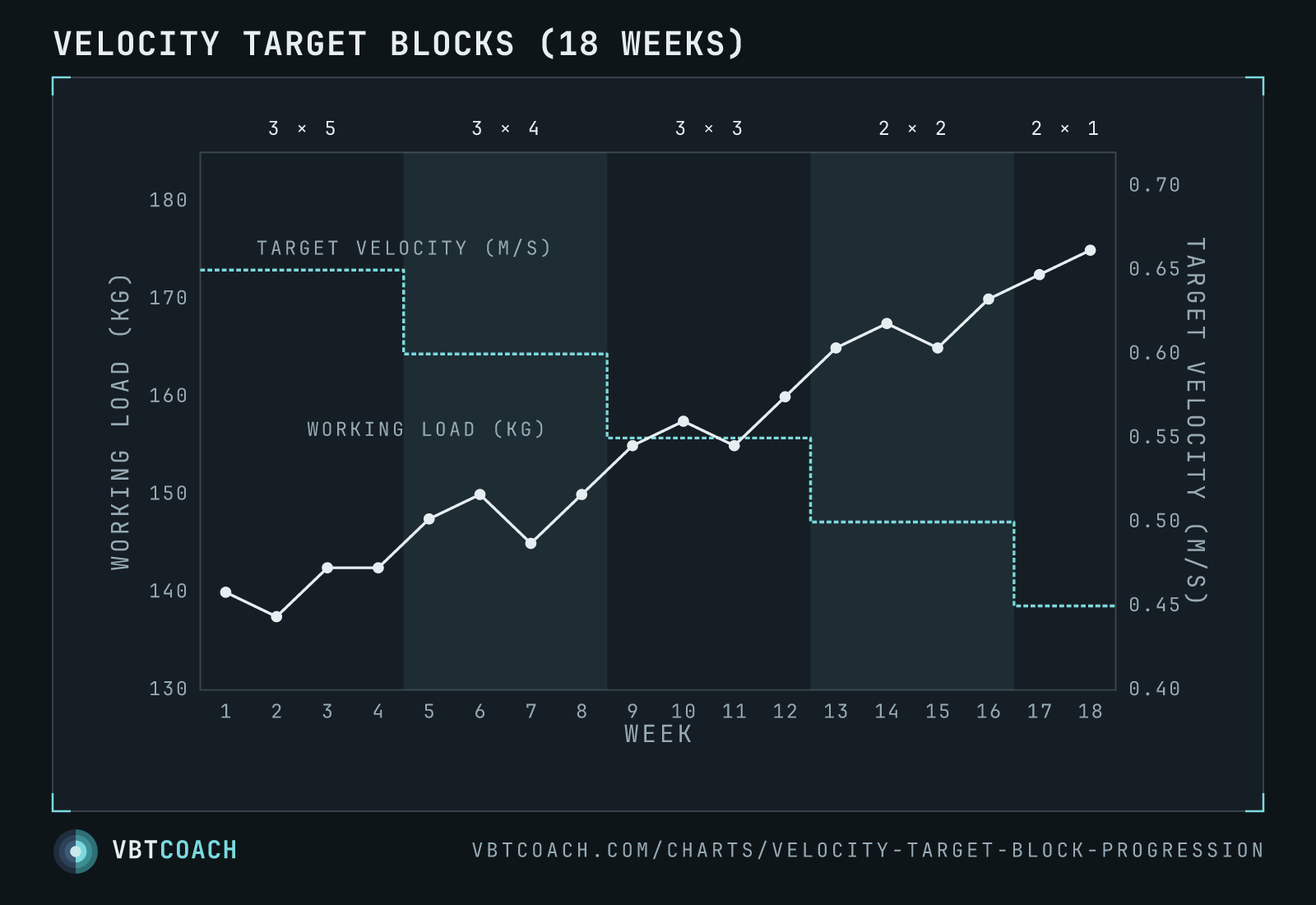
Velocity target block progression — 18 weeks of descending targets and rising loads
An 18-week strength cycle written entirely in bar speeds. The target velocity steps down once per block; the working load climbs — and wobbles — because it is read off the athlete's profile every session rather than prescribed.
Eighteen weeks of deadlifting, planned on day one, with the weight left open every single session. Two staircases running in opposite directions is the entire idea.
How to read this chart
Weeks along the bottom, and two axes doing different jobs:
- Dashed line, right axis — target velocity. Flat inside a block, stepping down 0.05 m/s between them: 0.65 → 0.60 → 0.55 → 0.50 → 0.45. This is the only thing written into the program.
- Solid line, left axis — working load. Never prescribed. Every point is a weight read off that day’s warmup profile at that block’s target.
The prescription across the top (3×5 → 3×4 → 3×3 → 4×2 → 3×1) is the other half of the plan. Volume comes down as the targets slow, so the cycle intensifies towards the peak without anyone planning the ramp.
What the two staircases show
Overload arrives twice. Inside a block the target is fixed, so any weight gained is adaptation — you got stronger at the same bar speed. Between blocks the target drops a notch, and the bar gets heavier at a stroke. Neither depends on you predicting your future strength.
The load line wobbles and the target line doesn’t. Four weeks go backwards — 2, 7, 11 and 15. Week 2 is the worked example: an exam week, poor sleep, slow warmups. The profile sat lower, the same 0.65 m/s target crossed it further left, and the athlete auto-deloaded 2.5 kg without a decision being made. Week 7 is a worse one, 5 kg down mid-block. Each time the next week recovers and carries on.
Four down weeks in eighteen is an ordinary cycle, not a bad one. A percentage-based plan would have prescribed the same weight regardless on all four, and either ground the athlete up or been abandoned somewhere around week 7.
The block gains look small; the finish doesn’t. Block one nets 2.5 kg. Boring — and it’s the wrong thing to look at. What isn’t on the chart is the missed sessions, the tweaked back and the bailed week that never happened. Eighteen weeks of uninterrupted training is what produces the 175 kg single at the end — a weight that was the athlete’s estimated max in week one.
Running it
- Blocks of 3–6 weeks. Four is a good default. Short enough to keep pushing at one target, long enough for the load to actually move.
- 0.05 m/s steps between blocks. Works for most lifters. Advanced, stronger athletes may need 0.02–0.03 m/s steps, because a 0.05 m/s drop is worth more kilos on a flatter profile.
- Recalibrate at each block start. Warm up as usual, then a primer single just above the last block’s working weight before the first slower-target sets.
- One change per re-run. Repeat it as written, or add a rep, or add a set, or shift every target down 0.03 m/s, or bolt a drop set at target +0.1 m/s onto the end. One of those — not four.
The linear alternative
Trade the steps for a ramp: drop the target ~0.02 m/s every week instead of 0.05 m/s every four, and the bar creeps heavier every session. It suits single-top-set work followed by drop sets, and it moves faster — but it gives up the thing blocks are good at, which is repeated exposure to one target so you can see whether you’re actually getting stronger at it.
Pitfalls
- The chart is an example, not a prescription. The loads shown belong to one lifter with a 175 kg e1RM. Yours resolve off your own profile.
- Don’t rescue a low week. Adding weight back because the number looks wrong deletes the only feature you were paying for.
- Targets are lift-specific. 0.65 m/s is a trapbar deadlift opener. Bench and conventional deadlift start nearer 0.55 m/s, rows and chins nearer 0.75 m/s.
- Five blocks is a long time at high intensity. The final block is optional and doubles as testing. Don’t run it back-to-back into another cycle without a break.
Where to go next
The daily mechanic each of these points comes from is on velocity target → today’s load. For where these loads sit on the load axis, see the VBTcoach 3-zone model, and for the rep-side autoregulation that pairs with it, velocity loss guidelines. Wider context on the programming topic page.
Download high res chart images
High-resolution PNG, 1600×1000, watermarked. Free to share, embed in slides, or print. Credit appreciated.