Best velocity-based training devices and apps — a buyer's guide
An independent comparison of every major VBT device — accuracy, price, pros, cons — plus the best VBT app for your phone. Updated 2026.
Updated May 2026: Welcome to the buyer’s guide. I keep this up to date with semi-regular passes as products launch, change, or pivot. The May 2026 refresh marks Metric on Android out of beta and public/stable, notes Perch’s acquisition by Catapult (now sold as Perch P2 under a hardware-as-a-service model), updates devices that have wound down (Beast, TrueRep, Push), and revises prices, capabilities, and validation links across the board.
If I got something wrong, or I left you off the list, get in touch: jacob@coreadvantage.com.au.
Introduction
Velocity based training (VBT) technology has evolved from Soviet sports science experiments in the 1950s to become an accessible training method for athletes of all levels. Thanks to pioneers like Dr. Bryan Mann (USA) and Dr. Dan Baker (Australia) in the 1990s and the invention of devices like the Tendo Unit, VBT has transformed from an elite sports technology to an affordable training tool available to everyone.
With numerous products now available across various price points, there’s never been a better time to incorporate velocity tracking into your training.
This guide serves coaches managing athlete groups, personal trainers with individual clients, powerlifters seeking competitive advantages, and any strength athlete wanting to implement data-driven training methods. Accurately monitoring and optimizing training through velocity feedback is quickly becoming standard practice at every level of strength and conditioning.
Disclosure: I co-founded Metric
Full disclosure: I co-founded Metric and work on it full-time across product, engineering, and sports science. We built Metric out of the Core Advantage High Performance Centre because nothing on the market suited our busy training flow and the ease of use was terrible. The existing devices were expensive, apps were hard to navigate, and none of them surfaced training data in a way that made it useful day-to-day. You’ll see me recommend Metric by name in a few places throughout this guide where the recommendation is honest — and you’ll see every other product treated on its actual merits and validation evidence, regardless of whether it competes with us. Products are grouped by category and listed alphabetically within each.
At a glance — every major VBT device compared
Every device with sustained presence in the market, ordered by category. Each name links to its full breakdown further down the page.
* Each brand below links to its full breakdown further down the page. The Power Coach column estimates the annual outlay for a coach running five hardware units plus the platform's coach / teams subscription sized for 50–100 athletes. Figures are estimates assembled from public pricing as of May 2026; tiers and bundled discounts vary — confirm with the vendor before budgeting.
| Brand | Type | iOS | Android | Free tier | Coach | Programming | Validation | Hardware $ | Subscription | Power Coach* |
|---|---|---|---|---|---|---|---|---|---|---|
 Metric Metric | App (Vision) | ✓ | ✓ | ✓ | ✓ | ✓ | ★★ | — | $65/yr | $500 |
 Eliteform Tracker Eliteform Tracker | App (Vision) | ✓ | ✗ | ✓ | ✗ | ✗ | ✗ | — | $60/yr | — |
 My Jump Lab My Jump Lab | App (Vision) | ✓ | ✓ | ✗ | ✗ | ✗ | ★★★ | — | $40/yr | — |
 QwikVBT QwikVBT | App (Vision) | ✓ | ✓ | ✓ | ✗ | ✗ | ★ | — | Free · $28 IAP | — |
 WL Analysis WL Analysis | App (Vision) | ✓ | ✓ | ✓ | ✗ | ✗ | ✗ | — | $9 one-off | — |
 Spleeft Spleeft | App (IMU) | ✓ | ✓ | ✗ | ✓ | ✓ | ✗ | — | $23–70/yr | $300 |
 ADR Encoder ADR Encoder | LPT | ✓ | ✓ | ✓ | ✓ | ✗ | ★★★ | $270 | Free | $1,350 |
 Flex Stronger Flex Stronger | Optical LPT | ✓ | ✓ | ✓ | ✗ | ✓ | ★★ | $495 | Free | $2,475 |
 Gymaware Gymaware | LPT | ✓ | ✓ | ✓ | ✓ | ✓ | ★★★ | $1,995 | $325–1,095/yr | $10,520 |
 RepOne Strength RepOne Strength | LPT | ✓ | ✓ | ✓ | ✓ | ✗ | ★★★ | $449 | Free · $999/yr | $3,245 |
 Tendo Tendo | LPT | ✓ | ✗ | ✗ | ✓ | ✗ | ★★★ | $1,499 | — | $7,495 |
 Vitruve Vitruve | LPT | ✓ | ✓ | ✓ | ✓ | ✓ | ★★★ | $447 | Bundled (Teams) | $3,500 |
 Enode Pro Enode Pro | IMU | ✓ | ✓ | ✓ | ✓ | ✓ | ★★★ | $329 | $500–2,050/yr | $2,660 |
 MoveFactorX MoveFactorX | IMU | ✓ | ✗ | ✓ | ✓ | ✗ | ✗ | $450 | Free | $2,250 |
 Output Output | IMU | ✓ | ✓ | ✗ | ✓ | ✓ | ★ | ~$500 | Contact sales | Contact sales |
 Remaker Remaker | IMU | ✓ | ✓ | ✓ | ✓ | ✓ | ✗ | $151 | $145/yr | $1,255 |
 Stance Fitness Stance Fitness | IMU | ✓ | ✗ | ✗ | ✗ | ✗ | ✗ | incl. | £60/yr launch | ~$750 |
 Eliteform (rack) Eliteform (rack) | Rack camera | — | — | ✗ | ✓ | ✓ | ★★★ | Custom | Custom | Custom |
 Perch Perch | Rack camera | ✓ | ✓ | ✗ | ✓ | ✓ | ★★★ | Bundled (HaaS) | Bundled (HaaS) | Bundled (HaaS) |
Download the comparison table
The full comparison as a high-resolution PNG (2000 px tall) — free to save, share, or embed in slides. Credit appreciated.
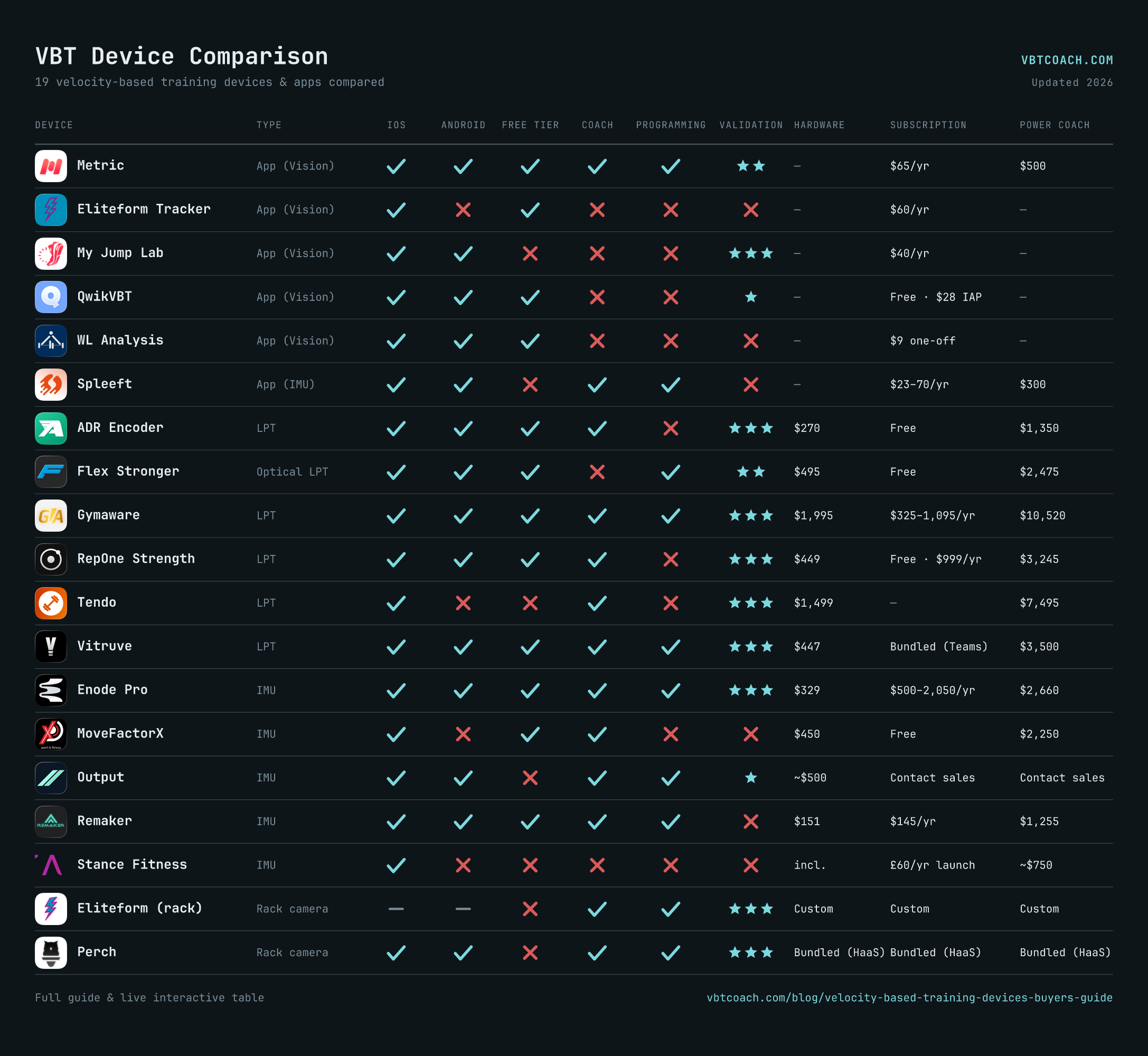
Finding the Right VBT Technology
There is no single “best” VBT device — the optimal choice depends on your training environment, exercise selection, specific requirements, budget constraints, and personal preferences. The best technology in one setting might be completely unsuitable for another.
For app-based solutions, I recommend trying several options during your training to find the best fit for your needs and flow. Many offer free trials or affordable monthly subscriptions, making experimentation practical. When considering hardware purchases, the information in this guide should help inform your decision, though manufacturer websites and community reviews can provide additional insights.
All prices listed are in USD (updated May 2026) and I picked annual prices where possible as these are always the most affordable and make for easier comparison.
How to choose a VBT device
Two things matter when picking a VBT tool: whether you’ll actually use it consistently, and whether the data you collect is reliable.
Consistency is what produces useful data over time. The best VBT system is the one you reach for every set without thinking about it. Hardware adds friction at every step — pairing, mounting, batteries, transporting devices, keeping track of who has what — and that friction is often the difference between accumulating months of useful data and giving up after a few weeks. A phone is already in your pocket and the athletes’ pockets. Open the app, set it down, lift.
Reliability across this category varies more than the marketing suggests. Validation findings are mixed across many of the apps and devices in this guide, so the published evidence matters.
How VBT Technology Works
To measure barbell velocity accurately, you need specialized technology designed specifically for tracking gym movements with precision. VBT technology tracks barbell movement using four primary methods: smartphone apps using computer vision to track movement via your phone’s camera; linear position transducers that physically attach to the barbell with a string; wearable accelerometers/IMUs that measure movement acceleration; and depth-sensing camera systems mounted to racks that track both barbell and body movement.
Each technology and supplier has their own unique approach to tracking bar speed, determining repetition start and end points, and calculating various metrics. Let’s examine each category in detail:
For simplicity, I have created four groups to categorise the available velocity based training technology.
- Smartphone velocity tracking apps
- Linear positional devices (string based)
- Accelerometers and IMUs
- Depth-sensing camera systems
Let’s go through each category
Phone based velocity tracking apps
This is the most diverse category, with dozens of apps available on both iOS and Android systems for tracking bar speed.
There is a lower barrier-of-entry developing a software product than a hardware product, so it is not surprising there are many options in this category!
Apple and Google include basic computer vision algorithms in their development frameworks, which makes it possible for even casual developers to build a handy rep tracking app on smartphones.
On the flip-side, at Metric we went fully custom and created a bespoke computer vision solution instead of using the Apple and Google frameworks to achieve the level of precision we believe is needed for useful velocity data.
So in the smartphone space there is a big mix of products which vary greatly in precision, and many options are not yet be scientifically validated. Additionally the features offered vary considerably based on maturity of the product and app specialisation.
Barbell velocity tracking apps, are by far the cheapest option for tracking velocity in the gym. Most apps are free to download, some are even completely free to use, while others require subscriptions ranging from $2-$20 a month for advanced features or at the end of a trial period — typical subscription app type offerings.
Linear positional transducers (LPT)
Also known as stringed or tethered bar speed trackers, LPTs are probably the most widely used device in velocity based training. Essentially, they are a box that sits on the floor below the barbell with a retractable tether which attaches to the barbell.
Some LPT products have in-built X-axis or 3D correction to account for curved bar paths or variable device placement, while others do not. This correction factor may impact reliability when device position changes relative to the barbell between training sessions.
Ranging from a few hundred to a few thousand dollar, LPTs have been commercially available the longest, with the Tendo Sports device being on the market since the 1990s. LPTs are largely reliable and well validated.
Accelerometers and IMUs
Accelerometers are typically a small wearable unit that can be attached to the body, barbell or wrist during training.
They use a range of gyroscope and accelerometer sensors (IMU - stands for inertial measurement unit) to measure the angle and acceleration of the device, from which they infer velocity and range of motion data during exercises.
IMUs are a more affordable hardware option costing in the low hundreds of dollars per unit. Findings on the validity and reliability of IMU devices is mixed, with many studies showing them to be both less reliable and less valid than LPTs and motion capture systems however this is heavily dependant on the application and hardware used.
Rack mounted depth sensing camera systems
Functioning by a similar principle to the Xbox Kinect unit (am I showing my age?), these boxes mount to a squat rack and measure the distance to the barbell or athlete, tracking velocity and range of motion during reps and feeding data back to a dedicated rack-mounted tablet.
Units can cost up to several thousand dollars each, plus annual software subscriptions, making them one of the most expensive options for velocity based training technology.
Systems in this category are growing in popularity at the college level as they reduce clutter on the gym floor (compared to LPTs) and can be rolled out at scale even with large cohorts of athletes. Rack mounted systems are well validated, showing better precision than IMUs and in some cases being comparable to LPT devices.
Barbell velocity tracking apps
Let’s start with smartphone velocity tracking apps. With dozens available, I picked a shortlist based on popularity, how long they have existed, and how frequently they are receiving updates in the App Store or Play Store. You will find an extended list of other apps below.
All apps in this section (with the exception of TrueRep, which requires a tracking puck) can be downloaded and used in your workout immediately, with either a free account, trial or low-cost subscription.
A note on validation and features: Smartphone apps move fast and are constantly being improved, as a result validation papers often lag behind the actual features and performance of the app in production. Also, high precision computer vision, camera resolution and smartphone processing speed has only reached a level that allows many of these apps to function as they do in the past ~7 years (since roughly the launch of the iPhone 11 and iOS 15 as a basic guide), making this category a rapidly evolving space.
Some of these apps I have not personally used so my knowledge on features may be missing or misattributed - if you produce one of these products, please get in touch so I can update the details so this guide stays accurate!
A note on the field of tracking apps as it stands today: tracking accuracy varies a lot, with mixed or no published validation for several of the apps below. Feature completeness also varies and will matter to you by different amounts depending on what you need from the tool (workout planner, video review/storage, profiling, 1RM estimation, coaching features, multi-athlete management etc). Development cadence is also an important factor for apps as apps can often decay over time due to support decreasing, so check the App Store / Play Store update history before committing to one.
Eliteform Tracker
Phone (CV)Eliteform Tracker is a barbell velocity tracking app from the same team that created the first rack mounted system — the Eliteform Powertracker. The app records velocity on 11 common barbell lifts at 30fps using the front-facing camera, surfaces four training metrics, and unlocks full training history with a subscription. There’s no video playback, no workout tracking features, and no profiling. Coach / team features live in a companion app: TeamSync, an iOS-only coach dashboard that pairs with the Tracker app — coaches upload rosters and 1RMs, athletes lift in Tracker, and TeamSync calculates loads from VBT zones and syncs sessions back for periodisation and progression tracking.
Website: www.eliteform.com ↗︎
Download: Eliteform Tracker (iOS only) ↗︎
Price: Free version with basic features. Monthly-only subscription at $4.99/mo for the full Tracker feature set. TeamSync is sold as a facility / team package — no public per-seat pricing; press coverage positions it as a “sub-$10K” VBT solution aimed at high-school and college budgets.
Equipment: iPhone X or newer. Tripod or stable object to position your phone for recording.
Validation: None found at time of writing.
Update 2026: Eliteform Tracker app last update was 15 July 2025, over ten months at the time of writing.
Metric
Phone (CV)Metric is built on a patented computer vision pipeline developed specifically for barbell tracking. It uses a purpose-built system rather than stitching on top of the generic CV frameworks that ship in iOS and Android SDKs. This approach is what makes the Metric tracking robust and accurate across phone angles, lighting conditions, and the full range of barbell and trapbar lifts.
The app records 60fps with HD video, requires no manual tracking target selection, and runs in real time while you lift. Video can also be imported from your camera roll for processing. Metric provides 13 rep-level metrics including mean/peak velocity, range of motion, tempo and power data. Bar path is directly embedded into video playback, real-time audible velocity and fatigue feedback, detailed analysis and progress/fatigue tracking, estimated 1RM, load–velocity profiling, video storage and sharing, and a full workout builder to log your training. Metric tracks velocity on over 60 barbell lifts and variations with the ability to create your own custom lifts as well. Metric has a free tier with unlimited workouts and sets plus Pro and coach subscriptions for extended features.
Website: www.metric.coach ↗︎
Download: Metric on iOS ↗︎ · Metric on Google Play ↗︎ (Android released to the Play Store in May 2026)
Price: Metric is free to use with unlimited sets with a basic account, Metric Pro provides more features, video storage and is available for $64.99 USD on an annual plan. Family and Coach plans are also available directly in the app.
Equipment: iPhone 11 or newer running iOS 18.6+, or a recent Android phone (Android 12+ on a flagship handset is the supported target). Tripod or stable object to position your phone for recording. Also supports newer iPad models. Full list of supported devices ↗︎
Validation: Metric found to be valid and reliable against both lab-grade 3D motion systems and against other commercially available LPT hardware.
My Jump Lab
Phone (CV)Developed by Dr. Carlos Balsalobre from Spain, My Jump Lab is a comprehensive jump, bar speed and physical performance testing app. The app uses your smartphone’s camera to measure jump height, barbell velocity, range of motion and much more providing instant feedback and analysis on a number of gym based movements and activities. My jump also allows for video playback and review.
My Jump Lab has both jump testing and barbell velocity tracking features. Most published independent validation research is dominated by countermovement-jump and drop-jump work against force plates and OptoJump where it performs strongly.
For barbell velocity validation, the only independent paper (Renner et al., PLOS One 2024) tested My Jump Lab against RepOne and Vicon across squat, bench, and deadlift and found it “substantially worse”. It missed ~30% of reps overall, and 84% on bench.
*The VBT features in My Jump Lab has also been known previously as MyLift and PowerLift
**Previous versions of the PowerLift app required manual selection of the start & stop frames after recording along with manual entry of the range of motion in order to get velocity data - the newest version of My Jump Lab now offers more automatic VBT tracking.
Website: www.carlos-balsalobre.com ↗︎
Download: My Jump Lab on iOS ↗︎ · My Jump Lab on Google Play ↗︎ (both published by Carlos Balsalobre)
Price: Solo subscription only — $5.99/mo, $39.99/yr, or $105.99 lifetime. There’s no separate coach / team tier; the in-app multi-profile feature lets a coach test multiple athletes under one paid account.
Equipment: Smartphone with a camera, tripod or stable object for phone placement
Validation: Well validated and researched. It is worth nothing that many validations of the app are authored by the My Jump Lab owner and creator Carlos Balsalobre a sports scientist and researcher. These have been peer reviewed.
- My Jump Lab Vs Gymaware LPT, Carlos Balsalobre, 2023
- MyJump vs 3D motion capture, Carlos Balsalobre, 2020
- Reproducibility of 5 different technologies to measure bar speed Javier Courel-Iba, 2019
- A letter response from Carlos regarding the above external validation
- A reply from the original authors regarding the above study critique
QwikVBT
Phone (CV)QwikVBT is a passion project of a single developer out of Vienna, Austria. It processes videos (recorded in-app or imported from your camera roll) through a computer vision tracking system to measure barbell velocity across a wide range of lifting movements. QwikVBT does not provide real-time feedback, and the workflow is deliberately simple — single-set recording or import only, with no workout planning, programming, or athlete-roster features. That puts it firmly in the basic-tool bucket alongside WL Analysis, useful for spot-checking velocity on individual sets rather than running a full session.
The app employs a plate-tagging system where users manually mark the weight plates for tracking in each video. The extra step gives QwikVBT reliable rep detection and good accuracy. Outputs include mean and peak velocity, range of motion, pause metrics, and video playback / storage with RPE logging.
Website: www.qwik-vbt.com ↗︎
Download: QwikVBT on Android ↗︎ or on iOS ↗︎
Price: Free to use, with a one-off $27.99 in-app purchase for premium features (extra storage, exports).
Equipment: iPhone or Android device
Validation: One independent peer-reviewed validation study has been published — Renner, Mitter & Baca (2024, PLOS One) — which is itself a head-to-head: it compared QwikVBT, Metric, and MyLift against RepOne and Vicon across squat, bench, and deadlift. QwikVBT performed well in that comparison.
Spleeft
Phone IMUA cross-platform iOS / Android / Apple Watch app that uses the device’s onboard IMU (accelerometer + gyroscope) rather than the camera — attach the device to the barbell or athlete and Spleeft infers velocity and range of motion from motion sensor data. The recent versions add a coach side, athlete management, and workout planning via a TrainingPeaks API integration (rather than a native planner inside Spleeft itself), pushing Spleeft toward a fuller platform but leaning on TrainingPeaks for the programming layer.
Website: www.spleeft.app ↗︎
Download: Spleeft on Android ↗︎ or on iOS ↗︎
Price: Tiered annual plans roughly $23 (PRO, solo athlete) through to $70 (Elite Coach). Apple Watch extension and some advanced features are paid extras.
Equipment: Smartphone with a camera, tripod or stable object for phone placement - Apple Watch optional
Validation: No independent peer-reviewed validation of Spleeft has been published to date. The “validation” links on Spleeft’s own site are all authored by the app’s founder Iván De Lucas-Rogero, which is a conflict that should weigh on how you read them. The frequently-cited Achermann 2023 Apple Watch barbell velocity paper does not validate Spleeft — it used a different data-capture app (Sensorlog). Treat Spleeft as unvalidated by independent research until that changes.
- Achermann et al. — Apple Watch is a valid tool to measure barbell velocity (Sports, MDPI, 2023) — independent, but uses Sensorlog, not Spleeft
WL Analysis
Phone (CV)WL Analysis is a focused app designed specifically for Olympic weightlifting with a focus on video review and bar path analysis. The app uses your smartphone’s camera to measure bar velocity during snatch and clean and jerk exercises, providing real-time feedback and post-set analysis. Like QwikVBT, it’s a single-set, single-clip tool — no workout planner, no programming, no athlete roster — which puts both apps in the basic-tool bucket for VBT shoppers who want a velocity reading on a clip rather than a full training platform.
Website: www.wlanalysis.com ↗︎
Download: WL Analysis Android ↗︎ or on iOS ↗︎
Price: Free version available with basic features and limited sets, $8.99 one-time payment for ongoing use and more video storage in app.
Equipment: Smartphone, tripod or stable object for phone placement.
Validation: None found at time of writing.
Other bar speed tracking apps
There are many other velocity based training apps on both iOS and Android, a quick search for “Velocity based training”, “Barbell tracking”, “Bar speed” and “Bar path” provided me with the following short list.
BarSense, DeepBarbell, Iron Path, Keelo Lift, RepSpeed, VBTFit just to name a few. Many of these have not had updates for 12+ months and have limited feature sets - be sure to check release cadence and website/socials for how well supported an application is before commiting.
Tethered LPT devices
This section contains velocity tracking products that require the purchase or lease of a physical hardware device, which then transmits data back to a smart device via Bluetooth. I have broken the device options into three categories; stringed devices (LPTs), IMU wearable units, and rack mounted depth sensing camera systems.
All prices I was able to find are in USD and accurate as of May 2026.
This article is a great resource linking to a meta-analysis of the state of VBT device validation and reliability.
First lets look at Linear Positional Transducers.
Flex Stronger
Optical LPTFrom the same company that produces the Gymaware, Flex Stronger is a linear positional device with a twist. Instead of a physical string attached to the barbell, Flex attaches magnetically to the cuff of the barbell and uses an array of optical lasers to measure the distance to a reflective mat on the ground. The app provides velocity, range of motion, real-time feedback, bar path, and a Workout Builder for programming sessions, with video recordable alongside data.
Website: www.flexstronger.com ↗︎
Price: $495 per unit, Flex Stronger personal app account is free to use.
Equipment: Flex unit, reflective mat to position under the unit (included), smart device running the Flex app.
Validation: Mixed. Two clean positives — Weakley 2020 establishes criterion validity vs 3D motion capture on back squat and bench press, and the 2025 PLOS One systematic review of VBT devices lists Flex as one of five devices meeting all validity criteria. The caveat is Fritschi 2021, which ranked Flex 4th of 5 devices tested, found it struggled with high velocities, and recorded the highest missed-rep share of any device in the comparison. Validated scope is also narrow — squat and bench, sub-maximal to 90% 1RM, mean velocity only.
- Weakley — Criterion Validity, and Interunit and Between-Day Reliability of the FLEX (JSCR, 2020)
- Fritschi — Validity and Effects of Placement of Velocity-Based Training Devices (Sports MDPI, 2021)
- Pueo et al. — Multi-layered systematic review of VBT devices (PLOS One, 2025)
Gymaware
LPTGymaware is a linear positional device from Kinetic Performance a company based in Canberra, Australia. One of the most widely used devices on the market, Gymaware units are known for their durability, reliability and precision thanks to its X-axis correction system and high quality hardware. Having been available for over two decades the Gymaware has more validation than just about any other solution.
The device connects via Bluetooth to an iOS or Android device and provides rich velocity based training features both in-app and on the web-dashboard (subscription required for dashboard access, athlete accounts and data storage).
Website: www.gymaware.com ↗︎
Price: $1,995 per unit for GymAware RS. Cloud subscription ranges from $325/yr (Cloud Essentials) through $1,095/yr (Cloud Premium) depending on athlete count and feature tier. The individual GymAware app is free for solo athletes with a unit.
Equipment: Gymaware unit, weight plate to keep unit in position, smart device running Gymaware app. Cloud dashboard is accessed on laptop from a web browser.
Validation: Lots, and almost universally very strong. While 3D motion capture is the actual “Gold Standard” and true measure of validity for tracking movement speed, Gymaware is one of the leading products for precision of velocity data accuracy when recording velocity outside the lab environment.
- Validity and Effects of Placement of Velocity-Based Training Devices, Fritschi, 2021
- The Reliability and Validity of Current Technologies for Measuring Barbell Velocity, Thompson, 2020
RepOne Strength
LPTRepOne is a linear positional transducer and software company out of the United States.
RepOne started as an open source project called OpenBarbell, providing the files and instructions to 3D print and build your own device (something I tried and almost succeeded in doing!). RepOne recently added a connected devices feature adding FlyWheel training measurement to its offering. While they have advertised the addition of a 3D motion correction system to account for device position and bar path in a future firmware update this has still not been added.
Website: www.reponestrength.com ↗
Price: $449 for a RepOne unit. Individual athlete app is free; coach / team workflows live in StrengthOS at ~$999/year per organisation.
Equipment: RepOne unit, weight plate to keep unit in position, smart device running the RepOne app
Validation: Multiple positive independent findings.
Tendo
LPTTendo has been around since 1993. The first of it’s kind Tendo is the Kleenex of velocity based training, a universal term for all bar speed tracking technology. The device provides real-time velocity feedback through a physical readout unit that attaches to the stringed unit. Tendo now produces a second cheaper product called MyUnit which transmits data to a smartphone app instead of the physical readout.
Website: www.tendosport.com ↗︎
Price: $1,499 for the Tendo Unit, $1,196 for Tendo MyUnit.
Equipment: Tendo unit with readout monitor. iPhone for data readout if using a MyUnit (the MyUnit app is iOS-only). Bluetooth and data cable connectors and extensions sold as optional extras.
Validation: Well validated and consistently found to be accurate.
Vitruve
LPTVitruve (formerly Speed4Lifts is a linear positional device out of Spain. The device and app provides detailed feedback on a number of metrics (including mean propulsive velocity), estimated 1RM scores, progress tracking, real time feedback.
Vitruve units do not have X-axis correction, meaning device positioning and bar path may impact data consistency. Vitruve also enables video recording alongside data collection but does not have a bar path feature. Vitruve Builder (their workout planner) and an AI workout generator now ship as part of the Teams plans, putting Vitruve squarely in the programming-platform tier alongside Gymaware, Metric, Perch, and Output.
Website: www.vitruve.fit ↗︎
Price: $447 for a Vitruve unit. Individual app is free. Coach and team workflows are bundled into Teams plans — Teams Basic from ~$620/yr, Elite ~$772/yr, Pro ~$1,251/yr.
Equipment: Vitruve unit, weight plate to keep unit in position, smart device running the Vitruve app
Validation: Well validated and researched. I could not find evidence for or against device placement effecting reliability (The negative effects of not having X axis correction are unproven)
ADR Encoder
LPTThe ADR Encoder is a cabled linear position transducer out of Spain, pitched as the most affordable scientifically-validated encoder on the market. It attaches to the bar and reports mean and mean propulsive velocity, with load–velocity profiling, estimated 1RM, and strength testing in the free companion app.
The hook is the pricing model: a one-off hardware cost with a genuinely free app — no subscription, lifetime updates, and unlimited athlete profiles for coaches and teams at no extra cost. There’s no built-in workout planner or programming layer, so it sits in the measurement-tool tier rather than the programming-platform tier (Gymaware, Vitruve, Enode, Metric).
Website: www.adrencoder.com ↗︎
Price: €249 (~$270) for the encoder. The ADR System app is free on iOS and Android with no subscription, and coach / multi-athlete management is included at no cost.
Equipment: ADR encoder unit, a weight plate or anchor to hold it in position, and a smart device running the ADR System app.
Validation: Genuinely independent and well-validated — I checked the studies behind the marketing. At least three peer-reviewed papers from separate university groups (Granada, Universidad Europea de Madrid, Murcia, among others), none vendor-authored, several with explicit no-conflict-of-interest declarations. They find the encoder reliable and valid for barbell mean velocity. The one caveat the marketing skips: it systematically underestimates mean propulsive velocity against a T-Force — reliable and well-correlated, but not perfectly interchangeable with a gold-standard reference. Strong credentials for a budget unit.
- The ADR Encoder is a reliable and valid device to measure barbell mean velocity during the Smith machine bench press, Pérez-Castilla et al., 2024
- Validity and reliability of a new low-cost linear position transducer to measure mean propulsive velocity: the ADR device, Lopez-Torres et al., 2025
- Level of agreement and reliability of the ADR encoder to monitor mean propulsive velocity during the bench press, Moreno-Villanueva et al., 2024
Other LPT devices
The list above is not exhaustive, there are many more LPT devices on the market. Barbell Mate, Chronojump, Ergonauta, T-Force to name a few.
Accelerometer & IMU units (wearables):
Enode Pro
IMUEnode Pro, formerly VMaxPro, is an accelerometer unit out of Germany that attaches to the barbell and measures velocity and power output. The device provides real-time feedback, detailed performance data, video recording, and bar path analysis. The app now also ships workout templates and an AI-assisted program builder, so programming and tracking sit in the same place. Enode units have flywheel training functionality, sell a version embedded in an Eleiko bar, and recently announced Enode One — an Apple Watch–based accelerometer product.
Website: www.enode.ai ↗︎
Price: $329 per unit. Individual app is free. Team / coach subscriptions: Trainer ~$500/yr, Team ~$1,015/yr, Enterprise from $2,050/yr.
Equipment: Enode unit, smart device to connect
Validation: Like all IMUs Enode has mixed findings and is not as strong as LPTs, however, most validation studies find it superior to Push and conclude it to be valid and useful.
- Validity and Reliability of the VMaxPro Sensor for Movement Velocity, Feuerbacher, 2023
- VMaxPro sensor for assessing velocity and load-velocity variables, Dragutinovic, 2024
- Validity and Reliability of the VmaxPro IMU for back squat exercise, Olaya-Cuarter, 2022
MoveFactorX
IMUMoveFactorX, formerly the Bar Sensei & assess 2 perform (A2P), is a wearable accelerometer device out of the United States that measures velocity, acceleration, power and more for barbell and bodyweight movements. The device provides real-time feedback, detailed analysis and more via it’s free iOS app.
The company behind MoveFactorX also produces an accelerometer enabled medicine ball called the Ballistic Ball.
Website: www.movefactorx.com ↗︎
Price: $450 for an MFX Sport unit, $545 for the Ballistic Ball, software is free (iOS only).
Equipment: MoveFactorX unit or Ballistic Ball, smart device to connect
Validation: No positive validation. The two papers on the predecessor (Bar Sensei / Assess2Perform) both returned negative findings on validity and reliability, and I could not find any peer-reviewed work on MoveFactorX itself since the rebrand.
- Beckham — Reliability and Criterion Validity of the Assess2Perform Bar Sensei (Sports, MDPI, 2019) — negative findings
- Thompson — Reliability and Validity of Current Technologies for Measuring Barbell Velocity (Sports, MDPI, 2020) — negative findings for Bar Sensei
Output
IMUOutput is a small accelerometer unit from a team out of Ireland, designed as a multi-purpose testing and measurement platform — VBT, DSI, sprint, jump, and a range of other strength and power tests. The companion app now also includes full program design tools, putting Output closer to a complete athlete management platform.
Price: Sensors now available for outright purchase at ~$500 each, alongside the original team subscription model (still demo-gated, contact for pricing).
Equipment: Output unit, smart device to connect (iOS or Android)
Website: www.outputsports.com ↗︎
Validation: Strong validation in some general performance tests but, for VBT specifically, the evidence is poor. The one direct VBT validation paper (Merrigan 2022) found high systematic bias and wide limits of agreement, with the authors explicitly warning that “researchers and practitioners are advised not to compare velocity estimates of the OUTPUT unit with criterion devices because these methods cannot be used interchangeably.” Reliability also degrades meaningfully at 85% 1RM — exactly where VBT-driven 1RM prediction and last-rep cut-offs matter most. The 2025 PLOS One systematic review of VBT devices did not include Output in its passing list.
- Merrigan & Martin — Is the OUTPUT Sports Unit Reliable and Valid? (JSCR, 2022)
- Pueo et al. — Multi-layered systematic review of VBT devices (PLOS One, 2025)
Remaker
IMU + strainA newer accelerometer and strain gauge from the UK. Remaker has two hardware products — the Remaker Link (a strain gauge for measuring tension, e.g. IMTP on a cable / chain) and the Remaker Move (an accelerometer wearable that attaches to the bar or body). The platform now includes a free tier, an Operator License for coaches running multiple athletes, and AI-assisted program design, so Remaker is competing as a full platform rather than just a sensor.
Website: www.remaker.co.uk ↗︎
Price: $150USD for the Remaker Move and $190USD for an annual solo athlete subscription
Equipment: Accelerometer unit that attaches to the barbell or body
Validation: None to date that I could find
Stance Fitness
IMUStance is a new accelerometer / wearable out of the UK with a distinct purple UI and features such as sticking-point detection aimed squarely at powerlifting. The iOS app has launched and is shipping as of 2026; the Android app is still pre-launch, targeted for mid-2026.
Website: www.stancefitness.co ↗︎
Price: Hardware ships with the subscription. Launch pricing of £60 for the first year, then £120/year ongoing — Stance dropped the original monthly tier.
Equipment: Accelerometer unit that attaches to the barbell or body
Validation: None to date (device is still in a pre-launch)
Rack Mounted Camera Systems
Finally, let’s look into rack mounted camera systems. There are two products I know of in this space, that dominate the College space.
Eliteform (rack)
Rack cameraFirst patented in 2012, Eliteform was the first rack-mounted depth sensing camera system that measures barbell velocity and power output using an external camera system.
Eliteform software provides athlete profiles, workout logging, velocity target setting, real-time feedback and much more.
Website: www.eliteform.com ↗︎
Price: Not listed on the website, setup, hardware, and software subscription costs.
Equipment: Eliteform camera system and rack mounting hardware, dedicated tablets to connect and display data
Validation: Mixed. Mostly strong validation, however on some explosive lifts it struggled.
- Reliability and validity of the ‘Elite Form’ 3D motion capturing system, Mosey, 2018
- VALIDATION OF A 3-DIMENSIONAL VIDEO MOTION CAPTURE SYSTEM, Fry, 2013
- Validity and reliability assessment of 3-D camera-based capture barbell velocity tracking device, Tomasevicz, 2019
Perch
Rack cameraPerch is a rack-mounted depth-sensing camera system that measures barbell velocity and power output. The system provides real-time feedback, lets users set velocity-based training targets, estimates 1RM, tracks bodyweight movements such as jumps, and ships with a full set of coach and team features in its integrated software. In June 2025 Perch was acquired by Catapult, the Australian elite-sport analytics company, and the unit is now sold as Perch P2 under Catapult’s hardware-as-a-service (HaaS) model — hardware, software, and support bundled into a single annual program rather than line-itemed.
Website: www.perch.fit ↗︎
Price: Bundled hardware-as-a-service through Catapult — no public list price. Pricing scales with athlete numbers and rack count; contact Catapult for a quote.
Equipment: Perch camera system, rack mounting hardware, tablet to run software.
Validation: Now well validated, with multiple positive independent findings plus inclusion in the 2025 PLOS One systematic review of VBT devices as one of the few that passes all criteria.
- Weakley — Criterion validity and between-day reliability of the Perch for measuring barbell velocity (JSCR, 2023)
- Pueo et al. — Multi-layered systematic review of VBT devices (PLOS One, 2025)
Archived products
A handful of products that show up in older VBT guides — and might still surface in a search — have since been discontinued, acquired, or quietly abandoned. They’re collected here so this guide stays a complete record. None are a current buy.
TrueRep VBT (phone + puck, wound down)
TrueRep VBT was a phone-plus-puck hybrid: computer vision on the iPhone tracked a green magnetic puck attached to the bar (or any implement) to measure bar speed, with real-time audible feedback, bar path, video recording, and velocity targets. Its developers (Ozark Apps) have since wound down active development and moved on to LiftLab, a collaboration with Chris Duffin (formerly of Kabuki Strength). The website and its sign-up flow still appear to work, but the iOS app hasn’t been updated since 2024 and there’s been no social presence for years — treat it as effectively archived rather than an actively supported product.
Website: www.truerep.app ↗︎
Beast Sensor (IMU, defunct)
Beast was a wearable accelerometer device out of Italy that measured barbell velocity with a small magnetic IMU unit. The Beast sensor struggled with poor validation findings and while their website is still up, the Android app was last updated in 2018, the iOS app seems to be no longer available, and all products are listed as sold out. It is my assumption that the product and company is no longer in operation.
Website: www.thisisbeast.com ↗︎
Validation: Performed poorly in a number of reliability and validation studies.
- Reliability of Seven Devices for the Assessment of Movement Velocity, Castilla, 2019
- The Reliability and Validity of Current Technologies for Measuring Barbell Velocity, Thompson, 2020
Push Band (IMU, acquired by WHOOP)
For a long time, the Push Band from a Canadian sports tech company was the dominant option for VBT accelerometers. A compact unit with options to attach to the barbell or body, Push was used at all levels and very popular in High School S&C & CrossFit training. In September 2021, Push was acquired by Whoop with the plan to integrate the technology into the Whoop 4.0 band (as of writing Whoop does not offer velocity tracking in its workout builder). The Push portal is still online for existing customers, but Push Bands are no longer available for purchase.
Website: Announcement of the acquisition ↗︎
Validation: Historically poor validity and reliability results.
- Validity and Effects of Placement of Velocity-Based Training Devices, Fritschi, 2021
- Reliability of Seven Devices for the Assessment of Movement Velocity, Castilla, 2019
- The Reliability and Validity of Current Technologies for Measuring Barbell Velocity, Thompson, 2020
Finding the right VBT device for you
Velocity-based training used to mean $1,500 of hardware, strings on all your bars, and thousands of dollars for ugly cloud platforms that forced you to do all the heavy lifting to analyse your team’s training data. Today there are dozens of options across phone apps, IMUs, LPTs, and rack-mounted systems — at every budget from free to tens of thousands of dollars in setup and software costs.
My recommendation: start with the Metric app. It’s free, runs on any recent iPhone or Android, gives you unlimited sets, tracks 60+ exercises (and custom lifts), and ships with video playback, bar path tracking, a full workout planner, and 1RM estimation. It’s one of the few phone apps with independent peer-reviewed validation. All on the free tier.
Given how much computer vision and smartphone processing power has progressed in the past five years, you’ll be blown away by how good the results are.