Warm-up calculator — the perfect ramp to your 1RM, working set, or PR
Free warm-up calculator. Enter a target weight, get a research-backed ramp set by set. Built for powerlifters, S&C coaches and serious lifters.
Read more ↓| Set | Weight | Reps | Note |
|---|---|---|---|
| Enter your PR or 1RM attempt weight to generate the ramp. | |||
Free warm-up calculator. Enter a target weight, get a research-backed ramp set by set. Built for powerlifters, S&C coaches and serious lifters.
Velocity Based Training for Powerlifting
Tell the calculator the weight of your PR or 1RM attempt, and it builds a clean ramp: progressively heavier sets at descending rep counts, finishing with a primer single before the attempt itself.
How to use it
- Enter your attempt weight in the calculator above.
- Choose how you want to ramp:
- By plates — natural plate progression. Add the largest plate you stock per side (25 kg or 20 kg) until you’re close to the attempt; smaller plates refine from there.
- By count — pick a fixed number of warm-up sets (4, 5, or 6) and the ramp builds percentages for you, rounded to nearest 10 kg.
- Read the ramp top-to-bottom. The last warm-up set is your primer single (~92 % of attempt) — treat it like an attempt rehearsal.
The principle behind a good warmup
A warmup is a ramp, not a workout. Its job is to wake up the nervous system, dial in technique, and prepare the connective tissue for the loads about to land, without taxing the energy system that needs to power the working sets.
The ratio that matters: rep count and load move in opposite directions. As the bar gets heavier, reps drop. By the time you’re within 10% of your top set, you’re doing singles or doubles — practising the movement at near-target intensity without spending the muscle endurance you need on the work itself. Get this ratio wrong (too many reps near the top of the ramp) and you arrive at the first working set already tired; get it right and the working set feels like the warmup just kept going.
The 2017 NSCA position stand on resistance training warm-ups (Fradkin et al.) and Krzysztofik & Wilk’s 2020 review on post-activation performance enhancement both land in roughly the same place: a structured, ascending ramp outperforms either no warmup or a generic bodyweight one for any compound lift over ~60% of 1RM.
Adjusting for fatigue and readiness
Warmups double as a readiness check. Pay attention to how the third or fourth set feels:
- Snappy and fast. Bar speed feels normal or a touch above. Continue as planned, possibly nudge the working set up.
- Heavier than expected. Bar feels grindy at a load that usually flies. You’re under-recovered. Don’t push the working set; cap velocity loss tighter, or hold load and pull back volume.
- Off-center or unstable. Technical wobble at submaximal loads is a stronger signal than perceived heaviness. Add an extra warmup set or two and use them as technique rehearsal.
If you track velocity, this stops being subjective — the ramp velocities tell you whether today’s loads will be slower or faster than usual against your standard load–velocity profile.
Warming up for a 1RM or PR attempt
A max-attempt ramp is its own animal. The stakes are higher, the fatigue cost of a wrong move is higher, and the technical primer matters more than on an everyday session.
Key differences from an everyday ramp:
- More warmup sets, smaller jumps near the top. Add 1–2 sets between 85% and the attempt — singles or doubles at 90% and 95% rather than jumping straight from 85% to attempt weight.
- Long rest at the top of the ramp. 3–5 minutes between the last warmup single and the attempt itself. The CNS needs the recovery; you’ll see this in bar speed if you’re tracking.
- A technical primer single. A clean single at ~85–90% does more for nerve activation than another submaximal triple. Treat it like an attempt rehearsal.
- Cap the volume of light work. Do fewer reps in the early ramp, not more. Save everything for the lift that counts.
For competition prep specifically: time the entire ramp around the call-out clock so the attempt itself lands when the CNS is hot and the energy system is fresh.
If you’re not chasing a max attempt, just warming up for everyday working sets, switch the calculator to a working-weight ramp. It gives you a shorter sequence without the primer single.
Warming up for the squat
The squat needs the longest neural primer of the four major lifts. Hip and ankle mobility, depth, brace, bar position — all of it has to be dialled before the working sets, and each carries a fatigue cost if you over-warm.A reliable squat ramp: empty bar × 8, light × 5, ~50% × 5, ~70% × 3, ~85% × 1–2, working set. For a max attempt, add ~92% × 1 between the 85% and the attempt.
Depth-check on at least one mid-load set — coming up short on a warmup is much easier to fix than mid-working set.
Warming up for the bench press
Bench responds to a shorter ramp than the squat — fewer joints, smaller muscle groups, less neural overhead. The trade-off: technique tightness (back, leg drive, bar path) is fragile under fatigue, so warmup sets are the place to dial it in.A reliable bench ramp: empty bar × 10, ~40% × 5, ~60% × 3, ~75% × 2, ~85% × 1, working set. For a paused-bench top set, include at least one paused warmup at ~75% so the pause doesn’t surprise the working set.
Warming up for the deadlift
Deadlift warmups are about set-up rehearsal more than muscle priming. Each rep is a near-1RM neural event — keeping warmup volume low protects the working sets.A reliable deadlift ramp: ~30% × 5, ~50% × 3, ~70% × 2, ~85% × 1, working set. Avoid sets of 5 above ~50% — the cumulative fatigue from a 5-rep deadlift set at 60% will cost more than it primes.
Warming up for the overhead press
The overhead press needs more mobility work in the warmup than the other three lifts. Thoracic extension, shoulder external rotation, and lat length all gate how cleanly you’ll lock out heavy singles.A reliable OHP ramp: bar × 10 (with mobility flow between sets), ~50% × 5, ~70% × 3, ~85% × 1, working set. The first warmup set should be slower and more deliberate than on any other lift — bar over the head against gravity is the unforgiving part.
FAQ
How many warmup sets should I do?
Three to six, depending on how heavy the working sets are and how technical the lift is. A 5×5 at 75% needs three or four. A heavy single at 90%+ usually needs five or six with smaller jumps near the top. Skilled lifters on a familiar lift can usually get away with fewer.
Should warmup sets follow a percentage of my 1RM or a percentage of working weight?
Use whichever makes the ramp shape clean. For everyday training the working-weight version is faster, since you pick the working set and walk it back. For a max attempt the 1RM-percentage version is more useful, because the jumps near the top need to land at known intensities (~85%, ~92%, attempt).
Will warmups affect my working sets?
Only if you do too many of them or too many reps at the top of the ramp. Three sets of five at submaximal loads cost almost nothing. Push those to sets of eight and you spend the muscle endurance you need at the working set. Keep reps low above ~70% and the working sets stay fresh.
Is the warmup different for powerlifting vs general training?
Powerlifting warmups for max attempts are longer, with smaller jumps and more singles near the top. For block training in the off-season, powerlifters use the same everyday ramp as anyone else.
Should I warm up the same way every session?
Keep the same ramp shape every session and change only the load. Adjust the top warmup set based on how the previous one felt: heavy and slow means drop the working set, snappy means hold or push.
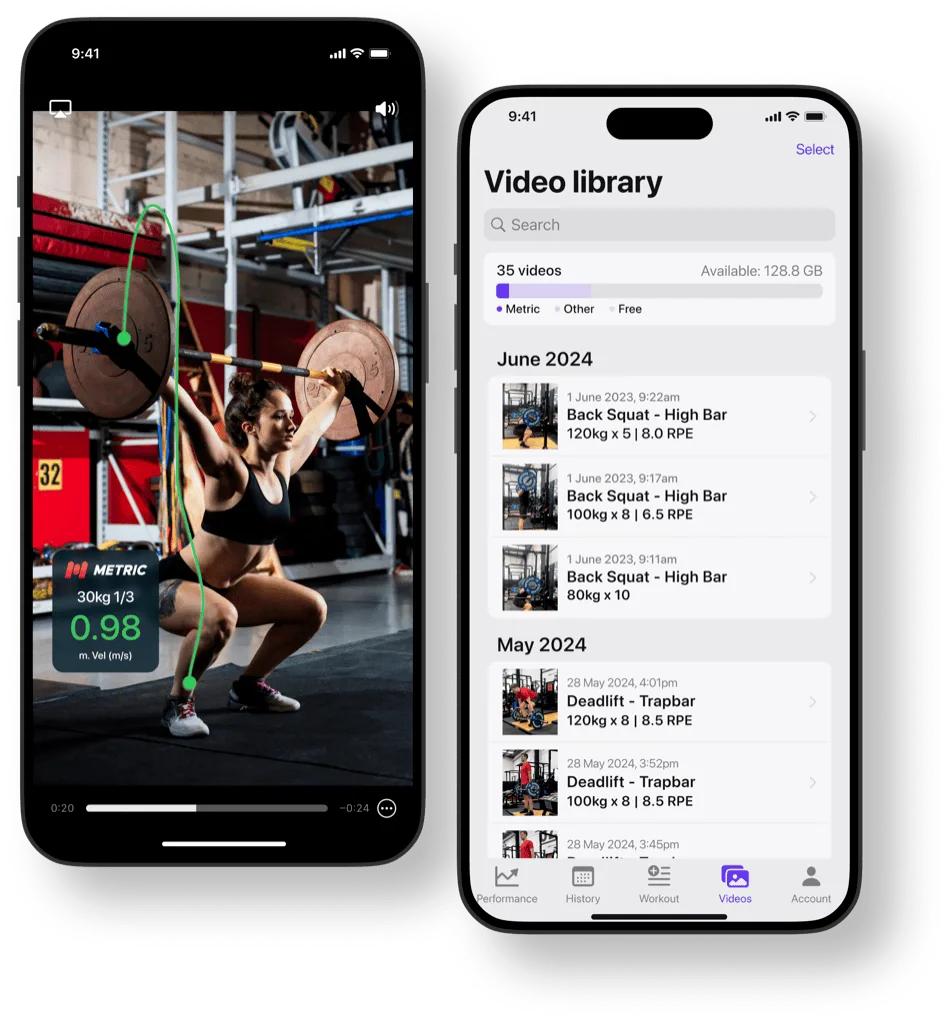
Warm up with bar speed
Metric measures your ramp-up sets and tells you when you're primed — not just warm.