RPE calculator — estimate your 1RM and build an RPE chart
Free RPE calculator. Enter your RPE, reps and load to get your 1RM. Or work backwards: pick a target RPE for any given lift. Includes full RPE chart.
Read more ↓↗ rpe × reps chart
Predicted load for any RPE × rep combination at the estimated 1RM.
| RPE \ Reps | 1 | 2 | 3 | 4 | 5 | 6 | 7 | 8 |
|---|---|---|---|---|---|---|---|---|
| 10.0 | — | — | — | — | — | — | — | — |
| 9.5 | — | — | — | — | — | — | — | — |
| 9.0 | — | — | — | — | — | — | — | — |
| 8.5 | — | — | — | — | — | — | — | — |
| 8.0 | — | — | — | — | — | — | — | — |
| 7.5 | — | — | — | — | — | — | — | — |
| 7.0 | — | — | — | — | — | — | — | — |
| 6.5 | — | — | — | — | — | — | — | — |
Free RPE calculator. Enter your RPE, reps and load to get your 1RM. Or work backwards: pick a target RPE for any given lift. Includes full RPE chart.
Velocity Based Training for Powerlifting
RPE, rate of perceived exertion, is fast, adaptive, and free. It’s also the only training prescription that self-corrects for daily readiness. The cost: it’s only as accurate as the lifter’s calibration. This calculator turns a single calibrated set into a full RPE × reps × load chart for the lift, plus an estimated 1RM.
How to use this calculator
The calculator runs in two directions:
- Assessment. You did a set. Enter the load, reps, and the RPE you’d give it. The output is a 1RM estimate and a chart of predicted loads for every other RPE / rep combination at that strength level.
- Prescription. You know your 1RM (or have just estimated it from a single set). Read across the chart to find the load that should produce a target RPE at a target rep count for your next set or block.
Read the chart below for the lookup table itself.
What RPE actually means
RPE on the modern lifting scale is the Tuchscherer scale — adapted from Borg’s original 6–20 scale and pinned to a “reps in reserve” definition rather than perceived heaviness:
| RPE | Reps in reserve | Feel |
|---|---|---|
| 10 | 0 | Maximum effort, no more reps possible |
| 9.5 | 0–1 | Maybe one more, no chance of two |
| 9 | 1 | One rep left in the tank |
| 8.5 | 1–2 | One left for sure, possibly two |
| 8 | 2 | Two left in the tank |
| 7.5 | 2–3 | Two left for sure, possibly three |
| 7 | 3 | Three left in the tank |
| 6 | 4+ | Easy, technique work |
Crucially: RPE measures proximity to failure on this lift, today — not perceived heaviness. A weight that feels heavy at RPE 6 (because the bar is loaded with 70% and you’re tired) and a weight that feels the same way at RPE 9 are very different proximities to failure. RPE is the second number; perceived heaviness is the first. If you want the full framework behind effort-based prescription, I cover it in depth in the book.
How RPE → 1RM math works
The calculator uses the Tuchscherer multiplier table — RPE × reps maps to a percentage of 1RM, validated against squat / bench / deadlift performance and used widely in the powerlifting community since 2011. A set of 5 reps at RPE 9 corresponds to ~84% of 1RM; a set of 3 reps at RPE 8 corresponds to ~83.5%; and so on.
The math is:
1RM ≈ load ÷ (multiplier for that RPE × reps combination)Working backward, the predicted load at any other RPE / rep count is:
load ≈ 1RM × multiplier for the target RPE × reps combinationThe lookup table that drives both directions is fixed; the lifter’s variable input is the calibration of the RPE call itself.
The conversion table the calculator uses is consistent with Zourdos et al. (2016), the most widely cited validation of RPE-based load prescription against measured 1RM in trained lifters.
RPE chart
Predicted percentage of 1RM by RPE × reps. Round to nearest 0.5%; small variations exist between calculators built on different datasets but the table below matches the modern powerlifting standard.| RPE | 1 rep | 2 reps | 3 reps | 4 reps | 5 reps | 6 reps | 7 reps | 8 reps |
|---|---|---|---|---|---|---|---|---|
| 10 | 100.0% | 95.5% | 92.2% | 89.2% | 86.3% | 83.7% | 81.1% | 78.6% |
| 9.5 | 97.8% | 93.9% | 90.7% | 87.8% | 85.0% | 82.4% | 79.9% | 77.4% |
| 9 | 95.5% | 92.2% | 89.2% | 86.3% | 83.7% | 81.1% | 78.6% | 76.2% |
| 8.5 | 93.9% | 90.7% | 87.8% | 85.0% | 82.4% | 79.9% | 77.4% | 75.1% |
| 8 | 92.2% | 89.2% | 86.3% | 83.7% | 81.1% | 78.6% | 76.2% | 73.9% |
| 7.5 | 90.7% | 87.8% | 85.0% | 82.4% | 79.9% | 77.4% | 75.1% | 72.3% |
| 7 | 89.2% | 86.3% | 83.7% | 81.1% | 78.6% | 76.2% | 73.9% | 70.7% |
| 6.5 | 87.8% | 85.0% | 82.4% | 79.9% | 77.4% | 75.1% | 72.3% | 69.4% |
To use the chart directly: cross-reference the RPE row with the rep column to find the percentage of 1RM that load represents. Multiply your 1RM by that percentage to get a target load, or divide your actual load by that percentage to back-solve a 1RM estimate.
RPE calculator for powerlifting
Powerlifting is where RPE earned its reputation. A few applications are specific enough to call out:- Opener selection. A clean RPE 7 single in the warmup room is a defensible opener — heavy enough to count, not so heavy that it costs anything for the second attempt. Walk it back: 1RM × 0.892 ≈ opener.
- Second-attempt math. Most lifters open at ~89% (RPE 7) and second at ~94% (RPE 8.5). The calculator gives you both numbers from a single 1RM input.
- Third-attempt risk. Third attempts are typically RPE 9.5–10. RPE 10 is the meet PR; RPE 9.5 is “make it” with a token rep left. The chart lets you see exactly how much that 0.5 RPE buys (~2.2% of 1RM, or about 5 kg on a 220 kg squat).
- Don’t ignore meet-day stress. RPE calls are noisier on the platform than in training. Adrenaline, crowds, and attempt timing all shift perceived effort. Keep the prescribed load conservative on second attempts so the third is genuinely available.
Pair RPE with bar speed
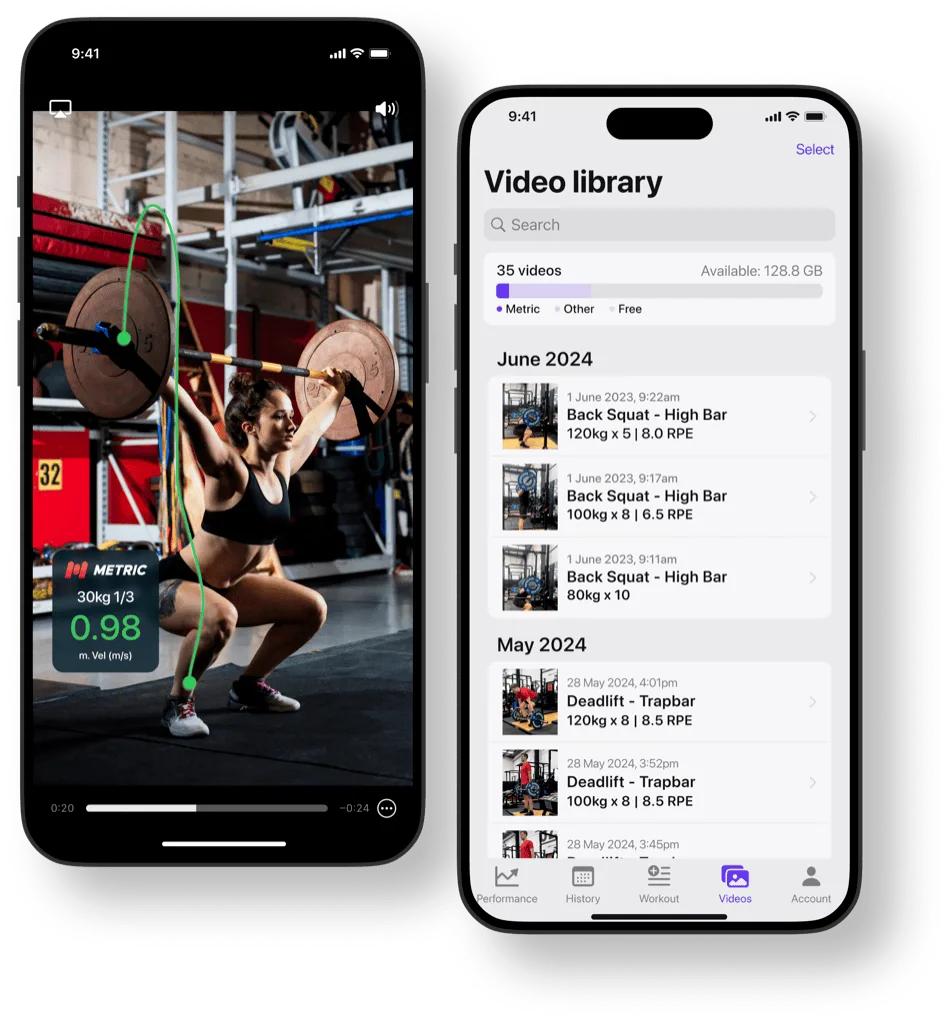
If you also track velocity, the RPE × last-rep velocity converter turns the speed of your last rep into a calibrated RPE. The two systems cross-validate — when the velocity-derived RPE and your subjective call agree, your calibration is solid; when they diverge, the velocity number is usually closer to the truth.
Pair RPE with bar speed
Metric tracks the velocity behind every RPE call so the two systems stay calibrated session-to-session.