RPE — last rep velocity
Find the last-rep velocity that matches each RPE value on your lifts. The fastest way to calibrate VBT and RPE training systems against each other.
Read more ↓| RPE | Last rep velocity |
|---|---|
| Enter at least two (rpe, velocity) pairs. | |
Find the last-rep velocity that matches each RPE value on your lifts. The fastest way to calibrate VBT and RPE training systems against each other.
Faster reps vs slow reps: Why you should be using both in your program
RPE and velocity-based training measure the same underlying thing, how much fatigue is in this set, through different lenses. Convert between them and you can use whichever is more practical in the moment without losing data fidelity. If you also program in percentages, the RPE calculator turns the same effort calls into an estimated 1RM and a full RPE chart.
What this calculator does
- Maps each RPE value (5–10) to the typical last-rep velocity for that lift.
- Lets you enter your own anchor data — over time the table calibrates to your lifts, not the population averages.
- Surfaces the discrepancy when your RPE call and your velocity reading disagree (a coaching opportunity).
How to use it
- Pick the lift.
- Either use the population-averaged defaults or enter your own anchor sets to personalise the table.
- During training: glance at last-rep velocity → read off the RPE for that set, or vice versa.
Worked example
Suppose you anchor two squat sets: an RPE 7 set whose last rep moved at 0.45 m/s, and an RPE 9 set whose last rep moved at 0.33 m/s. That’s a drop of 0.12 m/s across two RPE points, or roughly 0.06 m/s per RPE. The line through those anchors fills in the rest:
- RPE 8 last rep ≈ 0.39 m/s.
- RPE 10 last rep ≈ 0.27 m/s (near your squat MVT, as expected).
Now mid-session you grind a set and the last rep clocks 0.36 m/s. That’s between RPE 8 and 9 — call it RPE 8.5 — even if it felt like a 9. The bar speed keeps your effort calls honest.
Starter velocity reference
Typical last-rep velocities for the back squat, useful as defaults until your own anchor sets calibrate the table:
| RPE | Reps in reserve | Typical last-rep velocity |
|---|---|---|
| 10 | 0 | ~0.30 m/s |
| 9 | 1 | ~0.33 m/s |
| 8 | 2 | ~0.39 m/s |
| 7 | 3 | ~0.45 m/s |
| 6 | 4 | ~0.51 m/s |
These are squat starting points only. Bench, deadlift, and every other lift run their own ranges, and your numbers will shift the table once you enter real anchor sets.
FAQ
Why does last-rep velocity track RPE?
As you approach failure, fatigue forces every rep to slow down. The last rep of an RPE 9 set is measurably slower than the last rep of an RPE 7 set on the same lift, because you are closer to the velocity floor where the rep fails. That makes last-rep speed an objective stand-in for the subjective effort call.
Are these velocity values the same for every lift?
No. Each lift has its own velocity range, so an RPE 8 last rep on the bench sits at a different m/s than an RPE 8 on the squat. Use the lift selector, and ideally feed in two or three of your own anchor sets so the table reflects your bar speeds rather than population averages.
Which should I trust when RPE and velocity disagree?
Usually the velocity number. A bar-speed reading will not flatter you on a tired day or get talked up by adrenaline. When your subjective call and the velocity-derived RPE diverge, treat the gap as a calibration error in your effort sense and adjust toward the speed reading.
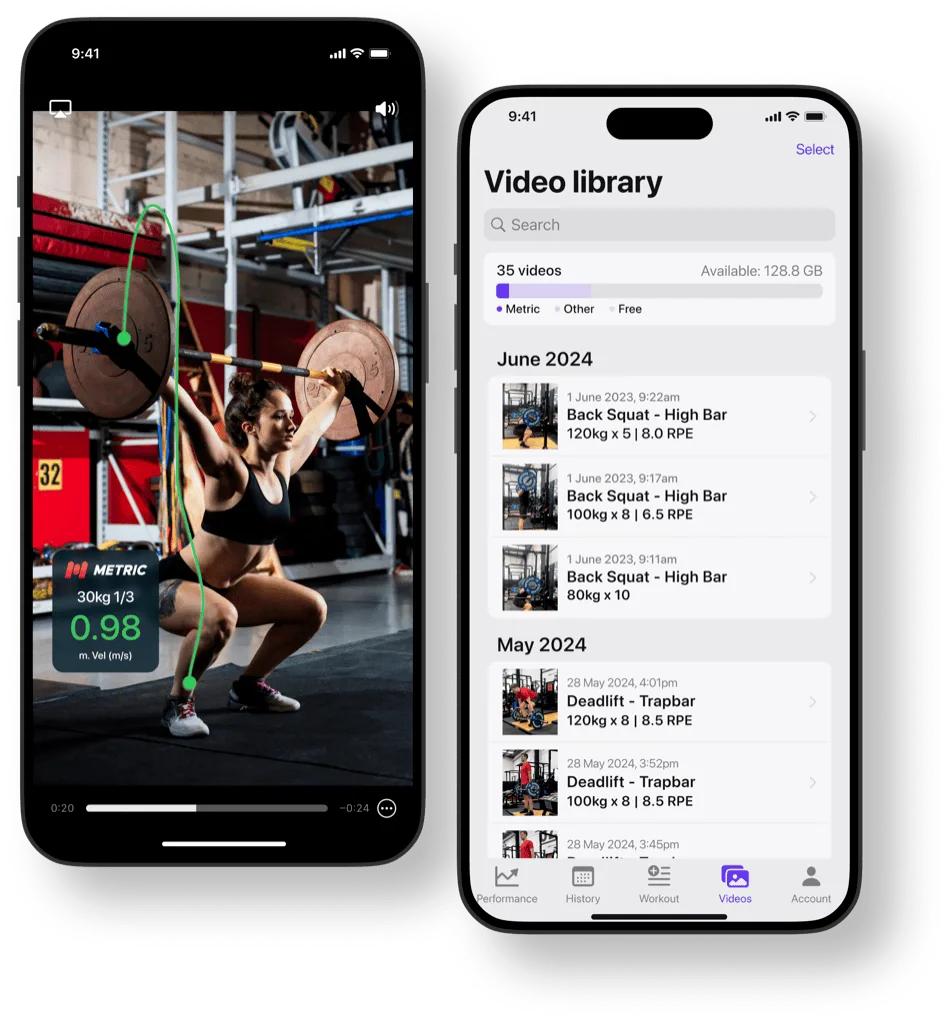
Calibrate RPE with velocity
Metric records last-rep velocity automatically so you can build your own RPE × velocity table over time.