Plate loading calculator
Solve the gym math instantly — "how do I get 117.5 kg on the bar?" Fastest plate combinations for any target weight, kg or lb, with bar weight and gym plate inventory accounted for.
Read more ↓ENTER BAR WEIGHT + TARGET TOTAL TO COMPUTE THE PLATE STACK.
↗ plate inventory · adjust + hide
Tap +/-. Tap - removes a plate from your inventory.
Solve the gym math instantly — "how do I get 117.5 kg on the bar?" Fastest plate combinations for any target weight, kg or lb, with bar weight and gym plate inventory accounted for.
Does velocity-based training actually make you stronger?
The most-used calculator in any gym, and the one nobody actually solves with arithmetic. Tell it the target weight and your bar, and it returns the per-side plate combination that gets you there with the fewest plates, plus a fall-back if your gym is out of small plates.
What this calculator does
- Takes a target weight, your bar weight, and (optional) your gym’s available plate sizes.
- Returns the per-side plate combination, fewest plates first.
- Switches between kg and lb instantly without re-entering values.
- Flags impossible loads (e.g. asking for 102.4 kg with only 2.5 kg increments).
How to use it
- Set your unit (kg or lb) and bar weight (default 20 kg / 45 lb).
- Enter the target weight.
- Read off the per-side stack. Walk to the bar.
Worked example
Take the classic gym question: how do I get 117.5 kg on a 20 kg bar?
- Subtract the bar: 117.5 − 20 = 97.5 kg of plates.
- Halve it: 97.5 ÷ 2 = 48.75 kg per side.
- Stack it: 20 + 20 + 5 + 2.5 + 1.25 = 48.75 kg.
So each side gets two 20s, a 5, a 2.5, and a 1.25. Mirror it on the other end and the bar reads 117.5 kg. That last 1.25 kg plate is why competition lifters chase the small change — without it, the closest you can load is 115 or 120 kg.
Standard bar and plate reference
The defaults the calculator ships with, matching most commercial gyms:
| Item | Weight |
|---|---|
| Men’s Olympic bar | 20 kg (44 lb) |
| Women’s Olympic bar | 15 kg (33 lb) |
| Standard kg plates | 25, 20, 15, 10, 5, 2.5, 1.25, 0.5 |
| Standard lb plates | 45, 35, 25, 10, 5, 2.5, 1.25 |
Set your bar weight and trim the inventory to what your gym actually stocks, and every stack the calculator returns is one you can physically load.
FAQ
How do I calculate plates per side?
Subtract the bar weight from your target, then halve what is left to get the load per side. For 100 kg on a 20 kg bar: 100 − 20 = 80 kg of plates, 40 kg per side. From there you stack the largest plates that fit and work down. The calculator does the subtraction, halving, and greedy stack for you.
How much does a standard barbell weigh?
A men’s Olympic barbell is 20 kg (44 lb). The common 45 lb spec is 20.4 kg, close enough that most lifters call it 20 kg. Women’s Olympic bars are 15 kg, and many fixed or technique bars are lighter, so always set the bar weight before you trust the plate math.
What if my gym is out of small plates?
Hide the missing plate sizes in the inventory and the calculator re-solves with what is left, flagging targets it cannot hit exactly. If 117.5 kg is impossible without 1.25s, you will see the nearest loadable weight instead of a wrong stack.
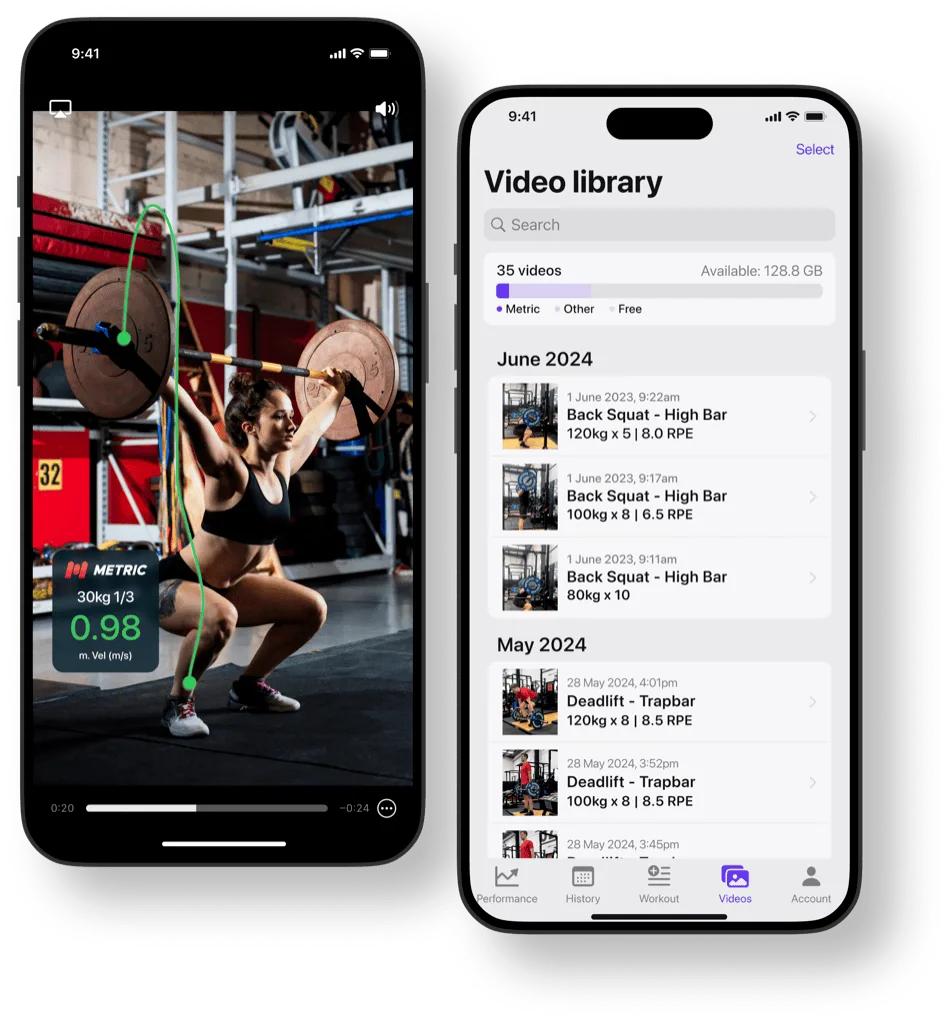
Stop counting plates
Metric shows you exactly which plates to load every set, no mental arithmetic.