Load–velocity profile generator
Create your own load–velocity profile from velocity-based training data. Estimate 1RM, track progress over time, and see how well you're training each lift.
Read more ↓ENTER 3+ SETS · POSITIVE-LOAD, FALLING-VELOCITY DATA
Create your own load–velocity profile from velocity-based training data. Estimate 1RM, track progress over time, and see how well you're training each lift.
Velocity Based Training for Powerlifting
Plug in a few sub-maximal sets — load on the bar, mean velocity at that load — and the line through them tells you almost everything you need to program the next four weeks. Where it crosses minimum velocity threshold (MVT) is your estimated 1RM. Where it crosses your day’s target velocity is the load you should be using.
What this calculator does
- Takes 3–6 sets of
(load, velocity)data and fits a line through them. - Returns: estimated 1RM at MVT, load for any target velocity, a saveable profile chart, and slope as a single number.
- Compares today’s profile against a baseline from a previous session — to see if you’re getting stronger, fatigued, or technically inconsistent.
How to use it
- Pick a lift. Profiles are lift-specific.
- Run a warm-up plus 3–6 sub-maximal working sets, ideally spread across 60–90% of estimated 1RM.
- Record load and the fastest representative rep’s mean velocity for each set.
- Drop the points in. The calculator does the rest.
Worked example
Say you run four squat sets and record the mean velocity of the fastest rep in each:
| Load | Mean velocity |
|---|---|
| 60 kg | 0.88 m/s |
| 100 kg | 0.65 m/s |
| 120 kg | 0.50 m/s |
| 140 kg | 0.35 m/s |
The line through those points loses about 0.0075 m/s for every kilo added. Squat MVT is roughly 0.30 m/s, so to drop from 0.35 m/s (at 140 kg) down to 0.30 you add about 7 kg, giving an estimated 1RM near 147 kg. The same line also reads forwards: want to train at 0.50 m/s today? That’s 120 kg. The profile is both your 1RM estimate and your daily load picker in one line.
Minimum velocity threshold by lift
Where the line crosses MVT is your 1RM estimate, so the threshold you use matters. Typical population averages, useful as starting points until you measure your own from a real max:
These are starting points, not your numbers. A measured MVT from an actual 1RM attempt is always more accurate and is what makes the profile genuinely individual.
FAQ
How many sets do I need to build a load–velocity profile?
Three is the minimum to fit a line, and four to six is better. Spread them across roughly 60–90% of estimated 1RM so the line has a wide base to sit on. Too narrow a load range and small velocity errors swing the projected 1RM hard.
What velocity should I use as the 1RM threshold?
The minimum velocity threshold (MVT) is lift-specific: roughly 0.30 m/s for back squat, 0.20 m/s for bench press, 0.20 m/s for deadlift. These are population averages. Your own MVT, measured from an actual 1RM, is more accurate and is what makes the estimate truly individual.
How often should I rebuild my profile?
Every three to six weeks, or whenever the loads at a given target velocity start feeling off. Profiles shift as you get stronger (the whole line moves right) or fatigued (the line drops). Comparing a fresh profile to a baseline is the fastest read on which is happening.
Track velocity automatically
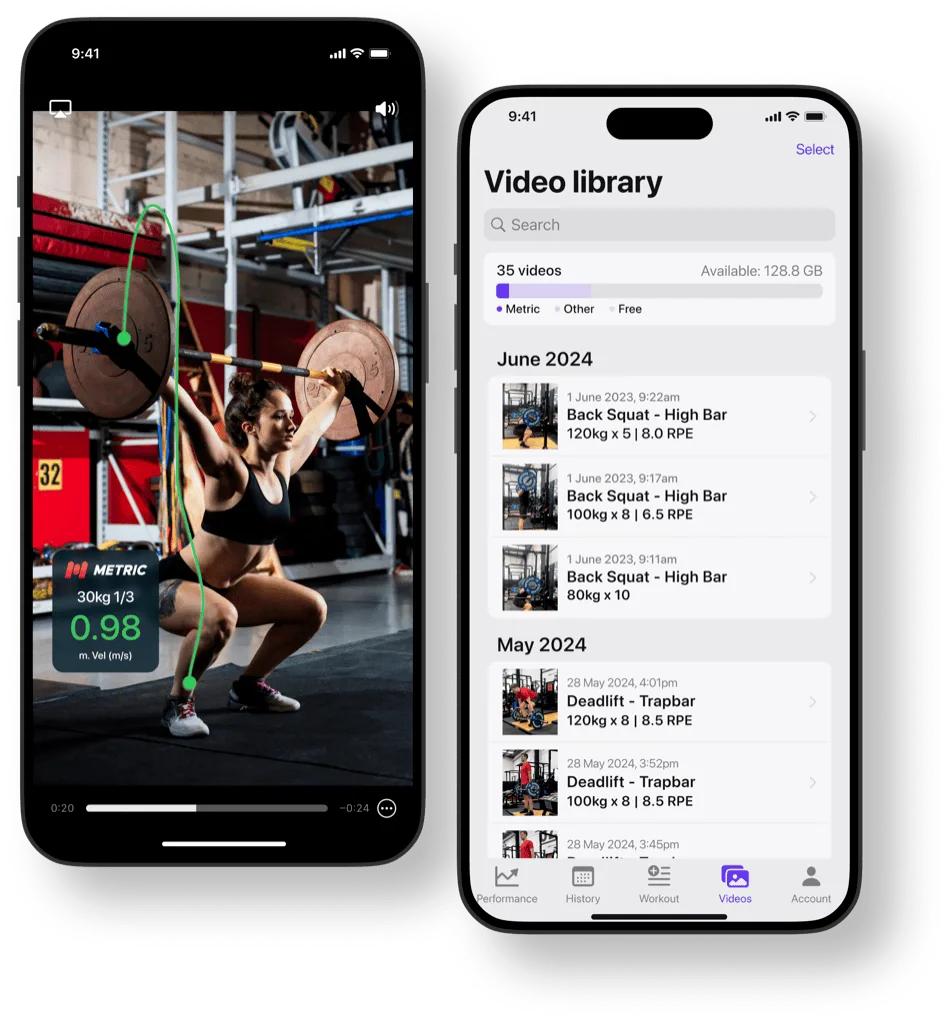
Metric measures bar speed from your phone and builds profiles automatically as you train.