Max power calculator
Find the load and velocity that produces peak mechanical power output on any of your lifts. Identify your peak-power load and program your power blocks around it.
Read more ↓ENTER 3+ (LOAD, POWER) POINTS · QUADRATIC FIT NEEDS BOTH SIDES OF THE PEAK
Find the load and velocity that produces peak mechanical power output on any of your lifts. Identify your peak-power load and program your power blocks around it.
Faster reps vs slow reps: Why you should be using both in your program
Power is force × velocity. Express the most of both at once and you produce more power than at either pure-strength loads (slow, heavy) or pure-speed loads (fast, light). The load that maximises this product is peak-power load, and programming around it is the most direct way to develop the explosive end of your strength-speed continuum.
What this calculator does
- Takes a load–velocity profile (or a few load–velocity points) and computes mechanical power at each.
- Returns the load that maximises power output — and the velocity that load should produce.
- Plots a power curve so you can see how steeply power falls off either side of peak.
How to use it
- Either feed in an existing load–velocity profile or run 3–4 sets across a range of loads (typically 30%, 50%, 70%, 85% of 1RM) and record load and velocity for each.
- The calculator returns peak-power load and curves either side.
- Use peak-power load for power-day work: typically 3–6 sets of 2–4 reps at this load with full intent.
Worked example
Power is the product of force and velocity, so neither the heaviest nor the fastest load is automatically the most powerful. Compare two squat sets:
- 100 kg @ 0.7 m/s: force = 100 × 9.81 = 981 N, so power = 981 × 0.7 ≈ 687 W.
- 60 kg @ 1.0 m/s: force = 60 × 9.81 = 589 N, so power = 589 × 1.0 ≈ 589 W.
The lighter, faster set feels more explosive, but the heavier set produces more mechanical power — because the drop in force outweighs the gain in velocity. Peak power lives at the load where the two terms are best balanced, usually somewhere in the middle of the range, which is exactly the point the curve fit finds for you.
Typical peak-power loads
Where power peaks depends heavily on the lift. Use these as starting ranges, then test to find your own:
| Movement | Typical peak-power load |
|---|---|
| Loaded jump squat | bodyweight to ~30% of 1RM |
| Back squat | ~50–60% of 1RM |
| Bench press | ~40–55% of 1RM |
| Power clean / clean pull | ~70–80% of 1RM |
These are population ranges, not prescriptions. Your own peak-power load can sit either side of them depending on training history and bar speed, which is why measuring it beats guessing.
FAQ
What load produces peak power?
For most barbell lifts peak power lands somewhere in the 30–60% of 1RM range, though it shifts by movement. The loaded jump squat sits near bodyweight to ~30%, while Olympic lift variations run much higher, often 70–80%. The only way to know yours is to test across a range of loads, which is what this calculator is for.
How is mechanical power calculated?
Power equals force times velocity. For a barbell lift, force is the load times gravity (9.81 m/s²) and velocity is the mean bar speed, so power in watts is load (kg) × 9.81 × velocity (m/s). The calculator fits a curve to your load-power points and finds the load at the peak.
How many reps and sets at the peak-power load?
Three to six sets of 2–4 reps at the peak-power load, every rep moved as fast as you can. Keep the volume low. Power work degrades quickly with fatigue, so stop the set the moment bar speed drops off rather than chasing a rep count.
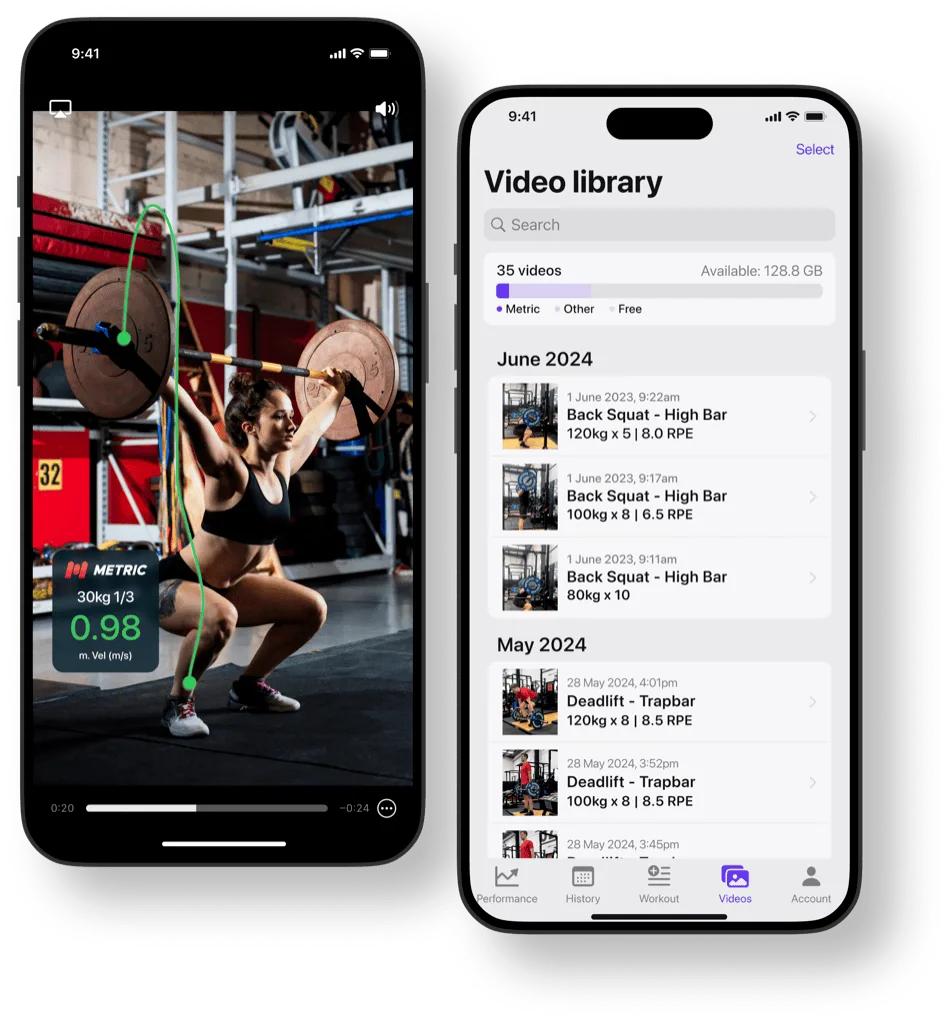
Track power automatically
Metric calculates power output set-by-set so your peak-power load is always current.