Keller 2014 — Feedback frequency scales long-term jump adaptation
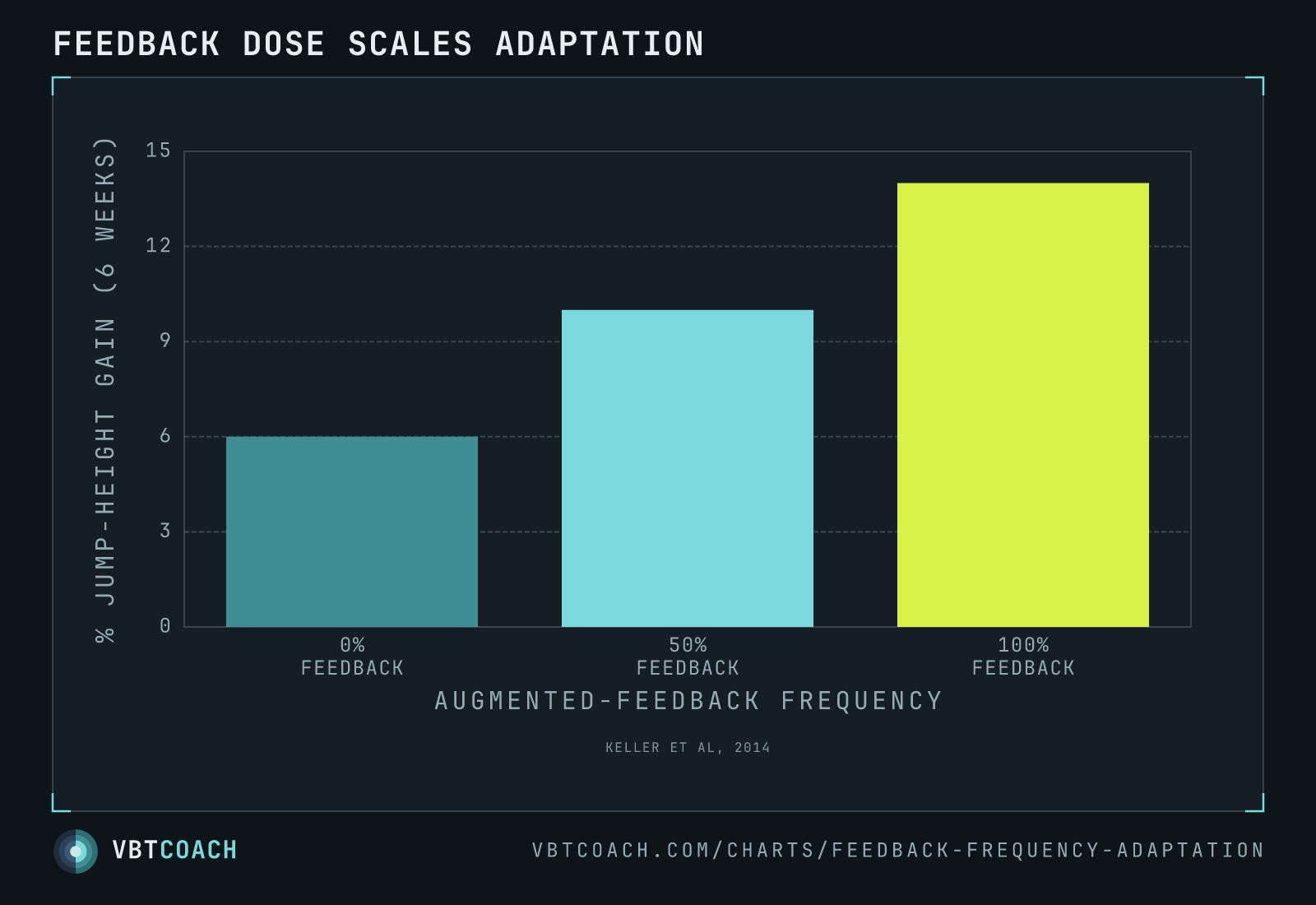
Keller 2014 — 6 weeks of drop-jump training, three groups by augmented-feedback frequency. Jump-height gain scaled with the dose: 100% feedback +14%, 50% +10%, 0% +6%.
The acute feedback chart (Keller 2015) shows augmented feedback boosting jump output within a single session. This is the chronic version — the same lab, a different study, asking whether that within-session boost compounds into real training adaptation over weeks. It does, and the effect is dose-dependent.
Keller and colleagues took 34 participants, split them into three groups, and ran identical drop-jump training — 3× a week for 6 weeks. The only difference between groups was how often each athlete saw their own jump height: on 100% of reps, 50% of reps, or 0% (no feedback at all). Same exercise, same volume, same coaching. Only the feedback dose changed.
How to read this chart
Three groups across the bottom, ordered by feedback frequency. The y-axis is percentage improvement in jump height from pre- to post-training (6 weeks). More feedback, taller bar: the 100% group gained +14%, the 50% group +10%, and the 0% control +6%. Even the no-feedback group improved — that’s the training itself working — but seeing the number on every rep more than doubled the gain.
Why the dose matters
Every rep an athlete sees their output is a rep with an explicit target: beat the last number. Across 18 sessions that’s hundreds of maximum-intent attempts the no-feedback group never made — they trained on “feels hard enough,” which drifts toward good-enough effort the moment fatigue or boredom sets in. Feedback keeps intent pinned to the ceiling, and the extra intent drives the extra neural adaptation.
The clean monotonic step — 6 → 10 → 14 — is the useful part. This isn’t feedback-vs-none as a binary. It’s a dose-response: partial feedback (50%) lands squarely between full and none. Halving how often the athlete sees their number roughly halves the extra gain feedback buys over baseline (+4% at 50%, +8% at 100%).
Note on the guidance hypothesis. Classic motor-learning theory (the “guidance hypothesis”) predicts that too much feedback makes learners dependent on it and hurts long-term retention — so less should be better. Keller found the opposite for maximising jump performance: 100% beat 50% beat 0%. For power/SSC output, more feedback is better, not worse.
When to use this evidence
- Justifying feedback on every rep, not every few. Coaches sometimes ration feedback to “avoid dependence.” For power and jump adaptation, this study says show the number every rep.
- Budgeting for feedback hardware. The gap between the 100% and 0% group is a doubling of adaptation from a device that displays a number — same training otherwise.
- Programming ballistic / SSC blocks. Drop jumps, jump squats, and other stretch-shortening-cycle work are exactly the modality tested here.
Pitfalls
- Jumps, not barbell strength. Keller measured drop-jump height. The effect should generalise to other ballistic work; it’s less established for grinding, sub-maximal-velocity strength sets.
- Effort ceiling. The wins are biggest where the athlete has room to push intent harder. An athlete already giving maximum intent on every rep has less to gain.
- The number must be trustworthy. Dose-response only holds if the feedback is accurate. Noisy or mis-timed numbers train the athlete to chase noise.
- 6 weeks, one cohort. Single controlled study — align it with the broader feedback literature rather than treating the exact percentages as universal.
Where to go next
For the within-session side of the same story, see the performance feedback chart (Keller 2015). For the barbell-training version of the longitudinal effect, velocity feedback transfer (Randell 2011) and the rugby cohort follow-up (Weakley 2019) show the same pattern under real-time bar-speed feedback. The practical setup guide is Real-time feedback with VBT.
Download high res chart images
High-resolution PNG, 1600×1000, watermarked. Free to share, embed in slides, or print. Credit appreciated.