Rheese 2021 — Cueing "move fast" adds nothing when the bar can't move faster
Rheese 2021 — 3 weeks of knee-extension training at a fixed 30°/s. Cueing high intended velocity produced no neural or performance advantage, and less than half the power gain of a steady-and-controlled cue.
I was on this study team, so weigh the framing accordingly — but the result is worth publishing precisely because it cuts against the VBT talking point.
Twenty untrained participants did three weeks of isokinetic knee-extension training. The dynamometer pinned actual movement velocity at 30°/s for everyone, so the only difference between groups was what they were told: “push up as hard and as fast as possible” (HIMV) versus “apply steady, controlled force” (TRAD). Same load, same volume, same actual speed.
Intent cueing bought nothing. On the one measure where the groups genuinely separated, it cost something.
How to read this chart
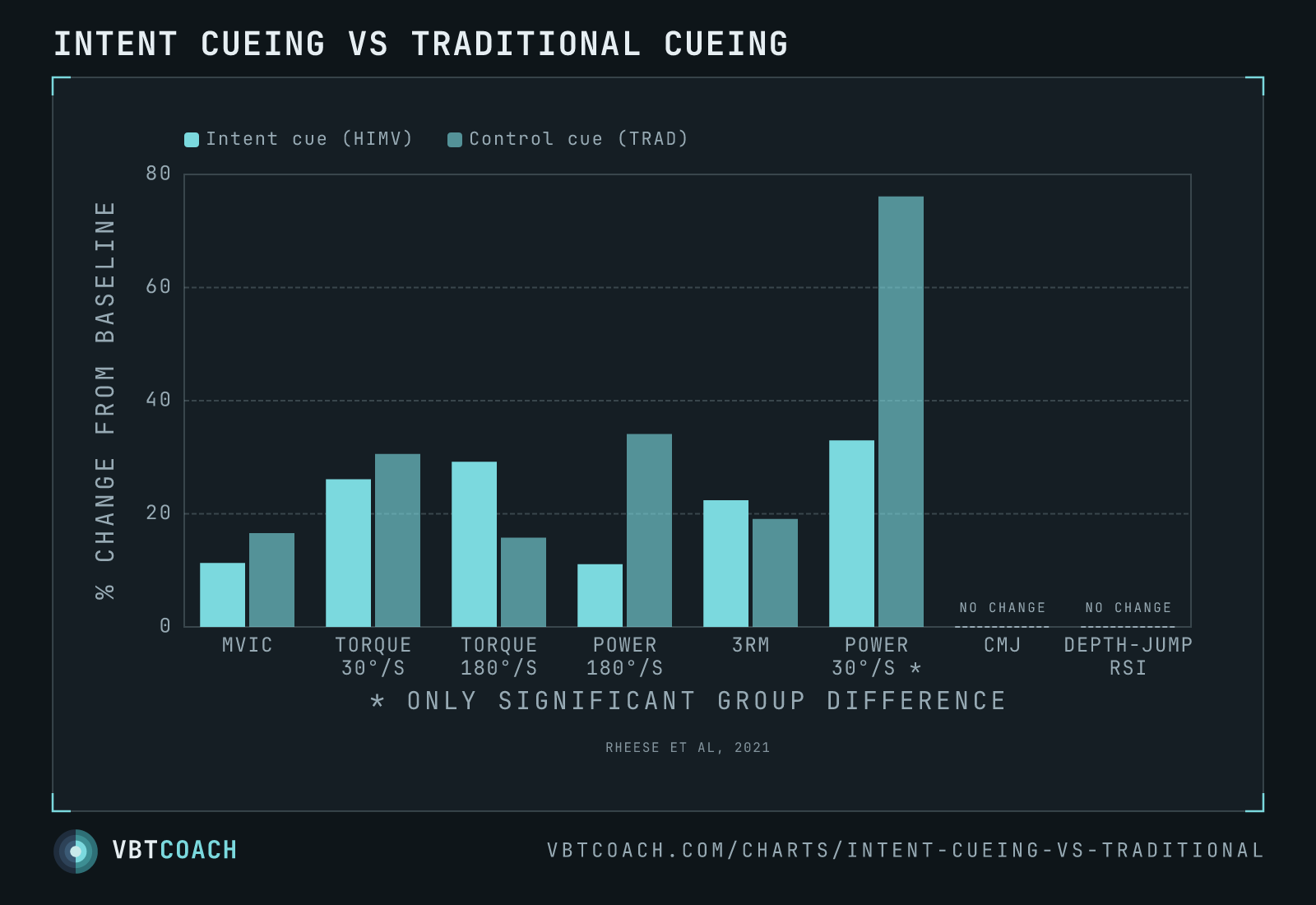
Eight outcomes across the bottom, percentage change from baseline up the side. Solid teal is the intent-cued group; the paler bars are the traditional cue. The final two — the jump tests — carry no bars at all, which is itself the result (see below).
Only the starred pair is a real difference. Mean power at 30°/s rose +76 % with the traditional cue against +33 % with the intent cue — the study’s single significant group × time interaction (p = 0.027). Every other pair on this chart is a non-significant gap: both groups improved, and which bar is taller is noise. HIMV “leading” peak torque at 180°/s (+29.2 % vs +15.8 %) is not a finding, and neither is TRAD leading MVIC. Both cues worked; neither worked better.
Yes, +76 % is an enormous number, and no, it isn’t a typo. It’s a big percentage of a small one: mean power went from 38.3 to 67.4 N·m·s⁻¹ in the traditional group and 36.2 to 48.2 in the intent group. Untrained participants on an unfamiliar isokinetic machine start close to the floor and have a lot of room to move. Read the direction of these bars, not their height.
The training itself was clearly effective. Pooled across groups: maximal isometric force +14 %, peak torque +29 % at 30°/s and +22 % at 180°/s, 3RM +20 %, and resting corticospinal excitability +43 %. The programme moved everything. The words didn’t.
What didn’t move at all
The last two columns are the ones worth staring at. Countermovement jump height and depth-jump reactive strength index were both measured, and neither budged — no group difference and no effect of training whatsoever (p = 0.205 and 0.949; RSI’s F was 0.004, meaning the pre and post means were all but identical). They’re drawn as a flat line rather than a bar because that’s the honest shape of the result: we looked, and nothing happened.
That null is arguably the most useful finding here for a coach, and it has nothing to do with cueing. Both groups got materially stronger — 3RM up 20 %, peak torque up 29 % — and none of it showed up in a jump. Isolated knee extension is a poor way to train a multi-joint, stretch-shortening-cycle task: the knee extensors contribute only a fraction of jump force, and a machine that eliminates the stretch-shortening cycle can’t train the quality the jump depends on. Getting stronger at the machine made people better at the machine.
Why the intent cue lost on mean power
When the machine holds you at 30°/s, “as fast as you can” produces one hard spike of force at the start of the rep and then a fade. “Steady and controlled” spreads force across the whole range. Mean power is force averaged over the movement, so the sustained effort wins. The cue didn’t change what the limb did — it changed when within the rep the effort was applied, and the spike was the wrong shape for the metric being measured.
When to use this evidence
- As a check on intent evangelism. Intent earns its keep when it can change the mechanics of the rep. Bolt movement speed to a machine and the cue alone stops paying.
- Choosing cues for machine-based work. On isokinetic and speed-limited machines, cue sustained maximal force through the range, not an explosive spike.
- Setting expectations for short blocks. Three weeks of single-joint work in untrained lifters improves nearly everything. Finding group differences on top of that is hard, and this study was not powered to find small ones.
Reading this against Behm & Sale
Behm & Sale 1993 is the study everyone cites for “intent is what matters” — it found high-velocity gains in a limb that was never allowed to move. This study cued intent and found no benefit. Both are true, and the reconciliation is in the stimulus, not the instruction:
- Behm & Sale’s isometric limb performed attempted ballistic contractions — maximal-RFD bursts against a restraint. The intent produced a genuinely different contraction, even with zero movement.
- Here, the isokinetic device blunted exactly that. Intent could not change the force–time profile in any way the training or the testing rewarded.
Intent is the input that drives rapid force production. It is not a magic word that upgrades a rep whose mechanics can’t change.
Pitfalls
- Small and short. 20 untrained participants, three weeks, single joint. Underpowered for anything but a large group difference.
- Don’t read the non-significant bars. Five of the six pairs here differ by noise. The chart shows them because hiding them would be worse — but the only pair you’re entitled to draw a conclusion from is the starred one.
- Isolating intent is genuinely hard. Cue someone to move fast in a free-weight lift and they do move faster — actual velocity becomes its own confound. The isokinetic design removes the confound and, in removing it, removes most of the effect it was trying to measure.
Where to go next
How this study came together is in Published! My first VBT research paper. For where intent genuinely does its work, see the Intent topic page, and Randell 2011 — where feedback (rather than cueing) let athletes actually move the bar faster, and the transfer followed.
Download high res chart images
High-resolution PNG, 1600×1000, watermarked. Free to share, embed in slides, or print. Credit appreciated.